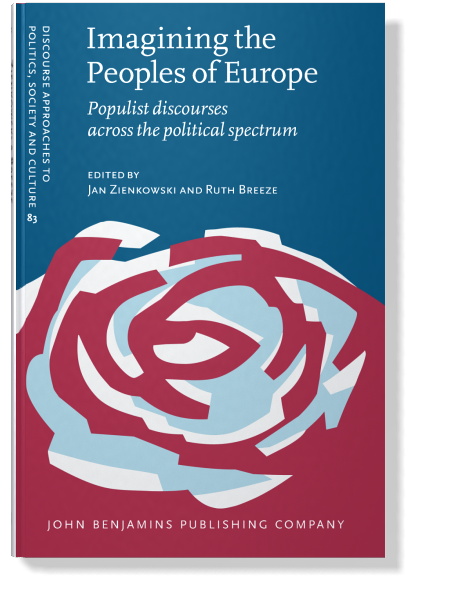
In:Imagining the Peoples of Europe: Populist discourses across the political spectrum
Edited by Jan Zienkowski and Ruth Breeze
[Discourse Approaches to Politics, Society and Culture 83] 2019
► pp. 201–228
Get fulltext
Chapter 8The discursive construction of the people in European political discourse
Semantics and pragmatics of a contested concept in German, French, and British parliamentary debates
Available under the Creative Commons Attribution-NonCommercial-NoDerivatives (CC BY-NC-ND) 4.0 license.
For any use beyond this license, please contact the publisher at rights@benjamins.nl.
Published online: 13 August 2019
https://doi.org/10.1075/dapsac.83.09tru
https://doi.org/10.1075/dapsac.83.09tru
Abstract
Who are the people? As a semantically underspecified noun, the lexeme “people” and related terms such as “citizen(s)” or “constituent(s)” lead to various representations and are filled with competing meanings. By undertaking a cross-linguistic analysis of the semantic value of nouns denoting human referents in France, Germany, and the United Kingdom, this paper investigates how the “people” (people in English, Volk in German, peuple in French) and related linguistic expressions (notably Mensch, Bürger, citoyen) are discursively staged in national parliamentary debates on Europe.
The people represent the entity Members of Parliament (MPs) speak to, about, and on behalf of. In political sciences, mentioning the people immediately raises concerns about a populist message or stance. To which extent, then, does the reference to “the people” or “a people” pertain to a populist stance?
Based on an annotated corpus of forty-four national parliamentary debates between 1998 and 2015, this paper uses mixed methods (qualitative and quantitative) to assess how the “people” are referred to across the political spectrum in the British House of Commons, the German Bundestag and the French Assemblée nationale. By taking into account a large amount of speakers across different times and cultures, the analysis shows that the reference to “the people” – partly in opposition to “a people” – is a basic component of political discourse, thus indicating that the mere mention of the “people” cannot be regarded as a feature of populist rhetoric.
Keywords: people, citizen, constituent, populism, political discourse, parliament, comparison, Germany, France, United Kingdom
Article outline
- Introduction: Referring to the “people”: A cross-linguistic perspective
- On the assumed relationship between people and populism
- Populism: The impossible definition?
- Minimum requirements to be a populist
- Populists in the parliament: An oxymoron?
- Semantic properties of the “people”
- Shared semantic properties in English, German, and French
- Whom do the lexemes people, Volk, and peuple refer to?
- Frequency and distribution of people, Volk, and peuple in the three corpora
- National specificities: German Volk and French peuple
- Defending the use of the noun Volk in German contemporary political discourse: A strong stance
- Representing le peuple in the context of the 2005 French referendum
- Responding to people’s (assumed) expectations
- Appealing to the people in English: Searching for French and German “equivalents”
- Formulating questions and claims through the lens of the people
- Making the people speak: Ventriloquizing as a resource in political discourse
- Picking the noun denoting human referents: “Citizens” and “people” in contrast
- Conclusion: The reference to the people, a property of political discourse
Notes References

References (35)
Baker, Paul, Andrew Hardie and Tony McEnery. 2006. A Glossary of Corpus Linguistics. Edinburgh: Edinburgh University Press.
Bouillaud, Christophe. 2001. “Par le peuple, pour le peuple. Le populisme et les démocraties.” Revue française de science politique 51 (1): 298–301.
Cappeau, Paul, and Catherine Schnedecker. 2014. “Gens, personne(s), individu(s): trois saisies de l’humain.” In 4ème Congrès Mondial de Linguistique Française, vol. 8, ed. by Judith Meinschaefer, Franck Neveu, Peter Blumenthal, Linda Hriba, and Annette Gerstenberg: 3027–3040. Berlin. [URL]
Cooren, François and Sergeiy Sandler. 2014. “Polyphony, Ventriloquism, and Constitution: In Dialogue with Bakhtin.” Communication Theory 24 (3): 225–244.
De Cock, Barbara. 2006. “El discurso político entre oral y escrito.” In Usos sociales del lenguaje y aspectos psicolingüísticos. Perspectivas aplicadas, ed. by Joana Salazar Noguera, Marian Amengual Pizarro, and María Juan Garau: 123–130. Palma: Universitat de les Illes Balears Servei de Publicaciones i Intercanvi Científic.
Dezé, Alexandre. 2004. “Lectures critiques : Le populisme ou l’introuvable Cendrillon. Autour de quelques ouvrages récents.” Revue française de science politique 54 (1): 179–199.
Dubois, Jean, and Françoise Dubois Charlier. 1996. “Collectifs d’êtres vivants.” Linx 34 (1): 125–132.
Ehrlich, Susan. 2012. “Text trajectories, legal discourse and gendered inequalities.” Applied Linguistics Review 3 (1). 47–73.
Hainsworth, Paul. 2006. “France Says No: The 29 May 2005 Referendum on the European Constitution.” Parliamentary Affairs 59 (1): 98–117.
Harris, Sandra. 2001. “Being Politically Impolite: Extending Politeness Theory to Adversarial Political Discourse.” Discourse & Society 12 (4): 451–472.
Heiden, Serge. 2010. “The TXM Platform: Building Open-Source Textual Analysis Software Compatible with the TEI Encoding Scheme.” 389–398. Institute for Digital Enhancement of Cognitive Development, Waseda University. [URL]
Hermet, Guy. 2001. Les populismes dans le monde. Une histoire sociologique, XIXe-XXe siècle. Paris: Fayard.
Higgins, Michael. 2013. “Governmentality, Populism and Empowerment: David Cameron’s Rhetoric of the Big Society.” In The Media, Political Participation and Empowerment, ed. by Richard Scullion, Roman Gerodimos, Daniel Jackson, and Darren Lilleker: 58–70. Abingdon: Routledge.
Hoffmann, Lutz. 1991. “Das ,Volk‘. Zur ideologischen Struktur eines unvermeidbaren Begriffs.” Zeitschrift für Soziologie 20 (3): 191–208.
Hubé, Nicolas, and Naomi Truan. 2016. “France: The Reluctance to Use the Word “Populism” as a Concept.” In Populist Political Communication in Europe. A Cross-National Analysis of European Countries, ed. by Toril Aalberg, Frank Esser, Carsten Reinemann, Jesper Stromback, and Claes de Vreese: 181–194. New York: Routledge.
Ihl, Olivier, Janine Chêne, and Eric Vial. 2003. La tentation populiste au cœur de l’Europe. Paris: La Découverte.
Kämper, Heidrun. 2005. Der Schulddiskurs in der frühen Nachkriegszeit. Ein Beitrag zur Geschichte des sprachlichen Umbruchs nach 1945. Berlin/New York: Mouton de Gruyter.
Koselleck, Reinhardt. 1992. “Volk, Nation, Nationalismus, Masse.” In Geschichtliche Grundbegriffe. Historisches Lexikon zur politisch-sozialen Sprache in Deutschland, vol. 7, ed. by Otto Brunner, Werner Conze, and Reinhardt Koselleck: 141–431. Stuttgart: Ernst Klett Verlag.
Laclau, Ernesto. 1977. Politics and Ideology in Marxist Theory: Capitalism – Fascism – Populism. London: New Left Books.
Lafon, Pierre. 1980. “Sur la variabilité de la fréquence des formes dans un corpus.” Mots 1 (1): 127–165.
Lecolle, Michelle. 2007. “Enjeux argumentatifs de la nomination : le cas du nom collectif communauté dans les discours publics contemporains.” In Christian Boix (ed.), Argumentation, manipulation, persuasion: 227–247. Paris: L’Harmattan.
Mange, Jessica and Pascal Marchand. 2007. “Oui ou non à la Constitution européenne. L’éloquence du forum.” Mots (83). 121–137. .
Moirand, Sophie. 2004. “L’impossible clôture des corpus médiatiques. La mise au jour des observables entre catégorisation et contextualisation.” Travaux neuchâtelois de linguistique (40). 71–92.
Retterath, Jörn. 2016. ,Was ist das Volk?‘. Volks- und Gemeinschaftskonzepte der politischen Mitte in Deutschland 1917–1924. Berlin/Boston: Walter de Gruyter.
Taguieff, Pierre-André. 2002. L’illusion populiste. De l’archaïque au médiatique. Paris: Berg International.
Teubert, Wolfgang, and Anna Cermáková. 2004. “Directions in corpus linguistics.” In Lexicology and Corpus Linguistics. An Introduction, ed. by Michel A. K. Halliday, Anna Cermáková, Wolfgang Teubert, and Colin Yallop: 113–166. London/New York: Continuum.
Touraine, Alain, Paul Thibaud, Benjamin Stora, Jean Stengers, Odile Rudelle, Alain Besancon, Alain Bergounioux, Bertrand Badie, and Maurice Agulhon. 1997. “Le populisme ?” Vingtième Siècle 56 (1): 224–242.
Truan, Naomi. 2016a. Parliamentary Debates on Europe at the Assemblée nationale (2002–2012) [Corpus]. ORTOLANG (Open Resources and TOols for LANGuage). [URL].
. 2016b. Parliamentary Debates on Europe at the Deutscher Bundestag (1998–2015) [Corpus]. ORTOLANG (Open Resources and TOols for LANGuage). [URL].
. 2016c. Parliamentary Debates on Europe at the House of Commons (1998–2015) [Corpus]. ORTOLANG (Open Resources and TOols for LANGuage). [URL].
. 2017. “Zwischenrufe zwischen parlamentarischer Routine und Kreativität. Bundestagsdebatten über Europa aus dem Blickwinkel von unautorisierten Unterbrechungen.” Cahiers d’Etudes Germaniques (73): 125–138.
. 2018. “Generisch, unpersönlich, indefinit? Die Pronomina man, on, one und generisches you im politischen Diskurs.” In Hélène Vinckel-Roisin, Laurent Gautier and Pierre-Yves Modicom (eds.), Diskursive Verfestigungen. Schnittstellen zwischen Morphosyntax, Phraseologie und Pragmatik im Deutschen und im Sprachvergleich: 347–363. Berlin/Boston: Walter de Gruyter. [URL].
Cited by (7)
Cited by seven other publications
Zehnter, Lisa
Salamurović, Aleksandra
Taylor, Charlotte & Dario del Fante*
Truan, Naomi
Truan, Naomi
2021. Narratives of dialogue in parliamentary discourse. Journal of Language and Politics 20:4 ► pp. 563 ff.
[no author supplied]
[no author supplied]
This list is based on CrossRef data as of 8 december 2025. Please note that it may not be complete. Sources presented here have been supplied by the respective publishers. Any errors therein should be reported to them.