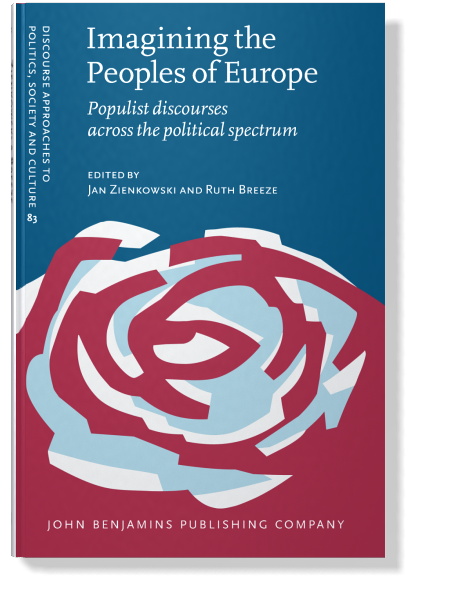
In:Imagining the Peoples of Europe: Populist discourses across the political spectrum
Edited by Jan Zienkowski and Ruth Breeze
[Discourse Approaches to Politics, Society and Culture 83] 2019
► pp. 173–200
Get fulltext
Chapter 7Performing ‘the people’?
The populist style of politics in the German PEGIDA-movement
Available under the Creative Commons Attribution-NonCommercial-NoDerivatives (CC BY-NC-ND) 4.0 license.
For any use beyond this license, please contact the publisher at rights@benjamins.nl.
Published online: 13 August 2019
https://doi.org/10.1075/dapsac.83.08onn
https://doi.org/10.1075/dapsac.83.08onn
Abstract
This chapter analyses the construction of the people (das Volk) in the populist style of politics as performed in the German PEGIDA-movement. Pointing at the ambiguities of the term in the German political post-unification discourse, he demonstrates how PEGIDA traces its legacy back to the GDR citizen movement and to the idea of resistance against a dictatorial system still awaiting a final redemption. PEGIDA presents Das Volk as the legitimate representative of the German population, threatened in its very existence by the machinations of a toxic combination of evil-minded domestic elites and trans-national migration. Önnerfors locates the linguistic and performative strategies of PEGIDA within a larger European New Right (ENR) discourse and argues that it combines elements from mono- and multifascism.
Keywords: post-unification Germany, PEGIDA, das Volk, populism
Article outline
- Introduction: Who are ‘the people’ in post-unification Germany?
- Between ‘ethnos´ and ‘demos’ – reflections on the German concept ‘Volk’
- The development of the contemporary new right discourse in Germany
- Theoretical and methodological considerations
- Selection of sources
- PEGIDA on the public stage
- Protocols of performativity: Styling ‘the people’ as actor and audience
- PEGIDA as part of the ENR discourse
Note References

References (22)
Bar-On, Tamir. 2001. “The Ambiguities of the Nouvelle Droite, 1968–1999”. The European Legacy 6(3): 333–351.
. 2009. “Understanding Political Conversion and Mimetic Rivalry, Totalitarian Movements and Political Religions”. Totalitarian Movements and Political Religions
10(3–4): 241–264.
Fischer, Vanessa. Deutschlandradio Kultur 2009. “Wir sind das Volk” (Archiv). 16 September 2009. Accessed 3 March 2017. [URL]
Fleischer, Rasmus. 2014. “Two fascisms in contemporary Europe? Understanding the ideological split of the radical right”. In In the Tracks of Breivik. Far Right Networks in Northern and Eastern Europe, ed. by Mats Deland, Michael Minkenberg and Christin Mays: 54–70. Münster: LIT.
Hennig, Sebastian. 2015. Pegida – Spaziergänge über den Horizont, Eine Chronik. Neustadt an der Orla: Arnshaugk.
Koselleck, Reinhart; Gschnitzer, Fritz; Werner, Karl Ferdinand; Schönemann, Bernd. 1978/2004. “Volk, Nation, Nationalismus, Masse” in Geschichtliche Grundbegriffe: Historisches Lexikon zur politisch-sozialen Sprache in Deutschland, Band 7, Stuttgart: Klett-Cotta: 141–431.
Lett, James. 1990. “Emics and Etics: Notes on the Epistemology of Anthropology”. In Emics and Etics: The Insider/Outsider Debate, ed. by Thomas N. Headland, Kenneth Pike, Marvin Harris: 130–145. Newbury Park, London: Sage.
Madisson, Mari-Liis. 2016. The Semiotic Construction of Identities in Hypermedia Environments: The Analysis of Online Communication of the Estonian Extreme Right. Tartu: University of Tartu Press.
Mathias, Alexa. 2018/1. “ ‘Wir sind das Volk!’ Zu Wortschatz und Argumentation rechtspopulistischer Gruppierungen in Deutschland”. Sprachdienst 4-5: 155–167.
. 2018/2. “Lexik und Legitimation in rechtspopulistischen Bewegungen: Korpuslinguistische Befunde aus Facebook-Postings von Pegida-Sympathisanten”. Muttersprache 128(1): 41–51.
Moffitt, Benjamin. 2015. “How to Perform Crisis: A Model for Understanding the Key Role of Crisis in Contemporary Populism”. Government and Opposition 50(2): 189–217.
. 2016. The Global Rise of Populism: Performance, Political Style, and Representation, Stanford: Stanford University Press.
Moffitt, Benjamin and Tormey, Simon. 2014. “Rethinking Populism: Politics, Mediatisation and Political Style”. Political Studies (62): 381–397.
Önnerfors, Andreas. 2017. “Between Breivik and PEGIDA: the absence of ideologues and leaders on the contemporary European far right”. Patterns of Prejudice 51(2): 159–175.
. 2019. “ ‘The Great Replacement’: Decoding the Christchurch Terrorist Manifesto”. 18 March 2019. Accessed 5 May 2019. [URL]
Paukstat, Adrian and Ellwanger, Cedric. 2016. “ ‘Wir Sind Das Volk’: Narrative Identity and the Other in the Discourse of the PEGIDA Movement.” Contention: The Multidisciplinary Journal of Social Protest, 4(1–2): 93–107.
Vorländer, Hans, Herold, Maik, Schäller, Steven. 2016. PEGIDA: Entwicklung, Zusammensetzung und Deutung einer Empörungsbewegung. Berlin: Springer.
Salzborn, Samuel. 2016. “Renaissance of the New Right in Germany? A Discussion of New Right Elements in German Right-Wing Extremism Today”. German Politics and Society 119(34): 36–63.
Wodak, Ruth. 2009. The semiotics of racism: A critical discourse-historical analysis. In Discourse, of Course. An overview of research in discourse studies, ed. Jan Renkema: 1–17. Amsterdam: John Benjamins.
Cited by (3)
Cited by three other publications
Mello, Brian
Önnerfors, Andreas
[no author supplied]
This list is based on CrossRef data as of 8 december 2025. Please note that it may not be complete. Sources presented here have been supplied by the respective publishers. Any errors therein should be reported to them.