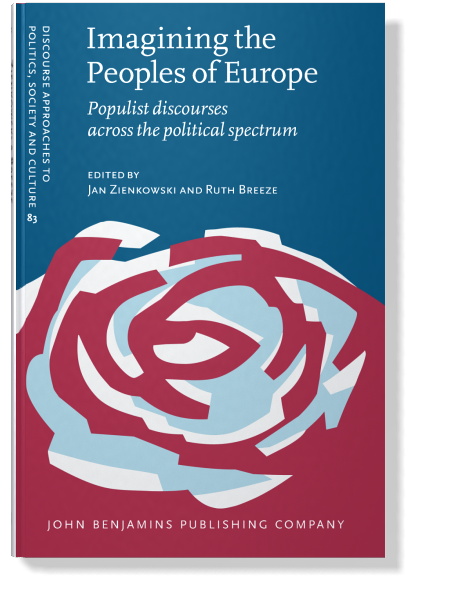
In:Imagining the Peoples of Europe: Populist discourses across the political spectrum
Edited by Jan Zienkowski and Ruth Breeze
[Discourse Approaches to Politics, Society and Culture 83] 2019
► pp. 123–147
Get fulltext
Chapter 5The articulation of ‘the people’ in the discourse of Podemos
Available under the Creative Commons Attribution-NonCommercial-NoDerivatives (CC BY-NC-ND) 4.0 license.
For any use beyond this license, please contact the publisher at rights@benjamins.nl.
Published online: 13 August 2019
https://doi.org/10.1075/dapsac.83.06mon
https://doi.org/10.1075/dapsac.83.06mon
Abstract
This chapter focuses on the construction of pueblo ‘people’ and patria ‘homeland’ in the Spanish discourse of Podemos and the party’s relation to la gente ‘the people’ between June 2016 and its second political conference, Vistalegre II (February 2017). The discursive analysis focuses on figures of speech, such as synecdoche and metaphors, followed by a narrative analysis. The data cover the General Secretary of the party, Pablo Iglesias and the head of the branch in Catalonia, Xavier Domènech. We then apply the explanatory logics developed within discourse theory (Glynos and Howarth 2007) to interpret the results of the analysis and we critically reflect on some observed ambiguities in the discourse of Podemos.
Keywords: Podemos, populism, discourse theory, narrative analysis, rhetoric analysis
Article outline
- Introduction
- Theoretical and methodological framework
- Analytical Approach
- Context and data
- Analysis of the data
- Podemos’ relationship with the people as a synecdoche
- Podemos is the people, a popular movement
- Podemos’ identification with the peoples and nations of Spain
- The construction of an antagonistic divide from the casta
- Results of the discursive-rhetoric analysis
- Narrative plotting
- Interpretation and discussion
- 15 M and Podemos: Two radically different forms of populism
- Conclusion
Notes References

References (40)
Borge, Rosa, and Eduardo Santamarina. 2015. “From Protest to Political Parties: Online Deliberation in the New Parties Arising in Spain.” Paper presented at the IPSA Conference Communication, Democracy and Digital Technology. Rovinj, Croatia, 2–3 October.
Briziarelli, Marco. 2018. “Podemos’ Twofold Assault on Hegemony: The Possibilities of the Post-Modern Prince and the Perils of Passive Revolution.” In García Agustín and Briziarelli (Eds.), pp. 97–122.
Briziarelli, Marco and Martínez Guillem, Susana. 2016. Reviving Gramsci – Crisis, Communication and Change. London: Routledge.
Castells, Manuel. 2000. The Rise of the Network Society (2nd ed.). Somerset, NJ: Blackwell Publishing.
De Cleen, Benjamin and Stavrakakis, Yannis. 2017. “Distinctions and Articulations: A Discourse Theoretical Framework for the Study of Populism and Nationalism, Javnost – The Public.”
Franzé, Javier. 2018. “The Podemos Discourse: A Journey from Antagonism to Agonism”. In García Agustín and Briziarelli (Eds.), pp. 49–47.
García Agustín, Óscar and Briziarelli, Marco. (Eds). 2018. Podemos and the new political cycle. Left-wing populism and anti-establishment politics. Chalm: Palgrave MacMillan.
Glynos, Jason, and David R. Howarth. 2007. Logics of Critical Explanation in Social and Political Theory. London: Routledge.
Kioupkiolis, Alexandros. 2016. “Podemos: the Ambiguous Promises of left-wing Populism in Contemporary Spain.” Journal of Political Ideologies 21 (2): 99–120.
Kioupkiolis, Alexandros, and Katsambekis, Giorgos 2018. “Radical Left Populism from the Margins to the Mainstream: A Comparison of Syriza and Podemos.” In: García Agustín and Briziarelli. (Eds.), pp. 201–226.
Laclau, Ernesto, and Chantal Mouffe. 1985. Hegemony and Socialist Strategy. Towards a Radical Democratic Politics. London: Verso.
Lakoff, George, and Mark Johnson. 1980. Metaphors We Live by. Chicago: The University of Chicago Press.
Martínez Guillem, Susana. 2018. “Podemos’ Performative Power: Space Struggles and/as Political Transformation.” In García Agustín and Briziarelli (Eds.), pp. 75–94.
Moffitt, Benjamin. 2016. The Global Rise of Populism. Performance, Political Style and Representation. Stanford: Stanford University Press.
Molpeceres Arnaiz, Sara. 2016. “Podemos: discurso retórico, Juego de tronos, redes sociales. Construyendo nuevas identidades políticas.” Revista de Ciencias Humanas y Sociales 12: 1119–1143.
Montesano Montessori, Nicolina. 2009. An Analysis of a Struggle for Hegemony in Mexico: the Zapatista Movement versus President Salinas de Gortari. Saarbrücken: VDM.
. 2011. “The Design of a Theoretical, Methodological, Analytical Framework to Analyse Hegemony in Discourse.” Critical Discourse Studies 8: 169–181.
. 2016. “A Theoretical and Methodological Approach to Social Entrepreneurship as World-making and Emancipation: Social Change as a Projection in Space and Time.” Entrepreneurship & Regional Development 28 (7–8): 536–562.
Montesano Montessori, Nicolina, and Esperanza Morales-López. 2015. “Multimodal Narrative as an Instrument for Social Change. Reinventing Democracy in Spain: the Case of 15M.” CADAAD 7 (2): 200–221.
Morales-López, Esperanza. 2016. “Frame Construction in Post-15M Speeches.” Res Rhetorica 1/2016: 50–67 ([URL]).
. 2017. “Cognitive Frames, Imaginaries and Discursive Constructions: Post 15M’s Discourses with Reference to Eco-social Alternatives.” In Morales-López and Floyd (Eds.), pp. 249–272).
Morales-López, Esperanza and Montesano Montessori, Nicolina. 2016. “A Shift of the Political Landscape in Spain: the Emancipation of the ‘Demos’.” Kring voor Internationale Betrekkingen (KIB) van de Universiteit Leuven, 24 April 2016.
Morales-López, Esperanza and Floyd, Alan. (Eds.). 2017. Developing New Identities in Social Conflicts: Constructivist Perspectives on Discourse Studies. Amsterdam: John Benjamins.
Olesen, Thomas. 2005. International Zapatismo. The Construction of Solidarity in the Age of Globalization. London: Zed Books.
Pujante, David and Morales-López, Esperanza. 2013. “Discurso (discurso político), constructivismo y retórica: los eslóganes del 15-M.” , Language, Discourse, & Society 2 (2): 32–59 ([URL]).
Pujante, David. 2016. “Constructivist Rhetoric within the Tradition of Rhetorical Studies in Spain.” Res Rhetorica 1/2016: 30–49.
. 2017. “The Discursive Construction of Reality in the Context of Rhetoric. Constructivist Rhetoric.” In Morales-López and Floyd (Eds.), pp. 42–65.
Quintiliano, Marco Fabio. 1996. Institutionis Oratoriae / Sobre la Formación del Orador. Salamanca: Publicaciones Universidad Pontificia.
Somers, Margaret R. 1994. “The Narrative Constitution of Identity: A Relational and Network Approach.” Theory and Society 23: 605–649.
White, Hayden. 1973. Metahistoria. La Imaginación Histórica en la Europa del Siglo XIX. México DF: Fondo de Cultura Económica 2001.
Cited by (6)
Cited by six other publications
Gonzálvez-Vallés, Juan Enrique, José Daniel Barquero-Cabrero & Natalia Enseñat-Bibiloni
Kantara, Argyro
Morales-López, Esperanza
2020. Discursive constructions on Spanish languages. Journal of Language and Politics 19:2 ► pp. 311 ff.
Morales-López, Esperanza
2021. Form-function dialectics in the analysis of irony in political discourse. Revista Española de Lingüística Aplicada/Spanish Journal of Applied Linguistics 34:2 ► pp. 527 ff.
Orriols, Lluís & Sandra León
[no author supplied]
This list is based on CrossRef data as of 8 december 2025. Please note that it may not be complete. Sources presented here have been supplied by the respective publishers. Any errors therein should be reported to them.