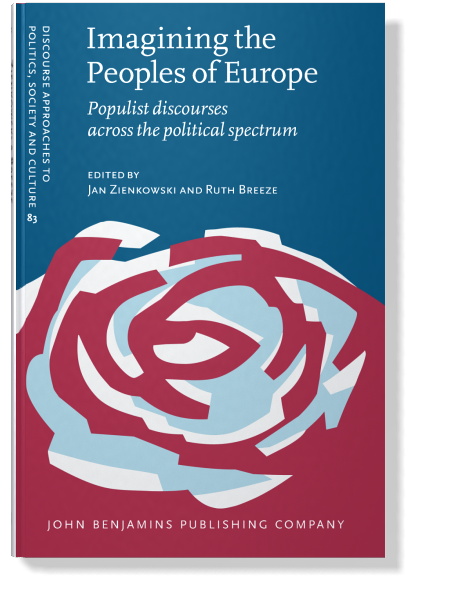
In:Imagining the Peoples of Europe: Populist discourses across the political spectrum
Edited by Jan Zienkowski and Ruth Breeze
[Discourse Approaches to Politics, Society and Culture 83] 2019
► pp. 19–42
Get fulltext
Chapter 1The populist political logic and the analysis of the discursive construction of ‘the people’ and ‘the elite’
Available under the Creative Commons Attribution-NonCommercial-NoDerivatives (CC BY-NC-ND) 4.0 license.
For any use beyond this license, please contact the publisher at rights@benjamins.nl.
Published online: 13 August 2019
https://doi.org/10.1075/dapsac.83.02cle
https://doi.org/10.1075/dapsac.83.02cle
Abstract
Aiming to provide some theoretical context to this edited volume on Imagining the Peoples of Europe, this chapter argues that a discourse-theoretical definition of populism as a political logic is the best basis for discursive analyses of populist politics. In identifying what makes populist politics across the political spectrum populist, the chapter strongly builds on Laclau’s work. But it more explicitly limits populism to a particular political logic that revolves around the claim to represent ‘the people’, discursively constructed through a down/up opposition between the people-as-underdog and ‘the elite’ as a small and illegitimately powerful group that is argued not to satisfy the needs and demands of the people. This definition also emphasizes how populism constructs not only ‘the people’ but also ‘the elite’, and how it presents certain demands as the will of the people. The chapter concludes with a discussion of the proposed definition’s implications for the empirical analysis of populist politics across the political spectrum, suggesting that we need to analyze the ways in which populists construct the down/up opposition between ‘people’ and ‘elite’ as well as how this opposition is articulated with other elements of populists’ particular programs and strategies.
Keywords: populism, discourse theory, political logic, Laclau, articulation
Article outline
- Introduction: Populism and the discursive construction of ‘the people’
- Ignoring the populist construction of ‘the people’
- Populist as popular and the reification of ‘the people’
- The populist electorate and the disregard for populist agency
- The nature of populism
- Definitional issues
- Covering varieties of populism
- Identifying the distinct character of populism
- Populism as a political logic
- ‘The people’ and ‘the elite’ as nodal points
- From ideology to political logic: The discursive construction of ‘the people’ and ‘the elite’
- The discursive analysis of populist politics
- Constructing ‘the people’ versus the ‘elite’
- Articulation and the role of populism in populist politics
Notes Bibliography

References (82)
Akkerman, Tjitske. 2003. “Populism and Democracy: Challenge or Pathology?” Acta Politica 38: 147–159.
Arditi, Benjamin. 2007. “Post-hegemony: Politics Outside the Usual Post-Marxist Paradigm.” Contemporary politics 13 (3): 205–226.
Beasley-Murray, Jon. 2006. “Review of ‘On Populist Reason’ (Ernesto Laclau) & ‘Populism and the Mirror of Democracy’ (Francisco Panizza (ed.)).” Contemporary Political Theory 5: 362–367.
Bourdieu, Pierre. 1990. “The Uses of ‘The People?’.” In In Other Words: Essays Towards a Reflexive Sociology, ed. by Pierre Bourdieu (trans. by Matthew Adamson): 150–155. Stanford: Stanford University Press.
. 2002. “Taking Politics to the People: Populism as the Ideology of Democracy.” In Democracies and the Populist Challenge, ed. by Yves Mény, and Yves Surel: 25–44. Basingstoke: Palgrave Macmillan.
De Cleen, Benjamin. 2009. “Popular Music Against Extreme Right Populism.” International Journal of Cultural Studies 12 (6): 577–595.
De Cleen, Benjamin, and Nico Carpentier. 2010. “Contesting Extreme Right Populism through Popular Culture. The Vlaams Belang and the 0110 Concerts in Belgium.” Social Semiotics 20 (2): 175–196.
De Cleen, Benjamin. 2013. “The Vlaams Blok/Belang Versus the Flemish City Theatres. An Analysis of Populist Radical Right Rhetoric about Culture.” In Right-wing Populism in Europe: Politics and discourse, ed. by Majid Khosravinik, Brigitte Mral, and Ruth Wodak: 209–222. London: Bloomsbury Academic.
. 2016a. “The Party of the People versus the Cultural Elite. Populism and Nationalism in Flemish Radical Right Rhetoric about Artists.” JOMEC – Journal of Journalism, Media and Cultural Studies vol. 9. [URL]
. 2016b. “Representing ‘the People’. The Articulation of Nationalism and Populism in the Rhetoric of the Flemish VB.” In Le Destin de la Norme, ed. by Jérôme Jamin: 224–242. Brussels: Academia Bruylant.
. 2017. “Populism and Nationalism.” In Handbook of Populism, ed. by Cristóbal Rovira Kaltwasser, Paul Taggart, Paulina Ochoa Espejo, and Pierre Ostiguy: 342–362. Oxford: Oxford University Press.
(2017b) “Review of Ruth Wodak. (2015) The Politics of Fear: What Right-Wing Populist Discourses Mean.” Journal of Language and Politics, 16(1): 137–140.
De Cleen, Benjamin, and Yannis Stavrakakis. 2017. “Distinctions and Articulations. Discourse Theory and the Study of Populism and Nationalism.” Javnost – The Public, 27(4): 301–319. .
De Cleen, Benjamin, Jason Glynos and Aurelien Mondon. 2018. “Critical Research on Populism: Nine Rules of Engagement.” Organization 25(5): 649–661.
De Cleen, Benjamin and Stavrakakis, Yannis. 2019. “Populismo y nacionalismo: representando al pueblo como ‘los de abajo’ y como nación.” Anales de la Cátedra Francisco Suárez 53: 97–130. [URL]
de la Torre, Carlos. 1997. “Populism And Democracy. Political Discourses And Cultures In Contemporary Ecuador.” Latin American Perspectives 24 (3): 12–24.
. 1998. “Populist Redemption And The Unfinished Democratization Of Latin America.” Constellations 5 (1): 85–95.
Di Tella, Torcuato. 1965. “Populism and Reform in Latin America?” In Obstacles to Change in Latin America, ed. by Claudio Veliz: 47–74. London: Oxford University Press.
Dyrberg, Torben Bech. 2003. “Right/Left In Context Of New Political Frontiers: What’s Radical Politics Today?” Journal of Language and Politics 2 (2): 339–342.
. 2006. “Radical and Plural Democracy: in Defence of Right/Left and Public Reason.” In Radical Democracy. Politics between Abundance and Lack, ed. by Lars Tønder, and Lasse Thomassen: 167–184. Manchester: Manchester University Press.
Fieschi, Catherine, and Paul Heywood. 2004. “Trust, Cynicism and Populist Anti-Politics.” Journal of Political Ideologies 9 (3): 289–309.
Germani, Gino. 1978. Authoritarianism, Fascism and National Populism. New Brunswick, NJ: Transaction books.
Glynos, Jason. 2008. “Ideological Fantasy at Work.” Journal of Political Ideologies 13 (3): 275–296.
Glynos, Jason, and David Howarth. 2007. Logics Of Critical Explanation In Social And Political Theory. London and New York: Routledge.
Howarth, David. 2005. “Applying Discourse Theory: The Method of Articulation.” In Discourse Theory in European Politics, ed. by David Howarth, and Jakob Torfing: 316–350. London: Palgrave.
. 2008. “Ethos, Agonism, and Populism.” British Journal of Politics and International Relations 10: 171–193.
Howarth, David, and Yannis Stavrakakis. 2000. “Introducing Discourse Theory and Political Analysis.” In Discourse Theory And Political Analysis. Identities, Hegemony And Social Change, ed. by David Howarth, Aletta Norval, and Yannis Stavrakakis: 1–23. Manchester and New York: Manchester University Press.
Ignazi, Piero. 1992. “The Silent Counter-Revolution. Hypotheses On The Emergence Of Extreme Right Parties In Europe.” European Journal of Political Research 12 (1): 3–34.
Jagers, Jan, and Stefaan Walgrave. 2007. “Populism As Political Communication Style: An Empirical Study Of Political Parties’ Discourse In Belgium.” European Journal of Political Research 46 (3): 319–345.
Jansen, Robert S. 2011. “Populist Mobilization: A New Theoretical Approach To Populism.” Sociological theory 29 (2): 75–96.
Kitschelt, Herbert, with McGann, Anthony. 1995. The Radical Right In Western Europe: A Comparative Analysis. Ann Arbor: University of Michigan Press.
Kitschelt, Herbert. 2002. “Popular Dissatisfaction With Democracy: Populism And Party Systems.” In Democracies and the Populist Challenge, ed. by Yves Mény, and Yves Surel: 179–196. Houndmills: Palgrave.
Kögl, Irene. 2010. “A Clash Of Paradigms: Populism and Theory Building.” Sociedade e Cultura 13 (2): 173–180.
Krzyżanowski, Michał, and Ruth Wodak. 2009. The Politics Of Exclusion: Debating Migration In Austria. New Brunswick, NJ: Transaction.
Laclau, Ernesto. 1977. Politics and Ideology in Marxist Theory: Capitalism, Fascism, Populism. London: New Left Books.
. 2005b. “Populism: What’s in a Name?” In Populism and the Mirror of Democracy, ed. by Francisco Panizza: 32–49. London: Verso.
Laclau, Ernesto, and Chantal Mouffe. 2001 [1985]. Hegemony and Socialist Strategy. Towards a Radical Democratic Politics (2nd ed). London: Verso.
MacRae, Donald. 1969. “Populism as an Ideology” In Populism. Its Meanings and Characteristics, ed. by Ghita Ionescu, and Ernest Gellner: 153–165. London: Weidenfeld and Nicolson.
Mény, Yves, and Yves Surel. 2000. Par le Peuple, Pour le Peuple: le Populisme et les Démocraties. Paris: Fayard.
Minogue, Kenneth. 1969. “Populism as a Political Movement.” In Populism. Its Meanings and Characteristics, ed. by Ghita Ionescu, and Ernest Gellner: 197–111. London: Weidenfeld and Nicolson.
Moffit, Benjamin, and Simon Tormey. 2014. “Rethinking Populism: Politics, Mediatisation and Political Style.” Political studies 62 (2): 381–397.
Moffitt, Benjamin. 2015. “How to Perform Crisis: A Model for Understanding the Key Role of Crisis in Contemporary Populism.” Government and Opposition 50 (2): 189–217.
. 2016. The Global Rise of Populism: Performance, Political Style, and Representation. Stanford, CA: Stanford University Press.
Mudde, Cas, and Cristóbal Rovira Kaltwasser. 2012. “Populism and (liberal) democracy: a framework for analysis.” In Populism in Europe and the Americas. Threat or Corrective to Democracy?, ed. by Cas Mudde, and Cristóbal Rovira Kaltwasser: 1–26. New York: Cambridge University Press.
Norris, Pippa. 2005. Radical Right: Voters and Parties in the Electoral Market. Cambridge: Cambridge University Press.
Ostiguy, Pierre. 2009. The High-Low Political Divide. Rethinking Populism and Anti- Populism. Kellogg Institute Committee on Concepts and Methods Working Paper 360. [URL]
Panizza, Francisco. 2005a. “Introduction: Populism and the Mirror of Democracy.” In Populism and the Mirror of Democracy, ed. by Francisco Panizza: 1–31. London: Verso.
Roberts, Kenneth M. 1995. “Neoliberalism and the Transformation of Populism in Latin America.” World Politics 48 (1): 82–116.
2006. “Populism, Political Conflict, and Grass-Roots Organization in Latin America.” Comparative Politics 38 (2): 127–148.
Sartori, Giovanni. 1968. “The Sociology of Parties: a Critical Review.” In Party Systems, Party Organizations, and the Politics of the New Masses, ed. by Otto Stammer: 1–25. Berlin: Freie Universität Berlin.
Stanley, Ben. 2008. “The Thin Ideology of Populism.” Journal of Political Ideologies 13 (1): 95–110.
Stavrakakis, Yannis. 2004. “Antinomies of Formalism. Laclau’s Theory of Populism and the Lessons from Religious Populism in Greece.” Journal of Political Ideologies 9 (3): 253–267.
. 2014. “The Return of ‘the People’: Populism and Anti-Populism in the Shadow of the European Crisis.” Constellations 21(4): 505–517.
. 2017. “How Did ‘Populism’ Become a Pejorative Concept? And Why is this Important Today? A Genealogy of Double Hermeneutics.” Populismus Working Papers 6. [URL]
Stavrakakis, Yannis, and Giorgios Katsambekis. 2014. “Left-wing Populism in the European Periphery: The Case of SYRIZA.” Journal of Political Ideologies 19 (2): 119–142.
. 2002. “Populism and the Pathology of Representative Politics.” In Democracies and the Populist Challenge, ed. by Yves Mény and Yves Surel: 62–80. Houndmills: Palgrave.
Taguieff, Pierre-André. 1997. “Le Populisme et la Science Politique du Mirage Conceptuel aux Vrais Problèmes.” Vingtième Siècle. Revue d’histoire 56: 4–33.
. 1998. “Populismes et anti-populismes: le choc des argumentations.” Mots: les languages du politique 55: 5–26.
Ware, Alan. 2002. “The United States: Populism as Political Strategy.” In Democracies and the Populist Challenge, ed. by Yves Mény, and Yves Surel: 101–119. Houndmills: Palgrave.
Weyland, Kurt. 2001. “Clarifying a Contested Concept: Populism in the Study of Latin American Politics.” Comparative politics 34 (1): 1–22.
Cited by (32)
Cited by 32 other publications
Bailly, Jessy, Coline Rondiat, Anaïs Augé & Min Reuchamps
Biancalana, Cecilia, Christian Lamour, Oscar Mazzoleni, Grégoire Yerly & Paul Carls
He, Kun, Scott A Eldridge & Marcel Broersma
He, Kun, Scott A Eldridge & Marcel Broersma
He, Kun, Scott A. Eldridge & Marcel Broersma
Ivaldi, Gilles & Oscar Mazzoleni
Novais, Rui Alexandre & Rogério Christofoletti
Ramos-González, Jorge
Ruth-Lovell, Saskia P. & Nina Wiesehomeier
Sandoval, Cristóbal
Talamayan, Fernan & John Lee Candelaria
Tao, Yuzhou, Zhiqin Zhan, Han Zhou, Jingshi Kang & Shaojing Sun
Yanchenko, Kostiantyn, Artur Lipiński & Giorgos Venizelos
Zehnter, Lisa
Breazu, Petre & Aidan McGarry
Marcos‐Marne, Hugo & Mariana Sendra
Novais, Rui Alexandre Sousa da Costa & Ângela Maria Teixiera Leite
Shchinova, Nadezda, Barbara De Cock & Philippe Hambye
Zienkowski, Jan
2024. Poststructuralist discourse theory. In Handbook of Pragmatics [Handbook of Pragmatics, ], ► pp. 187 ff.
González-Aguilar, Juan Manuel, Francisco Segado-Boj & Mykola Makhortykh
Krämer, Benjamin, Emily Alexander & Peter Maurer
Vaughan, Michael & Annett Heft
Wojczewski, Thorsten
Wojczewski, Thorsten
Čapinská, Barbora
Connett, Ricardo
Kantara, Argyro
Oswald, Michael, Mario Schäfer & Elena Broda
Venizelos, Giorgos
De Cleen, Benjamin, Jana Goyvaerts, Nico Carpentier, Jason Glynos & Yannis Stavrakakis
Furko, Peter
2019. Populist discursive strategies surrounding the immigration quota referendum in Hungary. In Imagining the Peoples of Europe [Discourse Approaches to Politics, Society and Culture, 83], ► pp. 341 ff.
This list is based on CrossRef data as of 8 december 2025. Please note that it may not be complete. Sources presented here have been supplied by the respective publishers. Any errors therein should be reported to them.