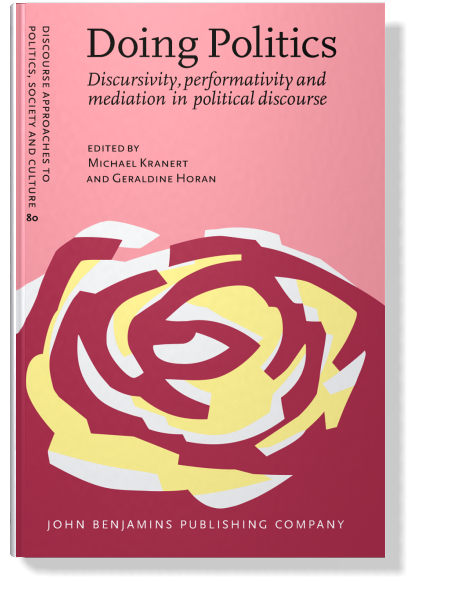
In:Doing Politics: Discursivity, performativity and mediation in political discourse
Edited by Michael Kranert and Geraldine Horan
[Discourse Approaches to Politics, Society and Culture 80] 2018
► pp. 1–24
Chapter 1Introduction
“Doing politics” – recent developments in political discourse analysis
Published online: 12 December 2018
https://doi.org/10.1075/dapsac.80.01kra
https://doi.org/10.1075/dapsac.80.01kra
Article outline
- Contexts, aims and scope of this volume
- The new field of discourse studies (DS)
- Political discourse analysis (PDA)
- Doing politics
- The structure and content of this volume: Themes, genres, methods
- Part I. Multidisciplinary approaches to political discourse – linguistic and political analysis
- Part II. Representing the people, representing the government – political discourse of British MPs
- Part III. Doing populism
- Part IV. Mediated politics
- Part V. Self-referential political discourse
- Part VI. Doing foreign policy
Notes References

References (73)
Ames, Daniel R., and Malia F. Mason. 2012. “Mind perception.” In The SAGE Handbook of Social Cognition, ed. by Susan T. Fiske, and C. N. Macrae, 115–37. Los Angeles, Calif. SAGE.
Angermuller, Johannes, Dominique Maingueneau, and Ruth Wodak (eds). 2014a. The Discourse Studies Reader. Amsterdam: John Benjamins.
. 2014b. “The Discourse Studies Reader: An Introduction.” In The Discourse Studies Reader, ed. by Johannes Angermuller, Dominique Maingueneau, and Ruth Wodak, 1–14. Amsterdam: John Benjamins.
Austin, J. L. 1962. How to Do Things with Words. The William James lectures. Oxford: Clarendon Press.
Berger, Peter L., and Thomas Luckmann. 1967. The Social Construction of Reality: A Treatise in the Sociology of Knowledge. London: Allen Lane.
Blommaert, Jan. 2005. Discourse: A Critical Introduction. Key topics in sociolinguistics. Cambridge: Cambridge University Press.
Blumler, Jay G., and Dennis Kavanagh. 1999. “The Third Age of Political Communication: Influences and Features.” Political Communication 16 (3): 209–30.
Burkhardt, Armin. 1996. “Politolinguistik: Versuch einer Ortsbestimmung.” In Sprachstrategien und Dialogblockaden: Linguistische und politikwissenschaftliche Studien zur politischen Kommunikation, ed. by Josef Klein, and Hans-Joachim Diekmannshenke, 75–100. Sprache, Politik, Öffentlichkeit 7. Berlin: de Gruyter.
Chilton, Paul, and Christina Schäffner. 2002a. “Introduction: Themes and Principles in the Analysis of Political Discourse.” In Politics as Text and Talk: Analytic Approaches to Political Discourse, ed. by Paul Chilton, and Christina Schäffner, 1–41. Amsterdam, Philadelphia: John Benjamins.
(eds). 2002b. Politics as Text and Talk: Analytic Approaches to Political Discourse. Amsterdam, Philadelphia: John Benjamins.
Cillia, Rolf de, and Ruth Wodak. 2004. “Politischer Diskurs.” In Sociolinguistics: An international handbook of the science of language and society = Soziolinguistik ein internationales Handbuch zur Wissenschaft von Sprache und Gesellschaft. Vol. 2, edited by Ulrich Ammon. 3 vols, 1638–1653. Berlin, New York: de Gruyter.
Esser, Frank, and Bernd Spanier. 2005. “News Management as News.” Journal of Political Marketing 4 (4): 27–57.
. 1995. Critical Discourse Analysis: The Critical Study of Language. Language in social life series. London, New York: Longman.
. 1998. “Political Discourse in the Media: Analytical Framework.” In Approaches to Media Discourse, edited by Allan Bell, and Peter Garrett, 142–146. Oxford, Malden, Mass. Blackwell.
. 2009. “A Dialectical-Relational Approach to Critical Discourse Analysis in Social Research.” In Wodak and Meyer 2009, 162–186.
Fetzer, Anita, and Elda Weizman. 2006. “Political Discourse as Mediated and Public Discourse.” Journal of Pragmatics 38 (2): 143–153.
Finlayson, Alan, and James Martin. 2008. “‘It Ain’t What You Say…’: British Political Studies and the Analysis of Speech and Rhetoric.” Brit Pol 3 (4): 445–464.
Finlayson, Alan. 2018. ““Dancing with doxa”: A “Rhetorical Political Analysis” of David Cameron’s sense of Britishness.” In Doing Politics. Discursivity, performativity and mediation in political discourse, edited by Michael Kranert and Geraldine Horan, 59–77. Discourse approaches to politics, society and culture (DAPSAC) 80. Amsterdam, Philadelphia: John Benjamins Publishing Company.
Flowerdew, John (ed). 2014. Discourse in context. 1st ed. Contemporary applied linguistics 3. London [u.a.]: Bloomsbury.
Gee, James P. 2005. An Introduction to Discourse Analysis: Theory and Method. 2nd ed. New York, Abingdon: Routledge.
Girnth, Heiko. 1996. “Texte im politischen Diskurs: Ein Vorschlag zur diskursorientierten Beschreibung von Textsorten.” Muttersprache (1): 66–80.
. 2002. Sprache und Sprachverwendung in der Politik: Eine Einführung in die linguistische Analyse öffentlich-politischer Kommunikation. Germanistische Arbeitshefte 39. Tübingen: Niemeyer.
Goffman, Erving. 1959. The Presentation of Self in Everyday Life. Edinburgh: University of Edinburgh Social Sciences Research Centre.
Halliday, M. A. K. 1979. Language as Social Semiotic: The Social Interpretation of Language and Meaning. London: Edward Arnold.
Halliday, M. A. K., and Christian M. I. M. Matthiessen. 2004. An Introduction to Functional Grammar. 3rd ed. London: Arnold.
Harris, Roxy, and Ben Rampton. 2014. “Ethnicities Without Guarantees: An Empirically Situated Approach.”In Discourse in context, edited by John Flowerdew. 1st ed., 133–57. Contemporary applied linguistics 3. London [u.a.]: Bloomsbury.
Hay, Colin. 2007. Why We Hate Politics. Cambridge: Polity.
Hofstetter, Emily, and Elizabeth Stokoe. 2018. “Making “politics” relevant: How constituents and a member of parliament raise political topics at constituency surgeries.” In Doing Politics. Discursivity, performativity and mediation in political discourse, edited by Michael Kranert and Geraldine Horan, 127–50. Discourse approaches to politics, society and culture (DAPSAC) 80. Amsterdam, Philadelphia: John Benjamins Publishing Company.
Hyland, Ken. 2005. Metadiscourse: Exploring Interaction in Writing. Continuum discourse series. London, New York: Continuum.
(ed). 2013. Discourse studies reader: Essential excerpts. Bloomsbury discourse. London, New Delhi, New York, Sydney: Bloomsbury Academic.
Keller, Reiner. 2011. Wissenssoziologische Diskursanalyse: Grundlegung eines Forschungsprogramms. 3. Aufl. Interdisziplinäre Diskursforschung. Wiesbaden: VS Verl. für Sozialwissenschaften.
Klein, Julie T. 2010. “A Taxonomy of Interdisciplinarity.” In The Oxford handbook of Interdisciplinarity, ed. by Robert Frodeman. Oxford handbooks. Oxford, New York: Oxford University Press.
Laclau, Ernesto, and Chantal Mouffe. 1985. Hegemony and Socialist Strategy: Towards a Radical Democratic Politics. London: Verso.
Luhmann, Niklas. 2000. The Reality of the Mass Media. Cultural memory in the present. Stanford, Calif. Stanford University Press.
Lusoli, Wainer, Stephen Ward, and Rachel Gibson. 2005. “(Re)connecting Politics? Parliament, the Public and the Internet.” Parliamentary Affairs 59 (1): 24–42.
Marcinkowski, Frank. 2014. “Mediatization of Politics: Reflections on the State of The Concept.” Javnost – The Public 21 (2): 5–22.
Marks, Michael P. 2016. Metaphors in International Relations Theory. Houndmills, Basingstoke, Hampshire: Palgrave Macmillan.
Mazzoleni, Gianpietro, and Winfried Schulz. 1999. “”Mediatization” of Politics: A Challenge for Democracy?” Political Communication 16 (3): 247–261.
Miskimmon, Alister, Ben O’Loughlin, and Laura Roselle. 2013. Strategic Narratives: Communication Power and the New World Order. London: Routledge.
Niehr, Thomas. 2014. Einführung in die Politolinguistik: Gegenstände und Methoden. Göttingen: Vandenhoeck & Ruprecht.
Reisigl, Martin, and Ruth Wodak. 2001. Discourse and Discrimination: Rhetorics of Racism and Antisemitism. London: Routledge.
Renkema, Jan. 2004. Introduction to Discourse Studies. Amsterdam, Philadelphia: John Benjamins Pub.
Schäffner, Christina. 2004. “Political Discourse Analysis from the Point of View of Translation Studies.” Journal of Language and Politics 3 (1): 117–150.
Schalk, Helge. 1999. “Diskurs: Zwischen Allerweltswort und philosophischem Begriff.” Archiv für Begriffsgeschichte 40: 56–104.
Schröter, Melani, and Björn Carius. 2009. Vom politischen Gebrauch der Sprache: Wort, Text, Diskurs. Frankfurt am Main, New York: Lang. Eine Einführung.
Searle, John R. 1969. Speech Acts: An Essay in the Philosophy of Language. London: Cambridge University Press.
Strauss, Gerhard. 1986. Der politische Wortschatz: Zur Kommunikations- und Textsortenspezifik. Tübingen: Narr.
van Dijk, Teun A. 1993. “Principles of Critical Discourse Analysis.” Discourse & Society 4 (2): 249–283.
van Leeuwen, Theo. 2005. “Three Models of Interdisciplinarity.” In A New Agenda in (Critical) Discourse Analysis: Theory, Methodology and Interdisciplinarity, ed. by Ruth Wodak, and Paul Chilton, 3–18. Discourse approaches to politics, society and culture v. 13. Amsterdam, Philadelphia: John Benjamins.
Warnke, Ingo H., and Jürgen Spitzmüller. 2008. “Methoden und Methodologie der Diskurslinguistik-: Grundlagen und Verfahren einer Sprachwissenschaft jenseits textueller Grenzen.” In Methoden Der Diskurslinguistik: Sprachwissenschaftliche Zugänge Zur Transtextuellen Ebene, ed. by Ingo H. Warnke, and Jürgen Spitzmüller, 3–54. Linguistik, Impulse & Tendenzen, 1612–8702 31. Berlin: de Gruyter.
Wengeler, Martin. 2011. “Linguistische Diskursanalysen – deskriptiv, kritisch oder kritisch durch Deskription?” In Sprachkritik und Sprachkultur: Konzepte und Impulse für Wissenschaft und Öffentlichkeit, ed. by Jürgen Schiewe, 35–48. Greifswalder Beiträge zur Linguistik 6.
Widdowson, Henry G. 1995. “Discourse Analysis: A Critical View.” Language and Literature 4 (3): 157–172.
Wodak, Ruth. 2004. “Critical Discourse Analysis.” In Qualitative Research Practice, ed. by Clive Seale, 197–213. London: SAGE.
. 2014. “Political Discourse Analysis – Distinguishing Frontstage and Backstage Contexts: A Discourse-Historical Approach.” In Flowerdew 2014, 321–345.
Wodak, Ruth, and Rolf de Cillia. 2007. “Commemorating the Past: The Discursive Construction of Official Narratives about the ‘Rebirth of the Second Austrian Republic’.” Discourse & Communication 1 (3): 337–363.
Wodak, Ruth, Rudolf de Cillia, Martin Reisigl, and Karin Liebhart. 1998. Zur diskursiven Konstruktion nationaler Identität. 1. Aufl. Suhrkamp Taschenbuch Wissenschaft 1349. Frankfurt: Suhrkamp.
Wodak, Ruth, and Michael Meyer (eds). 2009. Methods of Critical Discourse Analysis. 2nd edn. Introducing qualitative methods. London: SAGE.
(eds). 2016. Methods of Critical Discourse Studies. 3rd edn. London, Thousand Oaks California: SAGE.
Wodak, Ruth. 2018. ““We have the character of an island nation”: A discourse-historical analysis of David Cameron’s “Bloomberg speech” on the European Union.” In Doing Politics. Discursivity, performativity and mediation in political discourse, edited by Michael Kranert and Geraldine Horan, 27–58. Discourse approaches to politics, society and culture (DAPSAC) 80. Amsterdam, Philadelphia: John Benjamins Publishing Company.
Cited by (2)
Cited by two other publications
Weizman, Elda & Zohar Livnat
[no author supplied]
This list is based on CrossRef data as of 8 december 2025. Please note that it may not be complete. Sources presented here have been supplied by the respective publishers. Any errors therein should be reported to them.