In:Studies of Discourse and Governmentality: New perspectives and methods
Edited by Paul McIlvenny, Julia Zhukova Klausen and Laura Bang Lindegaard
[Discourse Approaches to Politics, Society and Culture 66] 2016
► pp. 297–322
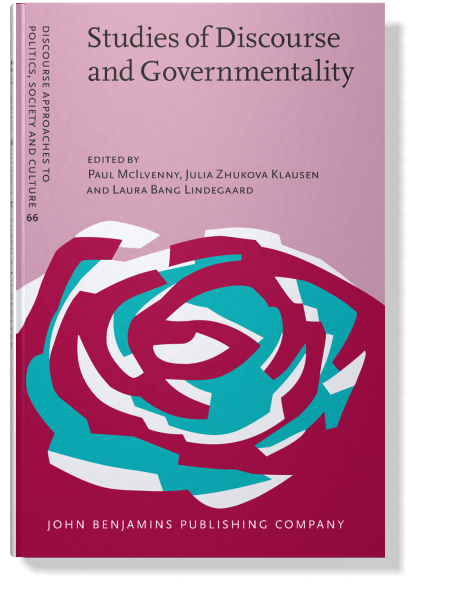
Governmentality through intertextuality
Strategic planning discourse in the administration of tertiary education
Published online: 29 June 2016
https://doi.org/10.1075/dapsac.66.10wal
https://doi.org/10.1075/dapsac.66.10wal
In this chapter I analyse texts composed and exchanged within the New Zealand
tertiary education domain in order to explore the “will to govern” (Miller and
Rose 2008: 29) in its contemporary manifestation. Using intertextuality as the
principle framework, the analysis is grounded in a detailed case study of the use
of strategic planning as a technology of government. The investigation reveals
the considerable extent to which governments can govern through textual
means, notwithstanding a tightening of control over the period studied through
changes in regimes of compliance. Notable also in the universities’ enforced
adoption of strategic planning is the extent to which the discursive practices
that characterise strategic planning in a complex, multi-levelled environment
can enhance a liberal rationality of rule.

References (36)
Bakhtin, Mikhail Mikhajlovitj. 1986. “The Problem of Speech Genres.” In Speech Genres and Other Late Essays, trans. by Vern W. McGee and ed. by Caryl Emerson and Michael Holquist, 60–102. Austin: University of Texas Press.
Bazerman, Charles, Adair Bonini, and Débora Figueiredo (eds). 2009. Genre in a Changing World. Fort Collins, Colorado: The WAC Clearinghouse and Parlor Press.
Death, Carl. 2010. “Counter-conducts: A Foucauldian Analytics of Protest.” Social Movement Studies 9 (3): 235–251.
De Saint-Georges, Ingrid. 2013. “Anticipatory Discourse.” The Encyclopedia of Applied Linguistics, ed. by Carol A. Chapelle, 1-7. Oxford: WileyBlackwell.
Dingo, Rebecca. 2012. Networking Arguments: Rhetoric, Feminism, and Public Policy Writing. Pittsburgh: University of Pittsburgh Press.
Dooris, Michael J., John M. Kelley, and James F. Trainer. 2002. “Strategic Planning in Higher Education.” New Directions in Higher Education 116: 5–11.
Dunmire, Patricia. 2005. “Preempting the Future: Rhetoric and the Ideology of the Future in Political Discourse.” Discourse and Society 16 (4): 481–513.
East, R.J. (1972). “Comparison of Strategic Planning in Large Corporations and Government.” Long Range Planning 5 (2): 2–8.
Foucault, Michel. 2003. Society Must Be Defended (Lectures at the Collège de France, 1975–76), ed. by Mauro Bertani and Alessandro Fontana. New York: Picador.
. 2007. Security, Territory and Population (Lectures at the Collège de France 1977–78), ed. by Michel Senellart. Basingstoke: Palgrave Macmillan.
. 2008. The Birth of Biopolitics (Lectures at the Collège de France, 1978–1979), ed. by Michel Senellart. Basingstoke: Palgrave Macmillan
Hunter, Ian. 1996. “Assembling the School.” In Foucault and Political Reason: Liberalism, Neo-liberalism and Rationalities of Government, ed. by Andrew Barry, Thomas Osborne, and Nikolas Rose, 143-166. Chicago: The University of Chicago Press.
Ivanic, Roz. 1998. Writing and Identity: The Discoursal Construction of Identity in Academic Writing. Amsterdam and Philadelphia: John Benjamins.
Kristeva, Julia. 1986. “Word, Dialogue and Novel”. In The Kristeva Reader, ed. by Toril Moi, 34-61. Oxford: Blackwell.
Marini, John. 2001. “Constitutionalism, the Public Philosophy, and Political Science.” Perspectives on Political Science 30 (1): 29–36.
Ministry of Education. 2002. Tertiary Education Strategy 2002/07. Wellington: Ministry of Education.
Olssen, Mark. 2002. “The Restructuring of Tertiary Education in New Zealand: Governmentality, Neo-Liberalism, Democracy.” McGill Journal of Education 37 (1): 57–87.
Scollon, Ron. 2008. Analyzing Public Discourse : Discourse Analysis in the Making of Public Policy. London and New York: Routledge.
Solin, Anna. 2004. “Intertextuality as Mediation: On the Analysis of Intertextual Relations in Public Discourse.” Text 24 (2): 267–296.
Tertiary Education Advisory Commission. 2000. Shaping a Shared Vision: Strategy, Quality, Access. Wellington: Tertiary Education Advisory Commission.
Tertiary Education Commission. 2004. The Distinctive Contributions of Tertiary Education Organisations. Wellington: Tertiary Education Commission.
. 2012 (a). Initial Plan Guidance for 2013 Plans: Guidance for All TEOs. Wellington: Tertiary Education Commission.
Cited by (1)
Cited by one other publication
This list is based on CrossRef data as of 8 december 2025. Please note that it may not be complete. Sources presented here have been supplied by the respective publishers. Any errors therein should be reported to them.