In:Discourse, Politics and Women as Global Leaders
Edited by John Wilson and Diana Boxer
[Discourse Approaches to Politics, Society and Culture 63] 2015
► pp. 251–272
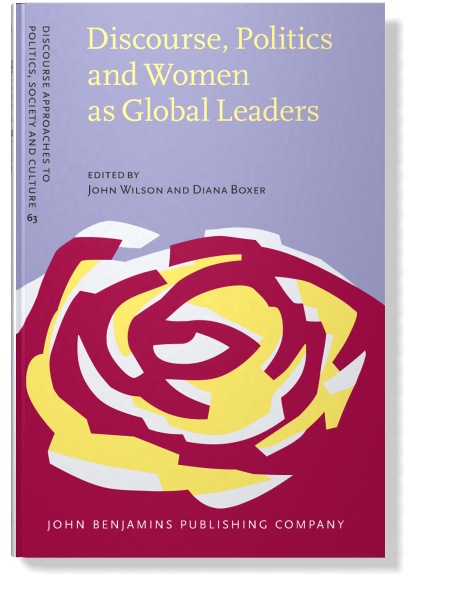
Chapter 10. Discourses of female leaders in postcolonial Hong Kong
Published online: 30 October 2015
https://doi.org/10.1075/dapsac.63.11fen
https://doi.org/10.1075/dapsac.63.11fen
The present study examines divergent political discourse systems in postcolonial Hong Kong (cf. Flowerdew 1997), as distinguished by the political claims of two female leaders regarding universal suffrage: Carrie LAM Cheng Yuet-ngor and Emily LAU Wai-hing. Data for analysis are derived from their public speeches addressed in the legislative council of Hong Kong from 2010–2013. The discourse of the chief secretary for Hong Kong Special Administrative Region, Carrie Lam, lacks a feminine register and represents the Confucianist discourse system, emphasizing consensus-seeking with the central government of China and people of Hong Kong. In contrast, the chairwoman of the Democratic Party, Emily Lau, with traces of a female register represents the Utilitarian discourse system, stressing the soonest possible timeline of universal suffrage as per “international standards.”

References (22)
Atkeson, L.R. 2003. “Not All Cues Are Created Equal: The Conditional Impact of Female Candidates on Political Engagement.” Journal of Politics 65(4): 1040-1061.
Basu, A., Naraja Gopal Jayal, Martha Nussbaum, and Yasmin Tambiah. 2003. Essays on Gender and Governance. India: Human Development Resource Center, United Nations Development Programme.
. 1995. Dimensions of Register Variation: A Cross-linguistic Comparison. Cambridge: Cambridge University Press.
Chancer, L.S. and B.X. Watkins, eds. 2006. Gender, Race and Class: An Overview. Oxford: Blackwell publishing.
Flowerdew, J. 1997. “Competing Public Discourses in Transitional Hong Kong.” Journal of Pragmatics 28(4): 533-553.
. 2004. “Identity Politics and Hong Kong’s Return to Chinese Sovereignty: Analysing the Discourse of Hong Kong’s First Chief Executive.” Journal of Pragmatics 36(9): 1551-1578.
Flowerdew, J., D.C.S. Li, and S. Tran. 2002. “Discriminatory News Discourse: Some Hong Kong Data.” Discourse & Society 13(3): 319-345.
Flowerdew, J. and S. Leong. 2010. “Presumed Knowledge in the Discursive Construction of Socio-political and Cultural Identity.” Journal of Pragmatics 42(8): 2240-2252.
Kuo, S. 2008. “A Woman Warrior or a Forgotten Concubine? Verbal Construction of a Feminist Politician in Taiwan.” In Discourses of Cultural China in the Globalizing Age, edited by Doreen D. Wu. Hong Kong: Hong Kong University Press.
Lee, E.W.Y. 2003. Gender and Change in Hong Kong: Globalization, Postcolonialism, and Chinese Patriarchy. Vancouver, B.C.: UBC Press.
Poon, K. 2008. The Political Future of Hong Kong: Democracy Within Communist China. London & New York: Routledge.
Scollon, R. and S.W. Scollon. 1995/2001. Intercultural Communication: A Discourse Approach. Malden: Blackwell.
Shaw, S. 2000. “Language, Gender and Floor Apportionment in Political Debates.” Discourse and Society 11(3): 401-418.
Sreberny, A. and L. van Zoonen, eds. 1999. Gender, Politics and Communication. New York: Hampton Press.
UNICEF. 2006. “Equality in Politics and Government” and “Reaping the Double Dividend of Gender Equality.” In The State of the World Children, 51–87. New York: The United Nations Children’s Fund.
Wu, Doreen D. and Agatha M.K. Chung. 2011. “Hybridized Images: Representations of the ‘Modern Woman’ Across Mainland China and Hong Kong TV Commercials.” Journal of Asian Pacific Communication 21(2): 177-195.
Cited by (1)
Cited by one other publication
This list is based on CrossRef data as of 8 december 2025. Please note that it may not be complete. Sources presented here have been supplied by the respective publishers. Any errors therein should be reported to them.