In:Discourse, Politics and Women as Global Leaders
Edited by John Wilson and Diana Boxer
[Discourse Approaches to Politics, Society and Culture 63] 2015
► pp. 195–216
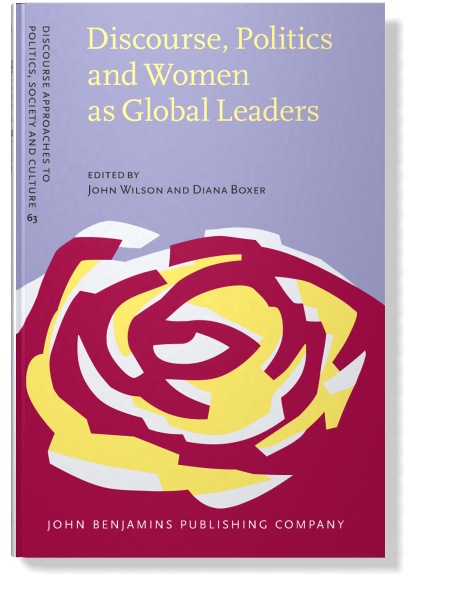
Chapter 8. “Thank you for heckling me”
Hillary Rodham Clinton’s discursive management of her public persona, her political message and the “Iron my shirt!” hecklers in the 2008 presidential election campaign
Published online: 30 October 2015
https://doi.org/10.1075/dapsac.63.09she
https://doi.org/10.1075/dapsac.63.09she
This chapter analyses an exchange where hecklers interrupt Hillary Rodham Clinton (HRC) at a 2008 U. S. Presidential campaign town hall meeting. Analysis of video records describes HRC’s impromptu, embodied rhetorical response that repositions the disruptors onto the discursive margin and upholds women’s discursive rights as she sidesteps the trap of the “double-bind,” and consolidates audience alignment with her values. Studying how public speakers negotiate unplanned, complex, multi-party events can reveal more about a leader’s discursive skills and social intelligence than the study of planned, text-centric political discourse alone. This chapter analyzes emergent, multimodal interaction (linguistic and gestural), and visible contributions from social others addressed by the speaker, a methodological shift important for recognizing the depth of women’s public speaking skill and stylistic variety.

References (38)
Bellantoni, Christina. 2008. Clinton to “Iron My Shirt Protester”: Sexism rampant. YouTube video, 2:11. Posted by “bellantoniwashtimes,” January 7. [URL]
Brooks Gardner, Carol. 1980. “Passing by: Street Remarks, Address Rights and the Urban Female.” Sociological Inquiry 50(3-4): 328-356.
Cameron, Deborah. 1998. “Introduction: Why is Language a Feminist Issue?” In The Feminist Critique of Language: A Reader 2nd Edition, edited by Deborah Cameron, 1-21. London: Routledge.
Campbell, Karlyn. 1998. “The Discursive Performance of Femininity: Hating Hillary.” Rhetoric & Public Affairs 1(1): 1-19.
. 2006. “Gender and Communication in Rhetorical Contexts.” In The SAGE Handbook of Gender and Communication, edited by B.J. Dow and J.T. Woods, 179-183. Thousand Oaks, CA: Sage Publications, Inc.
Campbell, Karlyn and Zornitsa Keremidchieva. 2006. “Gender and Public Address.” In The SAGE Handbook of Gender and Communication, edited by Bonnie. J. Dow and Julia. T. Woods, 185-201. Thousand Oaks, CA: Sage Publications Inc.
CitizenJanePolitics. Jan. 7, 2008. “Heckler at Hillary Clinton event.” Downloaded Dec. 30, 2013 from [URL]
Ehrlich, Susan. 1998. “Discursive Reconstruction of Sexual Consent.” Discourse & Society 9(2): 149-171.
Herring, Susan, Deborah A. Johnson, and Tamra DiBenedetto. 1995.“ ‘This Discussion is Going Too Far!’: Male Resistance to Female Participation on the Internet.” In Gender Articulated: Language and the Socially Constructed Self, edited by Kira Hall and Mary Bucholtz, 67-96. New York: Routledge.
Fahrenthold, David A. 2011. “American Town Halls More Contentious Than Ever, In Part by Design.” Washington Post, August 27. [URL]
Gates Jr., Henry Louis. 1996. “Hating Hillary. First Lady Hillary Rodham Clinton.” The New Yorker 72(2): 116, February 26.
Lakoff, Robin. 1992. “The Silencing of Women.” In Locating Power: Proceedings of the Second Berkeley Women and Language Conference, edited by Kira Hall, Mary Bucholtz, and Birch Moonwomon, 344-355. Berkeley, CA: University of California Berkeley.
. 1995. “Cries and Whispers: The Shattering of the Silence.” In Gender Articulated: Language and the Socially Constructed Self, edited by Kira Hall and Mary Bucholtz, 25-50. New York: Routledge.
Mendoza-Denton, Norma. 1995. “Pregnant Pauses: Silence and Authority in the Anita Hill-Clarence Thomas Hearings.” In Gender Articulated: Language and the Socially Constructed Self, edited by Kira Hall and Mary Bucholtz, 51-66. New York: Routledge.
Mofamfour. Jan. 7, 2008. “Hillary heckled, ‘Iron my shirt!’” Downloaded September 13, 2011 from [URL]
Myers, Dee Dee. 2008a. “The Free-Pass Sexism of the Hillary Hate Brigade.” Vanity Fair, February 5. [URL]
. 2008b. Sexism and the Media in the 2008 Primaries. YouTube video, 3:00. Posted by “ForaTv”, July 29, 2008. [URL]
Ochs, Elinor and Carolyn Taylor. 1995. “‘The Father Knows Best’ Dynamic In Dinnertime Narratives.” In Gender Articulated: Language and the Socially Constructed Self, edited by Kira Hall and Mary Bucholtz, 97-121. New York: Routledge.
Parry, Robert. 2008. “’Iron My Shirts” Taunt Helps Hillary.” Consortiumnews.com, January 9. [URL]
PBS.org. 2014. “Eleanor Roosevelt.” American Experience. [URL]
Rodham Clinton, Hillary. 1995. “Remarks to the U.N. 4th World Conference on Women Plenary Session.”
American Rhetoric Top 100 Speeches
. Speech presented in Beijing, China. September 5. [URL]
. 2011a. “Biography.” United States Department of State, August 12. [URL]
. 2011b. “Remarks in Recognition of International Human Rights Day.”
U.S. Department of State
. Speech presented at Palais des Nations in Geneva, Switzerland. December 6. [URL]
Rodham Clinton, Hillary, Chelsea Clinton, and Melinda Gates. 2014. “Why Women and Girls Count.” Discussion of partnership between the Gates Foundation and the No Ceilings Full Participation Project. September. [URL]
Sattel, Jack. 1983. “Men, Inexpressiveness and Power.” In Language, Gender and Society, edited by Barrie Thorne, Cheris Kamarea, and Nancy Henley, 119-124. Rowley, MA: Newbury House.
Sheldon, Amy. 1990a. “‘Kings are Royaler than Queens’: Language and Socialization.” Young Children 45(2): 4-9.
. 1992. “Conflict Talk: Sociolinguistic Challenges to Self-assertion and How Young Girls Meet Them.” Merrill-Palmer Quarterly 38(1): 95-117.
. 1996. “You Can Be the Baby Brother but You Aren’t Born Yet: Preschool Girls’ Negotiation for Power and Access in Pretend Play.” Research on Language and Social Interaction 29(1): 57-80.
. 1997. “Talking Power: Girls, Gender Enculturation and Discourse.” In Gender and Discourse, edited by Ruth Wodak, 225-244.
Sheldon, Amy and Lisa Rohleder. 1996. “Sharing the Same World, Telling Different Stories: Gender Differences in Co-constructed Pretend Narratives.” In Social Interaction, Social Context, and Language, edited by Dan Issac Slobin, Julie Gerhardt, Amy Kyratzis, and Jiansheng Guo, 613-632. New York: Psychology Press.
Sheldon, Amy and Heidi Engstrom. 2004. “Two Systems of Mutual Engagement: The Co-construction of Gendered Narrative Styles by American Preschoolers.” In The Sociolinguistics of Narrative, edited by Jennifer Coates and Joanna Thornborrow, 171-192.
Stormer, Nathan. 2006. “A Vexing Relationship: Gender and Contemporary Rhetorical Theory.” In The SAGE Handbook of Gender and Communication, edited by Bonnie J. Dow and Julia T. Wood, 247-262. Thousand Oaks, CA: Sage Publications, Inc.
Thumbelina Hillary Heckled ‘Iron My Shirt.’ 2008. YouTube video, 1:42. Posted by “thumbelina,” January 7. [URL]
Wills, Garry. 1996. “A Tale of Two Cities.” New York Review of Books, October 3. [URL]
Cited by (2)
Cited by two other publications
McNellis, Janet R. & Linda Haskins
This list is based on CrossRef data as of 8 december 2025. Please note that it may not be complete. Sources presented here have been supplied by the respective publishers. Any errors therein should be reported to them.