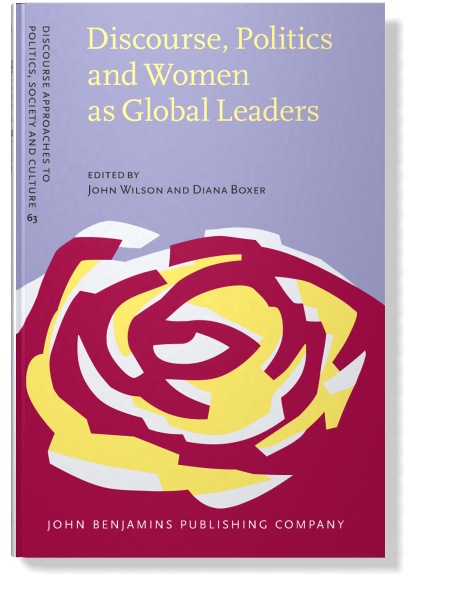
In:Discourse, Politics and Women as Global Leaders
Edited by John Wilson and Diana Boxer
[Discourse Approaches to Politics, Society and Culture 63] 2015
► pp. 43–66
Chapter 2. Breaking the glass & keeping the ceiling
Women presidents’ discursive practices in Latin America
Published online: 30 October 2015
https://doi.org/10.1075/dapsac.63.03cor
https://doi.org/10.1075/dapsac.63.03cor
During the last half of the 20th century grass root women’s movements have been instrumental in the transition to democracy in Latin America. These social movements were followed by an increased political representation of women at the congressional level, and within the last few decades, six women have been chosen to the highest office: Violeta Barrios de Chamorro (1990–97), Nicaragua; Mireya Moscoso de Arias (1999–2004), Panamá; Laura Chinchilla (2010–2014), in Costa Rica; Michelle Bachelet (2006–2010 & 2014 to present), Chile; Cristina Fernández de Kirchner (2007–to present), Argentina; Dilma Rousseff (2011 to present), Brazil. In our paper, we examine the discursive practices that allowed Kirchner and Bachelet to win their presidencies, and their position on gender, human rights, and economic issues.
Keywords: discursive practice, gender, Latin America, leadership styles, women’s movements

References (20)
Bachelet, Michelle. 2006(a). “Discurso de investidura.”
Retóricas, Speech presented at Palacio de la Moneda
, March 11. [URL].
. 2006(b). “Cuenta annual de la presidente del Congreso Pleno.” Speech presented in Valparaiso, Chile, May 21.
Barry, Carolina. 2011. Sufragio femenino: Prácticas y debates politicos, religiosos y culturales en Argentina y América. Buenos Aires: EDUNTREF.
Blommaert, Jan. 2005. Discourse: Key Topics in Sociolinguistics. Cambridge: Cambridge University Press.
Feijoó, María del Carmen and Marcela María Alejandra Nari. 1994. “Women and Democracy in Argentina.” In The Women’s Movement in Latin America, edited by Jane S. Jaquette, 109-129. Oxford: West View Press, Inc.
Fernández de Kirchner, Cristina. 2007. “Discurso de asunción ante la asamblea legislativa.” Speech presented in Buenos Aires, Argentina, December 10.
. 2011. “Discurso de asunción ante la asamblea legislativa.” Speech presented in Buenos Aires, Argentina. Web, December 10.
Htun, Mala N. 2002. “Women in Political Power in Latin America.” In International IDEA, Mujeres en el parlamento. Más allá de los números
. Stockholm, Sweden. 1-12.
Jamieson, Kathleen H. 1995. Beyond the Double Bind: Women and Leadership. Oxford: Oxford University Press.
Laclau, Ernesto. 2005. La razón populista. Buenos Aires, S.A.: Fondo de Cultura Económica de Argentina.
Levitsky, Steven and Victoria Murillo. 2008. “Argentina: De Kirchner a Kirchner.” Journal of Democracy 19(2):16-30.
Molyneux, Maxine. 2003. Women’s Movements in International Perspecties: Latin America and Beyond. London: Institute of Latin American Studies.
Morales Quiroga, Mauricio. 2008. “La primera mujer presidenta de Chile.” Latin American Research Review 43(1): 7-32.
Murray, Rainbow, ed. 2010. Cracking the Highest Glass Ceiling: A Global Comparison of Women’s Campaigns for Executive Office. Santa Barbara: Praeger.
Patrouilleau, María Mercedes. 2010. “Discurso y narración en las dinámicas de consitutción identitaria. La experiencia Kirchnerista en Argentina.” CONfines de Relaciones Internacionales y Ciencia Política 6(11): 37-58.
Piscopo, Jennifer M. 2010. “
Primera dama, Prima donna? Media Constructions of Cristina Fernández de Kirchner in Argentina.” In Cracking the Highest Glass Ceiling: A Global Comparison of Women’s Campaigns for Executive Office, edited by Rainbow Murray, 197-220. Santa Barbara: Praeger.
Rojas Mira, Claudia Fedora. 2011. “Rumbo a la moneda: Historia del movimiento sufragista en Chile, 1913-1952.” In Sufragio femenino: Prácticas y debates politicos, religiosas y culturales en Argentina y América Latina, edited by Barry Carolina, 391-409. Buenos Aires: EDUNTREF.
Cited by (2)
Cited by two other publications
Jalalzai, Farida, Brianna Kreft, Lizbet Martinez-Port, Pedro A. G. dos Santos & Brigid M. Smith
This list is based on CrossRef data as of 8 december 2025. Please note that it may not be complete. Sources presented here have been supplied by the respective publishers. Any errors therein should be reported to them.