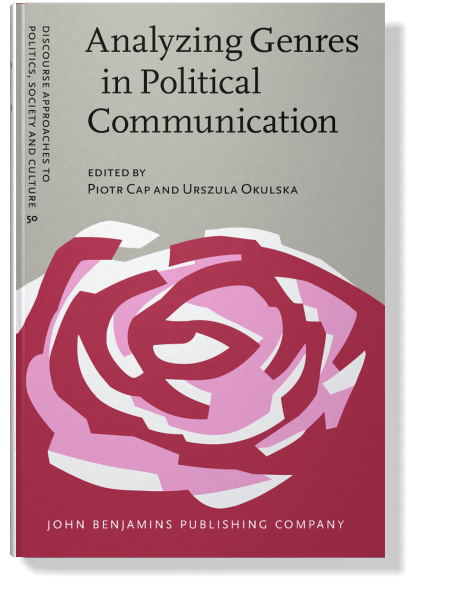
In:Analyzing Genres in Political Communication: Theory and practice
Edited by Piotr Cap and Urszula Okulska
[Discourse Approaches to Politics, Society and Culture 50] 2013
► pp. 73–99
Chapter 2. Political interviews in context
Published online: 16 July 2013
https://doi.org/10.1075/dapsac.50.04fet
https://doi.org/10.1075/dapsac.50.04fet
The genre of the broadcast political interview is examined from a compositional methodological approach, drawing on ethnomethodological conversation analysis, critical discourse analysis, sociopragmatics, social psychology and media studies. A distinction is proposed between the default and non-default political interview. In the prototypical (default) interview, there is the journalist as interviewer, who asks political questions, and the politician as interviewee, who answers political questions by giving political answers. In the non-default interview, this one-dimensional setting becomes blurred: in the employment of different semiotic codes and socio-cultural practices; in the inclusion of both public and private discourse identities; and in explicit accommodation to the audience’s needs. To capture the inherent dynamics of the genre, it proposed that political interviews be conceptualized as a hybrid genre, accommodating the constraints and requirements of both media communication and professional discourse.

Cited by (12)
Cited by 12 other publications
Weizman, Elda & Zohar Livnat
Luginbühl, Martin
Bjaiya al-mas'ud, Hameed Hassoon & Abdullah Muhammad Naif
Radulović, Milica & Vladimir Ž. Jovanović
2020. The pragmeme of disagreement and its allopracts in English and Serbian political interview discourse. Pragmatics. Quarterly Publication of the International Pragmatics Association (IPrA) 30:4 ► pp. 586 ff.
Armon, Rony
2019. Ordinary science. In The Construction of ‘Ordinariness’ across Media Genres [Pragmatics & Beyond New Series, 307], ► pp. 157 ff.
Weizman, Elda & Anita Fetzer
2019. Introduction. In The Construction of ‘Ordinariness’ across Media Genres [Pragmatics & Beyond New Series, 307], ► pp. 1 ff.
Cap, Piotr
2015. Monologic follow-ups in political macro-discourse. In The Dynamics of Political Discourse [Pragmatics & Beyond New Series, 259], ► pp. 59 ff.
Cap, Piotr
Fetzer, Anita & Elda Weizman
2015. Following up across contexts and discourse domains: Introduction. In Follow-ups in Political Discourse [Discourse Approaches to Politics, Society and Culture, 60], ► pp. ix ff.
Pishwa, Hanna
Schäffner, Christina
2015. Follow-ups in interpreter-mediated interviews and press conferences. In Follow-ups in Political Discourse [Discourse Approaches to Politics, Society and Culture, 60], ► pp. 205 ff.
Schäffner, Christina
2015. Speaker positioning in interpreter-mediated press conferences. Target. International Journal of Translation Studies 27:3 ► pp. 422 ff.
This list is based on CrossRef data as of 8 december 2025. Please note that it may not be complete. Sources presented here have been supplied by the respective publishers. Any errors therein should be reported to them.