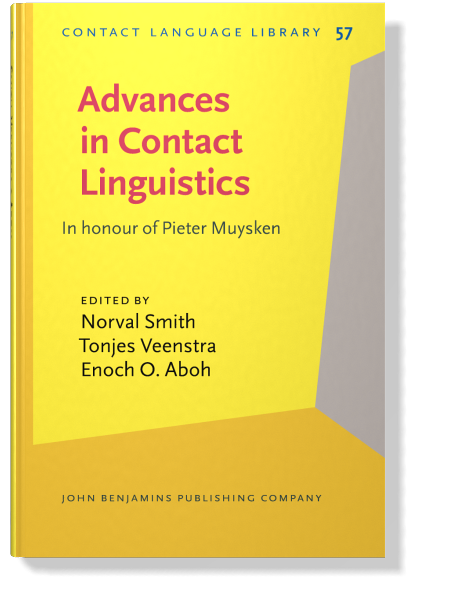
In:Advances in Contact Linguistics: In honour of Pieter Muysken
Edited by Norval Smith, Tonjes Veenstra and Enoch O. Aboh
[Contact Language Library 57] 2020
► pp. 1–34
IntroductionPieter C. Muysken
A brief biography, a language contact bibliography and a Festschrift summary
Published online: 29 October 2020
https://doi.org/10.1075/coll.57.int
https://doi.org/10.1075/coll.57.int
Article outline
- Introduction
- Part 1.Brief biography
- 1.1Birth
- 1.2University education
- 1.3Career
- Part 2.A language contact overview with bibliography
- 2.1Preoccupations
- 2.2Analysis of publications and editorial work
- 2.3Two examples of early seminal articles
- 2.4A provisional list of articles, authored and edited books involving Pieter C. Muysken’s language contact interests
- 2.4.1Pidgin & Creole studies
- 2.4.1.1Creole – Defining
- 2.4.1.2Pidgin & Creole – Detailed
- 2.4.2Language contact studies
- 2.4.3Bilingualism/multilingualism
- 2.4.4Code-switching/code-mixing
- 2.4.5Mixed language studies
- 2.4.6Areal linguistics
- 2.4.7The languages of immigrants
- 2.4.7.1Second language learning by foreign workers
- 2.4.7.2Ethnolects
- 2.4.7.3Heritage languages
- 2.4.8Regional studies (sub-continental)
- 2.4.9Borrowing
- 2.4.1Pidgin & Creole studies
- 2.5Final remarks
- Part 3.The Festschrift
- 3.1Creole languages and creole studies
- 3.1.1Moving into and out of Sranan: Multiple effects of contact (Essegbey & Bruyn)
- 3.1.2Sociolinguistic characteristics of the English-lexifier contact languages of West Africa (Yakpo)
- 3.1.3The quest for non-European creoles: Is Kukama (Brazil, Peru) a creole language? (Bakker)
- 3.1.4Are creoles a special type of language? Methodological issues in new approaches to an old question (Kouwenberg & Singler)
- 3.2Linguistic areas
- 3.2.1Separating layers of information: The anatomy of contact zones (van Gijn)
- 3.2.2Areal diffusion of applicatives in the Amazon (Crevels & van der Voort)
- 3.2.3Transfer of Swahili ‘until’ in contact with East African languages (Mous)
- 3.3Mixed languages and language mixing
- 3.3.1Turkish-German code-switching patterns revisited: What naturalistic data can(not) tell us (Treffers-Daller)
- 3.3.2Mixing and Semantic Transparency in the genesis of Yilan Japanese (Rojas Berscia)
- 3.3.3Pottefers Cant, Groenstraat Bargoens, and the development of “have” and “be” in the wider context of contact (Smith & Hinskens)
- 3.4Sociolinguistic aspects of language contact
- 3.4.1Sociolinguistic enregisterment through languagecultural practices: (Cornips & de Rooij)
- 3.4.2Snow on the Danish Antilles? Referee design in Virgin Island Dutch Creole (van Rossem)
- 3.1Creole languages and creole studies
Acknowledgements Notes References

References (9)
Blasí, D. E., Michaelis, S. M. & Haspelmath, M. 2017. Grammars are robustly transmitted even during the emergence of creole languages. Nature Human Behaviour 1: 723–729.
Daniëlsen, S., Dunn, M. J., Muysken, P. 2011. The spread of the Arawakan languages: A view from structural phylogenetics. In Ethnicity in Ancient Amazonia: Reconstructing Past Identities from Archeology, Linguistics, and Ethnohistory, A. Hornborg & J. D. Hill (eds), 173–196. Boulder CO: University of Colorado Press.
Muysken, P. C. 1981. Halfway between Quechua and Spanish: The case for relexification. In Historicity and Variation in Creole Studies, A. Highfield & A. Valdman (eds), 52–78. Ann Arbor MI: Karoma.
1988. Are creoles a special type of language? In Linguistics: The Cambridge Survey, Vol. 2, F. J. Newmeyer (ed.), 285–307. Cambridge: CUP.
Cited by (1)
Cited by one other publication
Bakker, Peter
This list is based on CrossRef data as of 8 december 2025. Please note that it may not be complete. Sources presented here have been supplied by the respective publishers. Any errors therein should be reported to them.