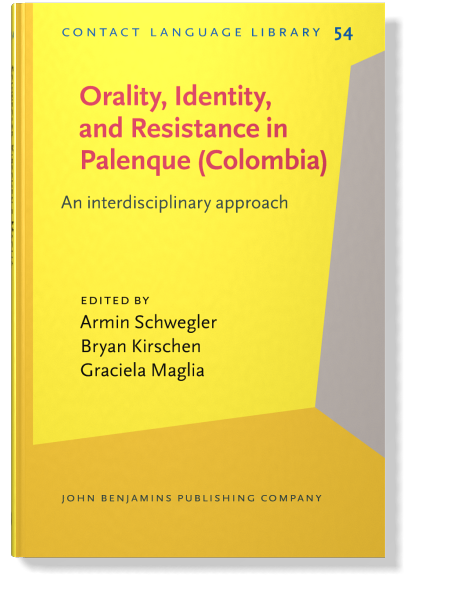
In:Orality, Identity, and Resistance in Palenque (Colombia): An interdisciplinary approach
Edited by Armin Schwegler, Bryan Kirschen and Graciela Maglia
[Contact Language Library 54] 2017
► pp. 15–50
Chapter 1Past, present, and future of Palenquero creole
Published online: 19 December 2017
https://doi.org/10.1075/coll.54.01mon
https://doi.org/10.1075/coll.54.01mon
Abstract
This article examines the current usage of the creole language of Palenque. To properly contextualize the topic in time and space, the study presents various aspects of Palenquero language and culture, linking them with the history and language use of other Afro-Colombian communities. I present an overview of Palenque’s oral history, which is then assessed in light of colonial archival records. Thereafter, attention is turned to the genesis and composition of the creole, in an effort to demonstrate that it must be considered a Neo-Romance vernacular, regardless of its rather minor linguistic African legacy. That legacy is traceable to a single sub-Saharan language, i.e. Kikongo. An attempt is made to offer a hypothesis for the unexpected uniformity of this African substrate. The sociolinguistic description of Palenque’s creole and Spanish bilingualism is at the core of this study. An effort is made to describe Palenqueros’ self-perception of their past and current language use. I claim that today’s relatively small proportion of fluent creole speakers, and the teaching of Palenquero as an L2 in Palenque’s secondary school, are two outward signs that the prospects for the creole’s survival are slim. This I argue in spite of recent community-based efforts to revitalize the creole, which has received support from UNESCO’s declaration in 2008 of Palenque as “Masterpiece of the Intangible Heritage of Humanity.” Finally, a theoretical analysis of orality, oral literature and “orature” will lead to a proposal to revitalize the use of the creole language.
Keywords: Congo, creole languages, metalanguage, orality, Palenquero, sociolinguistics
Article outline
- 1.Introduction
- 2.Palenque in Colombia
- 3.The creole language of Palenque
- 4.Present and future of the Palenquero language
- 5.Final considerations
Acknowledgments Abbreviations Notes References

References (51)
Ansari Pour, N. 2011. Human Genetic Variation, Relationships of Peoples of sub-Saharan Africa and Implications for Healthcare. PhD dissertation, University College London (Centre for Genetic Anthropology, Department of Genetics, Evolution and Environment). (Originally completed in 2010; slight revisions made in 2011).
Ansari Pour, N., Moñino, Y., Bradman, N. et al. 2016. Palenque de San Basilio in Colombia: Genetic data supports an oral history of a paternal ancestry in Congo. Proceedings of the Royal Society B (no Vol. number): 1–11. <>
Arrázola, R. 1970. Palenque, primer pueblo libre de América: história de las sublevaciones de los esclavos de Cartagena. Cartagena: Hernández.
Bickerton, D. & Escalante, A. 1970. Palenquero: A Spanish-based creole of northern Colombia. Lingua 24: 254–267.
Borrego Plá, C. 1973. Palenques de negros en Cartagena de Indias a fines del siglo XVII. Seville: Escuela de Estudios Hispano-Americanos.
Cunin, E. 2000. Le métissage dans la ville. Apparences raciales, ancrage territorial et construction de catégories à Cartagena (Colombie). PhD dissertation, Université de Toulouse Le Mirail. (In Spanish: (2003). Identidades a flor de piel. Lo ‘negro’ entre apariencias y pertenencias: mestizaje y categorías raciales en Cartagena (Colombia). Bogotá: ifea-icanh-uniandes-Observatorio del Caribe Colombiano).
De Boek, P. 1904. Grammaire et vocabulaire du lingala, ou langue du Haut-Congo. Brussels: Polleunis & Ceuterick.
Del Castillo Mathieu, N. 1984. El léxico negro-africano de San Basilio de Palenque. Thesaurus 39: 80–169.
Dieck, M. 2002. Distribución y alcance de la negación en palenquero. In Moñino & Schwegler (eds), 149–167.
Escalante, A. 1954. Notas sobre el Palenque de San Basilio, una comunidad negra de Colombia. Divulgaciones Etnológicas 3: 207–358.
de Friedemann, N. & Patiño Rosselli, C. 1983. Lengua y sociedad en el Palenque de San Basilio. Bogotá: Instituto Caro y Cuervo.
de Granda, G. 1968. La tipología “criolla” de dos hablas del área lingüística hispánica. Thesaurus 23: 193–205.
Jacobson, A. 1978. Symbolisme des couleurs et ordre social. Le culte nkisi chez les Bakongo (Afrique centrale). In Voir et nommer les couleurs, S. Tornay (ed.), 525–551. Nanterre: Labethno-Université Paris 10.
Le Page, R. & Tabouret-Keller, A. 1985. Acts of Identity: Creole-based Approaches to Language and Ethnicity. Cambridge: CUP.
Maglia, G. & Schwegler, A. (eds). 2012. Palenque (Colombia): oralidad, identidad y resistencia. Un enfoque interdisciplinario. Bogotá: Instituto Caro y Cuervo & Universidad Javeriana.
McWhorter, J. & Parkvall, M. 2002. Pas tout à fait du français: Une étude créole. Études Créoles 15(1): 179–231.
2002. Las construcciones de genitivo en palenquero: ¿una semantaxe africana? In Moñino & Schwegler (eds), 227–248.
2003. Lengua e identidad afroamericana: el caso del criollo de Palenque de San Basilio (Colombia). In Caminos cruzados, C. Alès & J. Chiappino (eds), 517–531. Paris: IRD – Éditions & Caracas: ULA – Grial.
2004. Une autre conception des lumières. Sur les noms de couleur en gbaya. In Du terrain au cognitif. Linguistique, ethnolinguistique, ethnosciences, E. Motte-Florac & G. Guarisma (eds), 241–266. Paris: Peeters.
2005. Citation, métalangage et autonymie en gbaya ’bodoe de Centrafrique. Histoire. Épistémologie. Langage 17(1): 115–126.
2007. Cruces lingüísticos iberocongoleses en palenquero: ¿integrarse a la sociedad mayoritaria o distinguirse de ella? In Lenguas en contacto en el Caribe y más allá, M. Sokol & W. Mihatsch (eds), 37–59. Frankfurt: Peter Lang.
Moñino, Y. & Ortiz, C. 1999. Réévaluation de deux procédés de morphologie évaluative en palenquero. SiLeXicales 2: La morphologie des dérivés évaluatifs, 253–261. [Lille: UMR 8528 du CNRS, Université de Lille III)]
Moñino, Y. & Schwegler, A. (eds). 2002. Palenque, Cartagena y Afrocaribe. Historia y lengua. Tübingen: Niemeyer.
Moscovici, S. 1994. Three concepts: Minority, conflict, and behavioural style. In Minority Influence, S. Moscovici, A. Mucchi-Faina & A. Maass (eds), 233–251. Chicago IL: Nelson-Hall.
Moscovici, S., Mugny, G. & Van Avermaet, E. (eds). 1985. Perspectives on Minority Influence. Cambridge: CUP.
Navarrete, M. C. 2008. San Basilio de Palenque: Memoria y tradición. Surgimiento y avatares de las gestas cimarronas en el Caribe colombiano. Cali: Programa Editorial Universidad del Valle.
Noguera, M. C., Schwegler, A. & Gusmão, L. et al. 2014. Colombia’s population crucible: Y chromosome evidence from six admixed communities in the Department of Bolivar. Annals of Human Biology 41(5): 453–459. E-print version (11 November 2013). <[URL]>
Ochoa Franco, J. 1945. Palenque: un rincón de África en Colombia. Cartagena: Imprenta Departamental.
Perl, M. 2002. El pronombre personal en función de sujeto en palenquero, en el criollo de Santo Tomé, en el español popular caribeño y en el portugués popular de Angola. In Moñino & Schwegler (eds), 117–127.
de Sandoval, A. 1987. Un tratado sobre la esclavitud. Madrid: Alianza editorial. (Original edition 1627, De Instauranda Æthiopum Salute. Seville: Francisco de Lira).
Schwegler, A. 1993. Rasgos (afro-)portugueses en el criollo del Palenque de San Basilio (Colombia). In Homenaje a José Pérez Vidal, C. Díaz Alayón (ed.), 667–696. La Laguna, Tenerife: Litografía A. Romero S. A.
1996. “
Chi ma nkongo
”: lengua y rito ancestrales en El Palenque de San Basilio, 2 vols. Frankfurt: Vervuert.
1998. Palenquero. In América negra: panorámica actual de los estudios lingüísticos sobre variedades criollas y afrohispanas, M. Perl & A. Schwegler (eds), 220–291. Frankfurt: Vervuert & Madrid: Iberoamericana.
2001a. The myth of decreolization: The anomalous case of Palenquero. In Degrees of Restructuring in Creole Languages [Creole Language Library 22], I. Neumann-Holzschuh & E. Schneider (eds), 409–436. Amsterdam: John Benjamins.
2001b. Superstrate, substrate, convergence: On the multiple origins of Palenquero yo, y-, i- ‘I’. In “Was ich noch sagen wollte”, B. Igla & T. Stolz (eds), 249–272. Berlin: Akademie Verlag.
2002a. El vocabulario africano de Palenque. Segunda parte: compendio alfabético de palabras (con etimologías). In Moñino & Schwegler (eds), 171–226.
2002b. On the (African) origins of Palenquero subject pronouns. Diachronica 19(2): 273–332.
2006. Bantu elements in Palenque (Colombia): Anthropological, archeological and linguistic evidence. In African Re-Genesis: Confronting Social Issues in the Diaspora, J. Haviser & K. C. MacDonald (eds), 204–222. London: University College London Press.
2010. State of the Discipline. Pidgin and creole studies: Their interface with Hispanic and Lusophone linguistics. Studies in Hispanic and Lusophone Linguistics 3(2): 431–481.
Schwegler, A. & Morton, T. 2003. Vernacular Spanish in a microcosm: Kateyano in El Palenque de San Basilio (Colombia). Revista Internacional de Lingüística Iberoamericana (rili) 1: 97–159.
Cited by (2)
Cited by two other publications
Valdez Jiménez, Wendy, Mirian Díaz Pérez, Juan Diego Pulgarín Rivera & Johan De La Rosa Yacomelo
Parkvall, Mikael & Bart Jacobs
This list is based on CrossRef data as of 8 december 2025. Please note that it may not be complete. Sources presented here have been supplied by the respective publishers. Any errors therein should be reported to them.