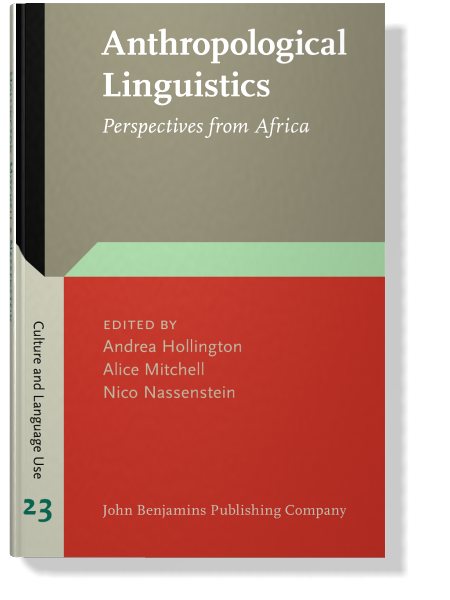
In:Anthropological Linguistics: Perspectives from Africa
Edited by Andrea Hollington, Alice Mitchell and Nico Nassenstein
[Culture and Language Use 23] 2024
► pp. 394–424
Get fulltext
Chapter 15Tail-head linkage in Upper Guinea Coast languages
The areal diffusion of pragmatic-syntactic structures (Baïnounk, Joola and Creoles)
Available under the Creative Commons Attribution-NonCommercial-NoDerivatives (CC BY-NC-ND) 4.0 license.
For any use beyond this license, please contact the publisher at rights@benjamins.nl.
Published online: 1 February 2024
https://doi.org/10.1075/clu.23.15cob
https://doi.org/10.1075/clu.23.15cob
Abstract
This paper draws attention to a phenomenon at the
intersection of pragmatics, discourse analysis and syntax known as tail-head
linkage (THL) in Baïnounk Gubëeher and other West African languages spoken
in Upper Guinea (Senegal, Guinea Bissau, Cabo Verde). THL is a discourse
feature common in narratives and procedural texts, whereby phrases or parts
of phrases are repeated in consecutive phrases to create discourse cohesion.
Largely absent from European languages, THL is common in languages of Papua,
Australia and the Amazon, but has not yet been described in depth for any
African or so-called Creole languages. However, these structures are well
attested in Atlantic languages spoken in the Casamance area and also in
various of the regional Portuguese based Creoles. As these languages are not
closely genetically related, THL is a good candidate for an areal feature.
Drawing on a corpus of transcribed texts in Baïnounk Gubëeher and Joola
Kujireray and Banjal as well as experimental data in those languages as well
as four varieties of Upper Guinea Creoles (Santo Antão, São Vicente,
Casamance, Bissau), the discursive function, frequency and the syntactic
strategies for the use of these structures are described and compared.
Article outline
- 1.Introduction
- 1.1Definitions and hypotheses
- 1.2Multilingualism and language ecology in Casamance
- 1.3The ethnographic picture of the Upper Guinea Coast
- 2.Constructions: THL in Upper Guinea languages
- 2.1Plain tail-head linkage
- 2.2Formally marked tail-head linkage
- 2.3Mixed linkage
- 2.4Summary linkage
- 3.Discussion
- 3.1Distribution and functions of THL
- 3.2THL and speech styles
- 4.Conclusion and future research
Notes Abbreviations References Appendix

References (55)
Aboh, E. O., Hartmann, K., & Zimmermann, M. (Eds.). (2007). Focus
strategies in African languages. De Gruyter Mouton.
Aikhenvald, A. Y. (2008). The
Manambu language of East Sepik, Papua New
Guinea. Oxford University Press.
(2019). Bridging
linkage in Tariana. An Arawak language from Northwest
Amazonia. International Journal of
American
Linguistics, 85(4), 455–496.
Alvanoudi, A. (2019). Clause
repetition as a tying technique in Greek
conversation. In V. Guérin (Ed.), Bridging
constructions (pp. 239–267). Language Science Press.
Baum, R. M. (1999). Shrines
of the slave trade. Diola religion and society in precolonial
Senegambia. Oxford University Press.
Berndt, W. (2010). A
cognitive approach to the functions of the particle me in
Joola-Banjal. In Proceedings
of the 6th WOCAL World Congress of African Linguistics, Cologne,
17–21 August
2009. Köppe.
Brooks, G. B. (1993). Landlords
and strangers. Ecology, society, and trade in Western Africa,
1000–1630. Westview Press.
Chafe, W. L. (Ed.). (1980). The
pear stories. Cognitive, cultural, and linguistic aspects of
narrative
production (Vol. 3). Praeger Pub Text.
Cobbinah, A. (2010). Casamance
as an area of intense language
contact. Journal of Language Contact
(THEMA
3), 175–201. Retrieved
on 23
February
2022 from [URL]
Cobbinah, A. Y. (2020). An
ecological approach to ethnic identity and language dynamics in a
multilingual area (Lower Casamance,
Senegal). In P. Di Carlo & J. Good (Eds.), African
multilingualisms. Rural linguistic and cultural
diversity (pp. 69–104). Lexington Books.
Cobbinah, A. Y., Hantgan, A., Lüpke, F., & Watson, R. (2016). Carrefour
des langues, carrefour des
paradigmes. In M. Auzeanneau, M. Bento, & M. Leclère (Eds.), Espace,
mobilités et éducation plurilingues. Éclairages d’Afrique ou
d’ailleurs (pp. 79–97). Édition des Archives Contemporaines.
Crowley, E. L. (1990). Contracts
with the spirit.: Religion, asylum, and ethnic identity in the
Cacheu Region of
Guinea-Bissau (Unpublished doctoral
dissertation). Yale University.
Enfield, N. J. (Ed.). (2002). Ethnosyntax:
Explorations in grammar and
culture. Oxford University Press.
Frusoni, S., & Lima, M. (1992). A
poética de Sérgio Frusoni. Uma leitura
antropológica. Instituto de Cultura e Língua Portuguesa.
Goodchild, S., & Weidl, M. (2018). Translanguaging
practices in the Casamance, Senegal: Similar but different; two case
studies. In E. Adami & A. Sherris (Eds.), Making
signs, translanguaging ethnographies: Exploring urban, rural, and
educational
spaces (pp. 133–151). Multilingual Matters.
Goodchild, S. (2019). Sociolinguistic
spaces and multilingualism. Practices and perceptions in Essyl,
Senegal (Unpublished doctoral
dissertation). SOAS, University of London.
Guérin, V., & Aiton, G. (2019). Bridging
constructions in typological
perspective. In V. Guérin (Ed.), Bridging
constructions (pp. 1–44). Language Science Press.
Guillaume, A. (2011). Subordinate
clauses, switch-reference, and tail-head linkage in Cavineña
narratives. In R. van Gijn, K. Haude, & P. Muysken (Eds.), Subordination
in Native South American
languages (pp. 109–139). John Benjamins.
Hale, K. (1986). Notes
on world view and semantic categories: some Warlpiri
examples. In P. Muysken & H. van Riemsdijk (Eds.), Features
and
projections (pp. 233–254). Foris.
Hawthorne, W. (2003). Planting
rice and harvesting slaves: Transformations along the Guinea-Bissau
Coast,
1400–1900. Heinemann.
Jacobs, B. (2010). Upper
Guinea Creole: Evidence in favor of a Santiago
birth. Journal of Pidgin and Creole
Languages, 25(2), 289–343.
Kihm, A. (2011). Substrate
Influences in Kriyol: Guinea-Bissau and Casamance Portuguese related
Creole. In C. Lefebvre (Ed.), Creoles,
their substrates, and language
typology (pp. 81–104). John Benjamins.
Kopytoff, I. (Ed.) (1987). The
African frontier. The reproduction of traditional African
societies. Indiana University Press.
Lang, J. (2011). A
Wolof trace in the verbal system of the Portuguese Creole of
Santiago Island (Cape
Verde). In C. Lefebvre (Ed.), Creoles,
their substrates, and language
typology (pp. 61–80). John Benjamins.
Longacre, R. E. (1968). Philippine
languages. Discourse, paragraph and sentence
structure. Summer Institute of Linguistics.
Lüpke, F. (2016a). Pure
fiction – The interplay of indexical and essentialist language
ideologies and heterogeneous practices: A view from
Agnack. In M. Seyfeddinipur (Ed.), African
language documentation. New data, methods and
approaches (pp. 8–39). University of Hawai’i.
Lüpke, Friederike. (2016b). Uncovering
small-scale multilingualism. Critical
Multilingualism
Studies, 4(2), 35–74.
Mark, P. (2002). “Portuguese”
style and Luso-African identity. Precolonial Senegambia,
Sixteenth–Nineteenth
Centuries. Indiana University Press.
McKay, G. (2008). Cohesive
features in Rembarrnga
narratives. In T. J. Curnow (Ed.), Selected
papers from the 2007 conference of the Australian Linguistic
Society.
Nicolle, S. (2015). A
comparative study of eastern Bantu narrative
texts. Electronic Working
Papers 2015–003. SIL International.
Nunez, J. J.-F. (2015). L’alternance
entre créole afro-portugais de Casamance, français et wolof au
Sénégal. Une contribution trilingue à l’étude du contact de
langues (Unpublished doctoral
dissertation). Université Sorbonne Paris Cité & Université Cheikh Anta Diop (Dakar).
Obert, K. (2019). The
linguistic encoding of space in
Dâw (Unpublished doctoral
dissertation). University of São Paulo.
(Forthcoming). How
to not lose the track: Tail-Head Linkage as a mechanism for
maintaining cohesion of spatial information in Dâw
narratives. Boletim do Museu Paraense
Emílio Goeldi. Ciências Humanas.
Pike, K. L. (1966). Tagmemic
and matrix linguistics applied to selected African
languages. University of Michigan.
Quint, N. (2006). Un
bref aperçu des racines africaines de la langue
cap-Verdienne. In J. Lang, J. Holm, J.-L. Rougé, & M. J. Soares (Eds.), Cabo
Verde. Origens da sociedade e seu
crioulo (pp. 63–74). Gunter Narr.
(2009). African
words and calques in Cape Verdean Creole (Santiago
dialect). In P. Baker & A. Bartens (Eds.), Black
through White. African words and calques in Creoles and transplanted
European
languages (pp. 3–29). Battlebridge.
Sarvasy, H. (2019). Short,
finite and one-sided bridges in
Logoori. In V. Guérin (Ed.), Bridging
constructions (pp. 79–98). Language Science Press.
Scott, J. C. (2009). The
art of not being governed: An anarchist history of upland Southeast
Asia. Yale University Press.
Sherzer, J. (1987). Discourse-centered
approach to language and
culture. American
Anthropologist, 89(2), 295–309.
Swolkien, D., & Cobbinah, A. (2019). Cape
Verdean Creole – Santo Antão: What we know so
far. In T. Hagemeijer, C. Truppi, F. Pratas, H. Cardoso, & N. Alexandre (Eds.), Lives
in contact: A tribute to nine fellow
Creolinguists (pp. 162–193). Edições Colibri.
Valdman, A. (1988). Ann
pale kreyòl. An introductory course in Haitian
Creole. Indiana University Press.
Vanhove, M. (2005). Du
lien entre propositions temporelles et anaphore en
bedja. In A. Mengozzi (Ed.), Studi
Afroasiatici. XI Incontro Italiano de Linguistica
Camitosemitica (pp. 153–166). Francoangeli.
Vries, L. de. (2005). Towards
a typology of tail-head linkage in Papuan
languages. Studies in
Language, 29(2), 363–384.
Watson, R. (2018). Patterns
of lexical correlation and divergence in
Casamance. Language &
Communication, 62(B), 170–183.
(2019). Language
as category: Using prototype theory to create reference points for
the study of multilingual
data. Language and
Cognition, 11(1), 125–164.
Weidl, M. (2019). The
role of Wolof in multilingual conversations in the Casamanceː
Fluidity of linguistic
repertoires (Unpublished doctoral
dissertation). SOAS, University of London.
Wierzbicka, A. (1988). The
semantics of grammar. John Benjamins.
(1979). Ethno-syntax
and the philosophy of
grammar. Studies in
Language, 3(3), 313–383.
Cited by (1)
Cited by one other publication
This list is based on CrossRef data as of 8 december 2025. Please note that it may not be complete. Sources presented here have been supplied by the respective publishers. Any errors therein should be reported to them.