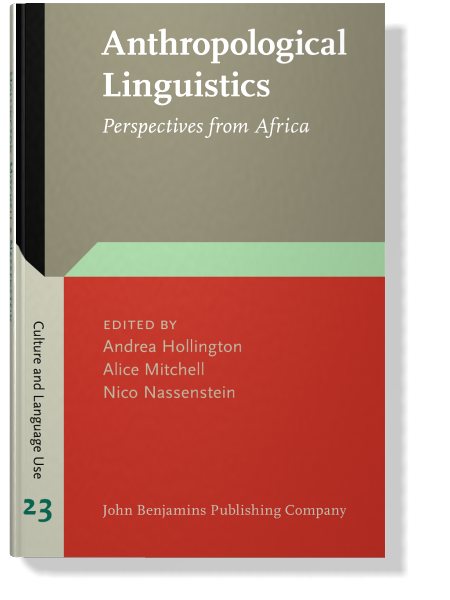
In:Anthropological Linguistics: Perspectives from Africa
Edited by Andrea Hollington, Alice Mitchell and Nico Nassenstein
[Culture and Language Use 23] 2024
► pp. 49–82
Get fulltext
Chapter 3A cautious approach to spatial orientation in Tima
Available under the Creative Commons Attribution-NonCommercial-NoDerivatives (CC BY-NC-ND) 4.0 license.
For any use beyond this license, please contact the publisher at rights@benjamins.nl.
Published online: 1 February 2024
https://doi.org/10.1075/clu.23.03ala
https://doi.org/10.1075/clu.23.03ala
Abstract
This study investigates two subdomains within the
semantic field of space among the Tima in Sudan: first, topology (and
toponymy), and second, frames of reference. Like many European languages,
Tima uses adpositions to indicate a goal/location and a source. Furthermore,
Tima uses locative prefixes (remnants of a noun class system) to designate
an area. With respect to frames of reference, we show that Tima uses a mixed
system, availing of all major frames, i.e., absolute, intrinsic, and
relative. The data at our disposal suggests that mobility as well as the
shape of figure and ground play a role in the encoding of spatial relations
in Tima, a hypothesis which needs testing with more data.
Keywords: spatial reference, Tima (Niger-Congo)
Article outline
- 1.Introduction
- 2.Background information on Tima
- 3.Topology (and a glance at toponymy)
- 3.1Locative prefixes
- 3.2Prepositions
- The source marker a=
- The goal marker V=
- 3.3Further spatial expressions
- 4.Frames of reference
- 4.1Absolute frame of reference
- 4.2Intrinsic frame of reference
- 4.3Relative frame of reference
- 5.Conclusion and outlook
Acknowledgements Notes Abbreviations References

References (29)
Alamin, S., Schneider-Blum, G., & Dimmendaal, G. J. (2012). Finding
your way in
Tima. In A. Mietzner & U. Claudi (Eds.), Directionality
in grammar and discourse: Case studies from
Africa (pp. 9–33). Köppe.
Brown, P. (2015). Space,
linguistic expression
of. In J. D. Wright (Ed.), International
encyclopedia of the social and behavioral
sciences (2nd
ed., Vol. 23, pp. 89–93. Elsevier.
Casaretto, A., Dimmendaal, G. J., Hellwig, B., Reinöhl, U., & Schneider-Blum, G. (2020). Roots
of ergativity in Africa (and
beyond). Studies in African
Linguistics, 49(1), 111–140.
Danziger, E. (2010). Deixis,
gesture, and cognition in spatial frame of reference
typology. Studies in
Language, 34, 167–185.
Dimmendaal, G. J. (2009). Tima. In G. J. Dimmendaal (Ed.), Coding
participant marking. Construction types in twelve African
languages (pp. 331–353). John Benjamins.
(2014). Where
have all the noun classes gone in
Tima? In C. de Feral, M. Kossmann, & M. Tosco (Eds.), In
and out of Africa. Languages in question in honour of Robert Nicolaï.
Vol. 2: Contact and language change in
Africa (pp. 103–125). Peeters.
Dimmendaal, G. J., & Rottland, F. (1996). Projective
space and spatial orientation in some Nilotic and Surmic
languages. In P. Zima (Ed.), Space
and direction in
languages (pp. 66–78). Institute of Advanced Studies at Charles University and Academy of Sciences of the Czech Republic.
Dimmendaal, G. J., & Schneider-Blum, G. (accepted). Locative expressions and their semantic extensions in Tima.
Dimmendaal, G. J., Veit, N., & Schneider-Blum, G. (in
preparation). Locatives as core arguments in Tima.
Himmelmann, N. P., & Primus, B. (2015). Prominence
beyond prosody. A first
approximation. In A. De Dominicis (Ed.), pS-prominenceS.
Prominences in
linguistics (pp. 38–58). DISUCOM.
Levinson, S. C. (1996). Frames
of reference and Molyneux’s question: Crosslinguistic
evidence. In P. Bloom, M. A. Peterson, L. Nadel, & M. F. Garrett (Eds.), Language
and
space (pp. 109–169). The MIT Press.
Meerpohl, M. (2012). The
Tima of the Nuba Mountains (Sudan) – A social anthropological
study. Köppe.
Mietzner, A. 2012. Spatial orientation in Nilotic languages and the forces of innovation. In Mietzner, A. and U. Claudi (Eds.), Directionality in grammar and discourse: Case studies from Africa (pp. 165–175). Köppe.
Schneider-Blum, G. (2011). Noun
phrase – compound – noun: Some problems with compounds in
Tima. In R. Kramer, H. Tröbs, & R. Kastenholz (Eds.), Afrikanische
Sprachen im
Fokus (pp. 239–256). Köppe.
(2013a). A
Tima-English
dictionary. Köppe. Also
online; retrieved on 17 June
2023 from [URL]
(2013b). Personal
pronouns in
Tima. In T. C. Schadeberg & R. M. Blench (Eds.), Nuba
mountain language
studies (pp. 281–296). Köppe.
Schneider-Blum, G., & Hellwig, B. (2018). Reference
tracking in Tima and its interplay with ergative
marking. Studies in
Language 42(4): 970–993.
Senft, G. (1997). Introduction. In G. Senft (Ed.), Referring
to space. Studies in Austronesian and Papuan
languages (pp. 1–38). Clarendon Press.
Skopeteas, S., Fiedler, I., Hellmuth, S., Schwarz, A., Stoel, R., Fanselow, G., Féry, C., & Krifka, M. (2006). Questionnaire
on Information Structure: Reference
manual. Universitätsverlag Potsdam.
Svorou, S. (1994). The
grammar of space. John Benjamins.
Cited by (1)
Cited by one other publication
Dimmendaal, Gerrit J. & Gertrud Schneider-Blum
2024. Locative expressions and their semantic extensions in Tima. In Predication in African Languages [Studies in Language Companion Series, 235], ► pp. 44 ff.
This list is based on CrossRef data as of 8 december 2025. Please note that it may not be complete. Sources presented here have been supplied by the respective publishers. Any errors therein should be reported to them.