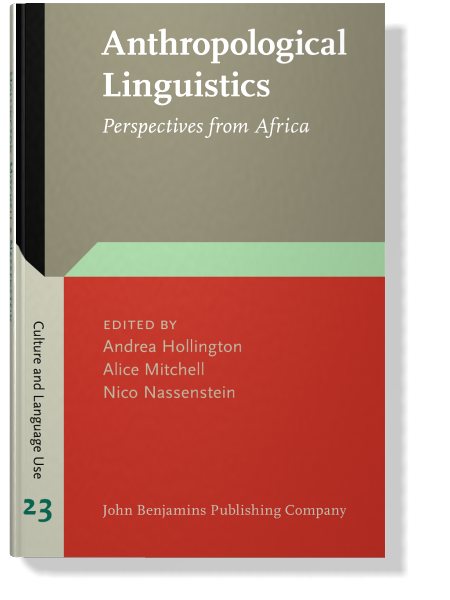
In:Anthropological Linguistics: Perspectives from Africa
Edited by Andrea Hollington, Alice Mitchell and Nico Nassenstein
[Culture and Language Use 23] 2024
► pp. 1–28
Get fulltext
Chapter 1Introduction
Available under the Creative Commons Attribution-NonCommercial-NoDerivatives (CC BY-NC-ND) 4.0 license.
For any use beyond this license, please contact the publisher at rights@benjamins.nl.
Published online: 1 February 2024
https://doi.org/10.1075/clu.23.01nas
https://doi.org/10.1075/clu.23.01nas
Abstract
The study of African languages, cultural practices and
speakers’ conceptualizations is complex and multilayered. This introductory
chapter provides an overview of the goals and scope of the volume. It also
offers a short historical survey of anthropological linguistics as well as
some reflections on the forms this field of enquiry has taken in relation to
African languages. We discuss the structure of the volume, including chapter
summaries and intersections, and conclude with some remarks on the future of
the anthropological linguistics of Africa.
Article outline
- 1.Goals and scope
- 2.Anthropological linguistics in historical context
- 3.Anthropological linguistics in African contexts
- 4.Contents and organization of the volume
- 4.1Time, space, and language
- 4.2Personhood, sociality, and naming
- 4.3Perception and classification
- 4.4Sociocultural dimensions of discourse structure
- 5.Whither anthropological linguistics?
Notes References

References (129)
Abun-Nasr, S. (1998). Von
der ‘Umbildung heidnischer Landessprachen zu christlichen” – die
Anfänge von Schrift und Schriftlichkeit in Akuapem,
Goldküste. In R. Wendt (Ed.), Wege
durch Babylon. Missionare, Sprachstudien und interkulturelle
Kommunikation (pp. 181–220). Narr.
Alim, H. S., Rickford, J. R., & Ball, A. F. (Eds.) (2016). Raciolinguistics:
How language shapes our ideas about
race. Oxford University Press.
Alphonce, C., & Sane, E. (2019). Toponyms
and identity in Hanang’ District: Their origin and
meaning. Ethnologia
Actualis, 19(1), 106–116.
Ameka, F. K. (2002). Cultural
scripting of body parts for emotions: On ‘jealousy’ and related
emotions in Ewe. Pragmatics &
Cognition, 10(1–2), 27–55.
Ameka, F. K., & Amha, A. (2022). Research
on language and culture in
Africa. In S. Völkel & N. Nassenstein (Eds.), Approaches
to language and
culture (pp. 339–384). De Gruyter Mouton.
Austin, J. L. (1962). How
to do things with words. The William James Lectures delivered at
Harvard University in
1955. Clarendon Press.
Bauman, R., & Sherzer, J. (Eds.). (1989). Explorations
in the ethnography of speaking (2nd
ed.). Cambridge University Press.
Bauman, R. & Briggs, C. L. (2003). Voices
of modernity: Language ideologies and the politics of
inequality. Cambridge University Press.
Berlin, B., & Kay, P. (1969). Basic
color terms: Their universality and
evolution. University of California Press.
Bisilki, A. K., & Yakpo, K. (2021). ‘The
heart has caught me’: Anger metaphors in Likpakpaln
(Konkomba). Sociolinguistic
Studies, 15(1), 65–89.
Boas, F. (1911). Introduction. In F. Boas (Ed.), Handbook
of American Indian
languages (pp. 5–83). Smithsonian Institution.
Brown, R. W., & Lenneberg, E. H. (1958). Studies
in linguistic
relativity. In E. E. Maccoby, T. M. Newcomb, & E. L. Hartley (eds.), Readings
in social
psychology (pp. 9–18). Holt, Rinehart and Winston.
Bucholtz, M. (2010). White
kids: Language, race, and styles of youth
identity. Cambridge University Press.
Bucholtz, M., & Hall, K. (2008). All
of the above: New coalitions in sociocultural
linguistics. Journal of
Sociolinguistics, 12(4), 401–431.
Comaroff, K., & Comaroff, J. L. (2012). Theory
from the south. Or, how Euro-America is evolving toward
Africa. Paradigm.
Connell, R. (2007). Southern
theory. The global dynamics of knowledge in social
science. Polity Press.
Copland, F., Creese, A., Rock, F., & Shaw, S. (2015). Linguistic
ethnography: Collecting, analysing and presenting
data. Sage.
Deumert, A., Storch, A. & Shepherd, N. (Eds.) (2020). Colonial
and decolonial linguistics: Knowledges and
epistemes. Oxford University Press.
D’hondt, S. (2019). Situated
language use in
Africa. In H. E. Wolff (Ed.), The
Cambridge handbook of African
linguistics (1st
ed., pp. 491–512). Cambridge University Press.
Diabah, G., & Appiah Amfo, N. A. (2015). Caring
supporters or daring usurpers? Representation of women in Akan
proverbs. Discourse &
Society, 26(1), 3–28.
Dimmendaal, G. J. (1995). Studying
lexical-semantic fields in languages: Nature versus nurture, or
where does culture come in these
days? Frankfurter Afrikanistische
Blätter, 7, 1–29.
(2002). Colourful
psi’s sleep furiously: Depicting emotional states in some African
languages. Pragmatics &
Cognition, 10(1–2), 57–83.
Duranti, A. (1997). Universal
and culture-specific properties of
greetings. Journal of Linguistic
Anthropology, 7(1), 63–77.
Ebenso, B., Adeyemi, G., Adegoke, A. O., & Emmel, N. (2012). Using
indigenous proverbs to understand social knowledge and attitudes to
leprosy among the Yoruba of southwest
Nigeria. Journal of African Cultural
Studies, 24(2), 208–222.
Engelbert, S., Mühlhäusler, P., Stolberg, D., Stolz, T., & Warnke, I. H. (Eds.). Colonial
and postcolonial linguistics [Book
series]. De Gruyter.
Evans, Nicholas. 2003. Context, Culture, and structuration in the languages of Australia. Annual Review of Anthropology 32: 13–40.
Evans-Pritchard, E. E. (1929). Some
collective expressions of obscenity in
Africa. The Journal of the Royal
Anthropological Institute of Great Britain and
Ireland, 59, 311–331.
(1934). Imagery
in Nģok Dinka cattle-names. Bulletin
of the School of Oriental and African
Studies, 7(3), 623–628.
(2012). Anthropological
linguistics. In C. A. Chapelle (Ed.), The
encyclopedia of applied
linguistics. John Wiley & Sons.
Friedrich, P. (1989). Language,
ideology, and political
economy. American
Anthropologist, 91(2), 295–312.
Gal, S., & Irvine, J. T. (2019). Signs
of difference: Language and ideology in social
life. Cambridge University Press.
Goodchild, S., & Weidl, M. (2018). Translanguaging
practices in the Casamance, Senegal: Similar but different: Two case
studies. In A. Sherris & E. Adami (Eds.), Making
signs, translanguaging ethnographies: Exploring urban, rural and
educational
spaces (pp. 133–151). Multilingual Matters.
Gumperz, J. J., & Hymes, D. (Eds.). (1972). Directions
in sociolinguistics; the ethnography of
communication. Holt, Rinehart and Winston.
Gumperz, J. J., & Levinson, S. C. (Eds.). (1996). Rethinking
linguistic relativity. Cambridge University Press.
Haugh, M., Kádár, D. Z., & Terkourafi, M. (Eds.) (2021). The
Cambridge handbook of
sociopragmatics. Cambridge University Press.
Heine, B., & Leyew, Z. (2007). Is
Africa a linguistic
area? In B. Heine & D. Nurse (Eds.), A
linguistic geography of
Africa (pp. 15–35). Cambridge University Press.
Hillewaert, S. (2016). Tactics
and tactility: A sensory semiotics of handshakes in coastal
Kenya. American
Anthropologist, 118(1), 49–66.
Hollington, A. (2015). Traveling
conceptualizations. A cognitive and anthropological linguistic study
of Jamaican. John Benjamins.
(2017). Emotions
in Jamaican: African conceptualizations, emblematicity and
multimodality in discourse and public
spaces. In A. Storch (Ed.), Consensus
and dissent. Negotiating emotion in the public
space (pp. 81–104). John Benjamins.
(2021). The
constructed other as historical source: Reclaiming linguistic
African roots in the
diaspora. Journal of Postcolonial
Linguistics, 4, 41–58.
Hollington, A., & Storch, A. (Eds.) (2016). Language
ideologies. Guest-edited special
issue of Critical Multilingualism
Studies, 4(2).
Hymes, D. (1962). The
ethnography of
speaking. In W. C. Gladwin & T. Sturtevant (Eds.), Anthropology
and human
behaviour (Vol. 13, pp. 11–74). Anthropological Society of Washington.
(1972a). Models
of the interaction of language and social
life. In J. J. Gumperz & D. Hymes (Eds.), The
ethnography of
communication (pp. 35–71). Holt, Rinehart & Winston.
(1972b). On
communicative
competence. In J. B. Pride & J. Holmes (Eds.), Sociolinguistics.
Selected
readings (pp. 269–293). Penguin.
Irvine, J. T. (1974). Strategies
of status manipulation in the Wolof
greeting. In R. Bauman & J. Sherzer (Eds.), Explorations
in the ethnography of
speaking (pp. 167–191). Cambridge University Press.
Jakobi, A. (1992). Ethnonyms
and language names as indicators of group identities – A case study
from the Nuba
Mountains. In Sudan:
Environment and People. Second International Sudan Studies
Conference, Conference
Papers (3, pp. 155–165). Sudan Archive, University of Durham.
Jim, R. L., & Webster, A. K. (2022). Native
North America: Notes towards a dialogical
ethnopoetics. In S. Völkel & N. Nassenstein (Eds.), Approaches
to language and
culture (pp. 385–424). De Gruyter Mouton.
Kövecses, Z. (2006). Language,
mind, and culture. A practical
introduction. Oxford University Press.
Kronenfeld, D. B. (2009). Fanti
kinship and the analysis of kinship
terminologies. University of Illinois Press.
Kroskrity, P. V. (2022). Language
ideologies and social
identities. In S. Völkel & N. Nassenstein (Eds.), Approaches
to language and
culture (pp. 101–126). De Gruyter Mouton.
Kroskrity, P. V., & Field, M. C. (Eds.) (2009). Native
American language ideologies. Beliefs, practices, and struggles in
Indian country. The University of Arizona Press.
Lentz, C. (2017). Culture: The making, unmaking and remaking of an anthropological concept. Zeitschrift
für
Ethnologie, 142(2), 181–204.
Levinson, S. C. (2000). Yeli
Dnye and the theory of basic color
terms. Journal of Linguistic
Anthropology, 10(1), 3–55.
Lucy, J. A. (1992). Language
diversity and thought. A reformulation of the linguistic relativity
hypothesis. Cambridge University Press.
(1996). Grammatical
categories and cognition. A case study of the linguistic relativity
hypothesis. Cambridge University Press.
(1997). The
linguistics of
“color”. In C. L. Hardin & L. Maffi (eds.), Color
categories in thought and
language (pp. 320 – 346). Cambridge University Press.
Lusekelo, Amani. 2021. Plant nomenclature and ethnobotany of the Hadzabe society of Tanzania. Talk given at Rift Valley Webinar Series 24/02/2021. Zenodo.
Malinowski, B. (1920). Classificatory
particles in the language of
Kiriwana. Bulletin of the School of
Oriental and African
Studies, I(IV), 33–78.
McIntosh, J. (2005). Liminal
meanings: Sexually charged Giriama funerary ritual and unsettled
participant frameworks. Language
&
Communication, 25(1), 39–60.
Meek, B. A. (2010). We
are our language. An ethnography of language revitalization in a
Northern Athabascan community. The University of Arizona Press.
Mensah, E., & Rowan, K. (2019). African
anthroponyms: Sociolinguistic currents and anthropological
reflections. Sociolinguistic
Studies, 13(2–4), 157–170.
Mietzner, A., & Treis, Y. (Eds.). (2008). Encoding
motion case studies from Africa. In memory of Ursula
Drolc. Köppe.
Mignolo, W. D. (2011). The
darker side of Western modernity. Global futures, decolonial
options. Duke University Press.
Mitchell, A., & Neba, A. N. (2019). Special-purpose
registers of language in
Africa. In H. E. Wolff (Ed.), The
Cambridge handbook of African
linguistics (1st
ed., pp. 513–534). Cambridge University Press.
Nassenstein, N. (2020). Pragmatics
in Bakuli: A linguistic ethnographer’s notes from the
neighborhood. Journal of Postcolonial
Linguistics, 2, 108–127.
Nassenstein, N., & Storch, A. (Eds.). (2020). Swearing
and cursing. Contexts and practices in a critical linguistic
perspective. De Gruyter Mouton.
Nassenstein, N., & Völkel, S. (2022). Studying
the relationship of language and culture: Scope and
directions. In S. Völkel & N. Nassenstein (Eds.), Approaches
to language and
culture (pp. 3–30). De Gruyter Mouton.
Okpewho, I. (1992). African
oral literature. Backgrounds, character, and
continuity. Indiana University Press.
Orwenjo, D. O. (2009). Political
grandstanding and the use of proverbs in African political
discourse. Discourse &
Society, 20(1), 123–146.
Owusu, M. (1978). Ethnography
of Africa: The usefulness of the
useless. American
Anthropologist, 80(2), 310–334.
Paris, D. (2011). Language
across difference. Ethnicity, communication, and youth identities in
changing urban schools. Cambridge University Press.
Pasch, H. (1994). Religiolekte
des
Sango. In T. Bearth, W. J. G. Möhlig, B. Sottas, & E. Suter (Eds.), Perspektiven
afrikanistischer Forschung, Beiträge zur Linguistik, Ethnologie,
Geschichte, Philosophie und Literatur. X. Afrikanistentag Zürich,
23.-25. September
1993. (pp. 271–288). Köppe.
(2019). ‘Head’
in some non-Bantu languages of the oriental province of DR
Congo. In I. Kraska (Ed.), Embodiment
in cross-linguistic studies. The
“head” (pp. 76–98). Brill.
Passmore, S., & Jordan, F. M. (2020). No
universals in the cultural evolution of kinship
terminology. Evolutionary Human
Sciences, 2.
Petrollino, S. (2022). The
Hamar cattle model: The semantics of appearance in a pastoral
linguaculture. Language
Sciences, 89, 101448.
Ponsonnet, M. (2018). A
preliminary typology of emotional connotations in morphological
diminutives and
augmentatives. Studies in
Language, 42(1), 17–50.
Pugach, S. (2012). Africa
in translation: A history of colonial linguistics in Germany and
beyond, 1814–1945. University of Michigan Press.
Quijano, A. (2000). Coloniality
of power, eurocentrism and Latin
America. Nepantla: Views from the
South, 1(3), 533–580.
Rampton, B. (2007). Neo-Hymesian
linguistic ethnography in the United
Kingdom. Journal of
Sociolinguistics, 11(5), 584–607.
Reyes, A. & Lo, A. (Eds.) (2009). Beyond
yellow English. Toward a linguistic anthropology of Asian Pacific
America. Oxford University Press.
Rosa, J. D. (2016). Standardization,
racialization, languagelessness: Raciolinguistic ideologies across
communicative contexts. Journal of
Linguistic
Anthropology, 26(2), 162–183.
Rüsch, M. (2020). A
conversational analysis of Acholi. Structure and socio-pragmatics of
a Nilotic language of
Uganda. Brill.
Sabino, R. (2018). Languaging
without languages: Beyond metro-, multi-, poly-, pluri- and
translanguaging. Brill.
Searle, J. R. (1969). Speech
acts. An essay in the philosophy of
language. Cambridge University Press.
Sharifian, F. (2011). Cultural
conceptualisations and language. Theoretical framework and
applications. John Benjamins.
Shaul, D. L. (2014). Linguistic
ideologies of Native American language revitalization. Doing the
lost language ghost
dance. Springer.
Silverstein, M. (2004). “Cultural”
concepts and the language-culture
nexus. Current
Anthropology, 45(5), 621–652.
Slobin, D. I. (1987). Thinking
for
speaking. In J. Aske (Ed.), Proceedings
of the Thirteenth Annual Meeting of the Berkeley Linguistics
Society (pp. 435–445). BLS.
(1996). From
‘thought and language’ to ‘thinking for
speaking.’ In J. J. Gumperz & S. C. Levinson (Eds.), Rethinking
linguistic
relativity (pp. 70–96). Cambridge University Press.
(2013). Knowing,
smelling, and telling tales in
Luwo. In A. Y. Aikhenvald & A. Storch (Eds.), Perception
and cognition in language and
culture (pp. 47–68). Brill.
(2014). A
grammar of Luwo. An anthropological
approach. John Benjamins.
(2020). Accomplished
works and facts: The family tree project of
Africanistics. In N. Shepherd, A. Deumert, & A. Storch (Eds.), Colonial
and decolonial linguistics. Knowledges and
epistemes (pp. 129–149). Oxford University Press.
Tedlock, D. (1983). The
spoken word and the work of
interpretation. University of Pennsylvania Press.
Whorf, B. L. (1956). Language,
thought and reality. Selected writings of Benjamin Lee
Whorf (J. B. Carroll, Ed.). The MIT Press.
Woldemariam, H. (2005). Historical
notes on numerals in Ometo: The obsolete quinary
system. Journal of Ethiopian
Studies, 38(1/2), 131–150.
Wyman, L. T., McCarty, T. L. & Nicholas, S. E. (Eds.) (2014). Indigenous
youth and multilingualism. Language identity, ideology, and practice
in dynamic cultural
worlds. Routledge.
Yankah, K. (1989a). Proverbs:
The aesthetics of traditional
communication. Research in African
Literatures, 20(3), 325–346.
(1995). Speaking
for the chief: Okyeame and the politics of Akan royal
oratory. Indiana University Press.
Cited by (1)
Cited by one other publication
This list is based on CrossRef data as of 8 december 2025. Please note that it may not be complete. Sources presented here have been supplied by the respective publishers. Any errors therein should be reported to them.