In:Cultural-Linguistic Explorations into Spirituality, Emotionality, and Society
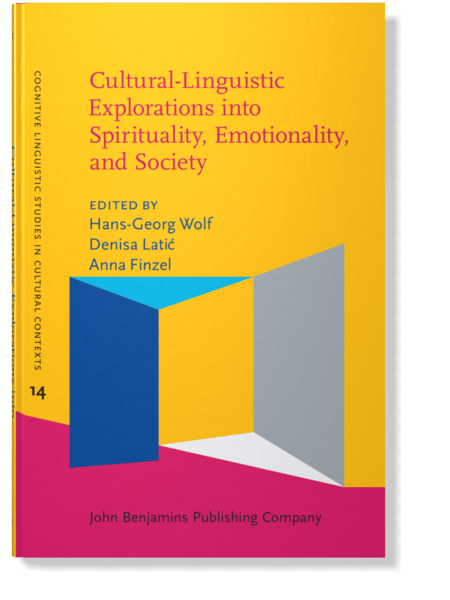
Edited by Hans-Georg Wolf, Denisa Latić and Anna Finzel
[Cognitive Linguistic Studies in Cultural Contexts 14] 2021
► pp. 9–22
Cultural Linguistics and religion
Published online: 8 September 2021
https://doi.org/10.1075/clscc.14.02sha
https://doi.org/10.1075/clscc.14.02sha
Abstract
Spiritual systems such as religions embody
particular worldviews or systems of conceptualizing life, death,
morality, creation, the life hereafter, fate, and so on. Since these
conceptualizations are more or less shared across any speech
community that believes in the same faith, religions can be viewed
as providing systems of cultural
conceptualizations. The analytical framework of Cultural
Linguistics should therefore be able to offer fruitful tools for
examining the language and conceptualizations associated with
spiritual systems. This chapter demonstrates this premise by
presenting a survey of the research on language and religion from
the perspective of Cultural Linguistics.
Article outline
- 1.Cultural Linguistics
- 2.Background
- 3.Conceptualizations relating to Sufi life
- 4.Conceptualizations relating to death in Buddhist and Christian eulogistic idioms
- 5.Conceptualizations relating to Sacred Sites in Aboriginal
English
- 5.1Aboriginal English
- 5.2Sacredness in Aboriginal English
- 6.Concluding remarks
References

References (51)
ABC. (2001). Australia’s sacred sites part 1. [URL] (accessed April 17, 2021)
Ahmadi, N., & Ahmadi, F. (1998). Iranian
Islam: The concept of the
individual. Basingstoke, UK: Palgrave MacMillan.
Can, S. (2005). Fundamentals
of Rumi’s thought: A Mevlevi Sufi
perspective (Z. Saritoprak, Ed.
and Trans.). New Jersey: The Light.
Chilton, P., & Kopytowska, M. (Eds.) (2018). Religion,
language, and the human
mind. Oxford: Oxford University Press.
Darquennes, J., & Vandenbussche, W. (2011). Band
25 (2011) Sprache und
religion / Language and religion / Langue et
religion. Berlin, Boston: De Gruyter.
Dingle, S. (2015). What is sacred now? Background briefing. [URL] (accessed April 17, 2021)
Eades, D. (1982). You
gotta know how to talk …: Ethnography of information seeking
in South-east Queensland Aboriginal
society. Australian Journal
of
Linguistics, 2: 61–82.
(1988). They
don’t speak an Aboriginal language, or do
they? In I. Keen (Ed.), Being
Black: Aboriginal cultures in ‘settled’
Australia. Canberra: Aboriginal Studies Press.
(1992). Aboriginal
English and the law: Communicating with Aboriginal English
speaking clients. A handbook for legal
practitioners. Brisbane: Queensland Law Society.
(1993). The
case for Condren: Aboriginal English, pragmatics and the
law. Journal of
Pragmatics, 20: 141–62.
(1994). A
case of communicative clash: Aboriginal English and the
legal
system. In J. Gibbons (Ed.), Language
and the
law (pp. 234–264). London: Longman.
(1995). Cross-examination
of Aboriginal children: The Pinkenba
case. Aboriginal Law
Bulletin, 3(75): 10–11.
(1996). Legal
recognition of cultural differences in communication: The
case of Robyn Kina. Language
and
Communication, 16: 215–27.
(2000). I
don’t think it’s an answer to the question: Silencing
Aboriginal witnesses in
court. Language in
Society, 29(2): 161–96.
Get Up! Australia (2009). Voices from the homeland. [URL] (accessed April 17, 2021).
Global Oneness Project (2009a). Major Sumner: Complete interview. [URL] accessed April 17, 2021).
(2009b). Max Harrison: Complete interview. [URL] (accessed April 17, 2021).
Habib, S. (2012). Meeting
the Prince of Darkness: A Semantic analysis of English
the Devil, Arabic
Ashaytân and Hewbrew
Hasatan. In G. Zuckermann (Ed.) Burning
issues in Afro-Asiatic
linguistics (pp. 123–160). Cambridge: Cambridge Scholarly Publishing.
(2018). Heaven
and hell: A cross-linguistic semantic
template for supernatural
places. RASK: International
Journal of Language and
Communication, 48, 1–29.
Harkins, J. (1990). Shame
and shyness in the Aboriginal classroom: A case for
practical
semantics. Australian Journal
of
Linguistics, 10, 293–306.
Kaldor, S., & Malcolm, I. G. (1991). Aboriginal
English – an
overview. In S. Romaine (Ed.), Language
in
Australia (pp. 67–83). Cambridge: Cambridge University Press.
Koch, H. (2000). Central
Australian Aboriginal English: In comparison with the
morphosyntactic categories of
Kaytetye. Asian
Englishes, 3(2), 32–59.
Lu, W. (2017). Cultural
conceptualisations of death in Taiwanese Buddhist
and Christian Eulogistic
idioms. In F. Sharifian (Ed.), Advances
in Cultural
Linguistics (pp. 49–64). Cham, CH: Springer.
Malcolm, I. G. (1994a). Aboriginal
English inside and outside the
classroom. Australian Review
of Applied
Linguistics, 17(2), 147–80.
(1994b). Discourse
and discourse strategies in Australian Aboriginal
English. World
Englishes, 13(3), 289–306.
(2001). Aboriginal
English: Adopted code of a surviving
culture. In D. Blair & P. Collins (Eds.), English
in
Australia (pp. 201–222). Amsterdam: John Benjamins.
(2004). Australian
creoles and Aboriginal English: Morphology and
syntax. In B. Kortmann, K. Burridge, R. Mesthrie, E. W. Schneider, & C. Upton (Eds.), A
handbook of varieties of English, Volume 2: Morphology and
syntax (pp. 657–681). Berlin: Mouton de Gruyter.
Nūrbakhsh, J. (1992). The
psychology of sufism (Del va
nafs). London: Khaniqahi Nimatullahi Publications.
Omoniyi, T., & Fishman, J. A. (Eds.). (2006). Explorations
in the sociology of language and
religion. Amsterdam: John Benjamins.
Pandharipande, R. V., David, M. K., & Ebsworth, M. E. (Eds.). (2019). Language
maintenance, revival and shift in the sociology of
religion. Bristol: Multilingual Matters.
Parliament of Australia (n.d.). House of Representatives Committee. [URL] (accessed April 17, 2021)
Petruzello, M. (n.d.). Is
a tomato a fruit or a vegetable? Encyclopaedia
Britannica, online. [URL] (accessed April 24,
2020).
(1987). The
Language of
religion. In A. Ulrich, D. Norbert, and M. J. Klaus (Eds.), Sociolinguistics:
An international handbook of the science of language and
society (Vol. 1, pp.85–91). Berlin/New York: de Gruyter.
Sawyer, J. F. A. (2001a). General
introduction. In J. F. A. Sawyer, & J. M. Y. Simpson (Eds.), Concise
encyclopedia of language and
religion (pp. 1–2). Amsterdam: Elsevier.
(2001b). Religion
and
language. In R. Mesthrie, (Ed.), Concise
encyclopedia of
sociolinguistics (pp. 262–265). Oxford: Pergamon.
Sawyer, J. F. A., & Simpson, J. M. Y. (Eds.) (2001). Concise
encyclopedia of language and
religion. Amsterdam: Elsevier.
Sharifian, F., Dirven, R., Yu, N., & Niemeier, S. (2008). Culture and language: Looking for the “mind” inside the body. In F. Sharifian, R. Dirven, N. Yu, & S. Niemeier (Eds.). Culture, body, and language. Conceptualizations of internal body organs across cultures and languages (pp. 3–24). Berlin/New York: Mouton de Gruyter.
Sharifian, F. (2011). Cultural
conceptualisations and language: Theoretical framework and
applications. Amsterdam: John Benjamins.
(2017b). Cultural
Linguistics: Cultural conceptualisations and
language. Amsterdam/Philadelphia: John Benjamins.
Sharifian, F., & Bagheri, M. (2019). Conceptualisations
of xoshbakhti ‘happiness/prosperity’ and
baxt ‘luck/fate’ in
Persian. Journal of
Historical
Pragmatics, 20(1), 78–95.
Spolsky, B. (2006). Introduction Part II. In T. Omoniyi & J. A. Fishman (Eds.), Explorations in the sociology of language and religion (pp. 4–9). Amsterdam & Philadelphia: John Benjamins.
Wierzbicka, A. (2001). What
did Jesus mean? Explaining the Sermon on the Mount and the
parables in simple and universal human
concepts. Oxford, Oxford University Press.
Wolf, H.-G. (2006). Religion
and traditional beliefs in West African English: A
linguistic
analysis. In T. Omoniyi, & J. A. Fishman (Eds.), Readings
in the sociology of language and
religion (pp. 42–59). Amsterdam: John Benjamins.
Cited by (6)
Cited by six other publications
Heidari Tabrizi, Hossein & Azizeh Chalak
Latić, Denisa
Abbaszadeh, Elnaz & Ali Dabbagh
Dhama, Muhammad
Stadnik, Katarzyna
[no author supplied]
This list is based on CrossRef data as of 8 december 2025. Please note that it may not be complete. Sources presented here have been supplied by the respective publishers. Any errors therein should be reported to them.