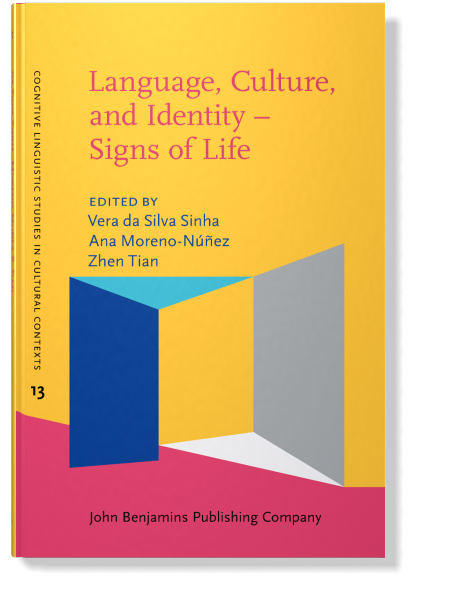
In:Language, Culture and Identity – Signs of Life:
Edited by Vera da Silva Sinha, Ana Moreno-Núñez and Zhen Tian
[Cognitive Linguistic Studies in Cultural Contexts 13] 2020
► pp. 295–316
Chapter 14A study of Chinese non-basic color terms from the perspective of cognitive semantics
Published online: 30 April 2020
https://doi.org/10.1075/clscc.13.14xue
https://doi.org/10.1075/clscc.13.14xue
Abstract
This paper makes a study from the perspective of cognitive semantics of Chinese non-basic color terms, the subcategories of color terms, on their representation, cognitive motivation and cultural connotation. It is found that there are four major representation forms of non-basic color terms in Chinese: object color terms, proper noun color terms, color terms denoting degree, color terms denoting mixed color. The major cognitive motivations are metaphor, metonymy and conceptual integration. The use of cultural-specific terms to capture fine distinctions of color reveals from one aspect how the Chinese subcategorize color concept and construe color experience as meaning as well as the close relationship between linguistic categories, cognitive capacity and ethnic traditions.
Article outline
- Introduction
- Defining Chinese basic color terms and non-basic color terms
- Research procedure
- The representation forms of Chinese non-basic color terms
- Object color terms
- Proper noun color terms
- Color terms denoting degree
- Color terms denoting mixed color
- Cognitive motivations of Chinese non-basic color terms
- Metaphor
- Metonymy
- Conceptual integration
- Socio-cultural factors involved in the naming of Chinese non-basic color terms
- Conclusion
Notes References

References (51)
Baxter, William. 1983. “A Look at the history of Chinese color terminology.” Journal of the Chinese Language Teaching Association 18 (2): 1–26.
Berlin, Brent and Kay, Paul. 1999. Basic Color Terms: Their Universality and Evolution. Berkeley: University of California Press.
Biggam, Carole P. 1997. Blue in Old English: An Interdisciplinary Semantic Study. Amsterdam and Atlanta: Rodopi.
Casson, Ronald W. 1994. “Russett, Rose, and Raspberry: the Development of English Secondary Color Terms.” Journal of Linguistic Anthropology 4 (1): 5–22.
1997. “Color Shift: Evolution of English Color Terms from Brightness to Hue.” In Color Categories in Thought and Language, Clyde L. Hardin and Luisa Maffi (eds), 224–239. Cambridge: Cambridge University Press.
Conklin, Harold C. 1955. “Hanunoo Color Categories.” Southwestern Journal of Anthropology 11 (4): 339–344.
1964. “Ethnogeneological Method.” In Explorations in Cultural Anthropology, Ward H. Goodenough (ed.). New York: McGraw-Hill.
Cytowic, Richard E. 2002. Synesthesia: A Union of the Sense (2nd ed.). Cambridge Massachusetts: MIT Press.
Fauconnier, Gilles and Turner, Mark. 2003. The Way We Think: Conceptual Blending and the Mind’s Hidden Complexities. New York: Basic Books.
Gleason, Henry A. 1961. An Introduction to Descriptive Linguistics. New York: Holt, Rinehart and Winston.
Hu, Pu’an. 1941. “The Ancient Color Discrimination and Dyeing Technology from the Perspective of Philology.” Xuelin (3): 53–67.
Jin, Funian. 2003. A Study on the Application of Rhetoric of Modern Chinese Color Words [Doctoral dissertation]. Fuda University, Shanghai, China.
Kay, Paul, Berlin, Brent and Merrifield, William. R. 1991. “Biocultural Implications of Systems of Color Naming.” Journal of Linguistic Anthropology 1 (1):12–25.
Kay, Paul and McDaniel, Chad K. 1978. “The linguistic Significance of the Meanings of Basic Color Terms.” Language 54 (3): 610–646.
Kövecses, Zoltán. 2005. Metaphor in Culture: Universality and Variation. Cambridge: Cambridge University Press.
Lakoff, George and Turner, Mark. 1989. More Than Cool Reason: A Field Guide to Poetic Metaphor. Chicago: Chicago University Press.
Lenneberg, Eric H. and Roberts, John M. 1956. The Language of Experience: A Study in Methodology. [Indiana University Publication in Anthropology and Linguistics, Memoir 13. Supplement to International Journal of American Linguistics 22.2]. Baltimore: Waverly Press.
Levinson, Stephen C. 1997. “From outer to inner space: linguistic categories and non-linguistic thinking.” In Language and Conceptualization, Jan Nuyts and Eric Pederson (eds), 13–45. Cambridge: Cambridge University Press.
Lin, Helen, Luo, Ming Ronnier, MacDonald, Lindsay W. and Tarrant, Arthur W. S. 2001a. “A Cross-Cultural Colour-Naming Study Part I: Using an Unconstrained Method.” Color research and application (26): 40–60.
2001b. “A Cross-Cultural Colour-Naming Study Part II: Using a constrained Method.” Color research and application (26): 193–208.
2001c. “A Cross-Cultural Colour-Naming Study Part III: A Colour-naming Model.” Color research and application (26): 270–277.
Liu, Danqing. 1990. “The Number and Sequence of Basic Color Terms in Modern Chinese”. Journal of Nanjing Normal University (Social Science Edition) (3): 77–80.
MacLaury, Robert E. 1995. “Vantage theory.” In Language and the Cognitive Construal of the World. (Trends in Linguistics. Studies and Monographs 82), John R. Taylor and Robert E. MacLaury (eds), 231–276. Berlin/New York: Mouton de Gruyter..
1997. Color and Cognition in Mesoamerica: Constructing Categories as Vantages. Austin: University of Texas Press.
Maxwell-Stuart, Peter G. 1981a. Studies in Greek Colour Terminology [vol. 1: γλανκος]. Leiden: E. J. Brill.
. 1975b. “Cognitive Representations of Semantic Categories.” Journal of Experimental Psychology General 104 (3): 192–233.
. 1975c. “The Nature of Mental Codes for Color Categories.” Journal of Experimental Psychology: Human Perception and Performance 1 (4): 303–322.
. 1978. “Principles of Categorization.” In Cognition and Categorization, Eleanor Rosch and Barbara B. Lloyd (eds), 27–48. Hillsdale: Lawrence Erlbaum Associates.
Steinvall, Anders. 2002. English Color Terms in Context [Doctoral dissertation]. Umeå Universitet, Umeå kommun, Sweden.
Taylor, John R. 2001. Linguistic Categorization: Prototypes in Linguistic Theory. Oxford: Oxford University Press.
Wierzbicka, Anna. 1990. “The Meaning of Color Terms: Semantics, Culture and Cognition.” Cognitive Linguistics 1 (1): 99–150..
Xie, Haijiang and Zhang Liping. 2004. A Contrastive Study of Chinese and English Color Terms. Shanghai: Shanghai Lexicographical Publishing House.
Xue, Yahong. 2013. A Contrastive Study of the Subcategories of English and Chinese Color Terms [Doctoral dissertation]. Northeast Normal University, Changchun, China.
Xue, Yahong and Yang Zhong. 2014. “A Contrastive Study of English and Chinese Non-basic Color Terms from the Perspective of Cognitive Semantics.” Journal of Foreign Languages (1) 36–42.
Yang, Yonglin. 2002. A Socio-Cognitive Study of Chinese Students’ Color Codability in English. Beijing: Tsinghua University Press.
Yao, Xiaoping. 1988. “Review of Theory of Basic Color Terms and the Evolution of Chinese Basic Color Terms.” Foreign Language Teaching and Research 1: 119–28.
Ye, Jun. 2001. An Analysis of Modern Chinese Color Terms. Hohhot: Inner Mongolian People’s Publishing House.
Zhang, Peiji. 1964. English Words of Color and Sound and Their Translation. Beijing: Commercial Press.
Cited by (1)
Cited by one other publication
Toratani, Kiyoko
2023. Metonymy in the nomenclature of Japanese traditional colors. Cognitive Linguistic Studies 10:1 ► pp. 57 ff.
This list is based on CrossRef data as of 8 december 2025. Please note that it may not be complete. Sources presented here have been supplied by the respective publishers. Any errors therein should be reported to them.