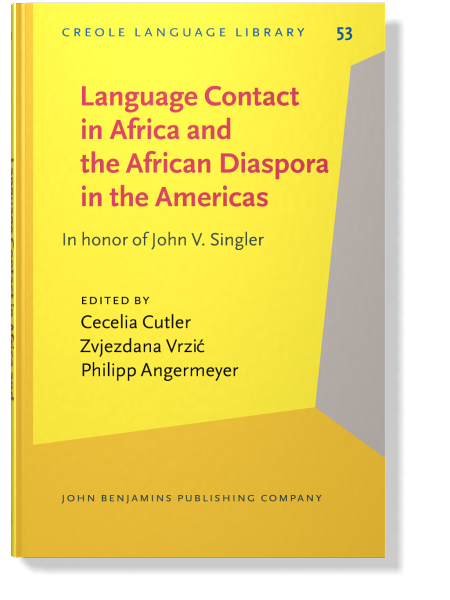
In:Language Contact in Africa and the African Diaspora in the Americas: In honor of John V. Singler
Edited by Cecelia Cutler, Zvjezdana Vrzić and Philipp Angermeyer
[Creole Language Library 53] 2017
► pp. 305–322
Variationist creolistics, with a phonological focus
Published online: 12 July 2017
https://doi.org/10.1075/cll.53.13ric
https://doi.org/10.1075/cll.53.13ric
John Singler is among a relatively small group of variationist creolists who have worked on phonological variation, which, although less of a research focus in creolistics than grammatical variation, can be illuminated by and illuminate quantitative and other systematic approaches to sociolinguistic variation and change. I illustrate this by introducing quantitative data on vowel laxing, h-deletion, and other phonological processes in the personal pronoun system of Guyanese Creole. In each case the quantitative data contribute to decisions about basic vs derived forms, and enrich our understanding of linguistic constraints and the sociolinguistic milieu (social class, gender, age and style) in which the variation is embedded. Phonological variation in pidgins and creoles can in turn enhance our understanding of larger theoretical issues within variation theory and creolistics.
Keywords: Guyanese Creole, phonological variation, quantitative analysis, social class, gender, age
Article outline
- 1.Introduction
- 2.Vowel laxing
- 3. h-deletion
- 4. t-deletion
- 5.The raising and backing of a
- 6.Monophthongization of [aɪ]
- 7.Summary and conclusion
Notes References

References (23)
Allsopp, R. 1958. Pronominal Forms in the Dialect of English Used in Georgetown (British Guiana) and its Environs by Persons Engaged in Non-Clerical Occupations. MA thesis, London University.
Devonish, H. 2002. Talking Rhythm, Stressing Tone: The Role of Prominence in Anglo-West African Creoles. Kingston, Jamaica: Arawak Publications.
Edwards, W. 1983. Code selection and shifting in Guyana. Anthropological Linguistics 20(5): 194–213.
Hooper, J. 1973. Aspects of natural generative phonology. PhD dissertation, University of California – Los Angeles.
Irvine, A. 2004. A good command of the English language: Phonological variation in the Jamaican acrolect. Journal of Pidgin and Creole languages 19(1): 41–76.
Labov, W. 1969. Contraction, deletion and inherent variability of the English copula. Language 45(4): 715–762.
. 1971. The notion of “system” in creole languages. In Pidginization and Creolization of Languages, D. Hymes (ed.), 447–472. Cambridge: CUP.
Lacoste, V. 2012. Phonological Variation in Rural Jamaican Schools. Amsterdam: John Benjamins.
Rickford, J. 1979. Variation in a Creole Continuum: Quantitative and Implicational Approaches. PhD dissertation, University of Pennsylvania.
. 1981. A variable rule for a creole continuum. In Variation Omnibus, D. Sankoff & H. Cedergren (eds), 201–208. Carbondale and Edmonton: Linguistic Research, Inc.
. 1986. The need for new approaches to social class analysis in sociolinguistics. Language and Communication 6(3): 215–221.
. 1987. The haves and have nots: Sociolinguistic surveys and the assessment of speaker competence. Language in Society 16(2): 149–177.
. 1991. Sociolinguistic variation in Cane Walk: A quantitative case study. In English Around The World: Sociolinguistic Perspectives, J. Cheshire (ed.), 609–616. Cambridge: CUP.
. 1993. Phonological features in Afro-American pidgins and creoles and their diachronic significance. In Africanisms in Afro-American Language Varieties, S. Mufwene (ed.), 346–363. Athens GA: University of Georgia Press.
Rosenfelder, I. 2008. Sociophonetic Variation in Educated Jamaican English: An Analysis of the Spoken Component of ICE-Jamaica. PhD dissertation, Albert Ludwigs Universität Freiburg.
Sankoff, G. 1974. A quantitative paradigm for the study of communicative competence. In Explorations in the Ethnography of Speaking, R. Bauman & J. Sherzer (eds) 18–49. Cambridge: CUP.