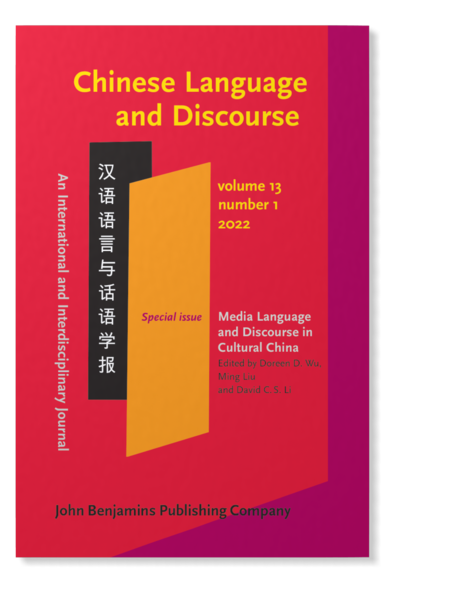
Article published In: Media Language and Discourse in Cultural China
Edited by Doreen D. Wu, Ming Liu and David C.S. Li
[Chinese Language and Discourse 13:1] 2022
► pp. 28–57
Doing participatory fandom through trans‑scripting
The case of multilingual K-pop fans on Chinese social media
Published online: 29 March 2022
https://doi.org/10.1075/cld.21003.son
https://doi.org/10.1075/cld.21003.son
Abstract
This article examines trans-scripting in transnational, multilingual fandom on Sina Weibo, the largest Chinese microblogging site. Taking one of the most popular Korean pop music (K-pop) bands named BTS as a case study, 741 instances of trans-scripting were manually selected from a total of 18,243 comments under the official Weibo account of the largest BTS fan club in China. Combining online observation and corpus-based analysis, our study draws on the notions of engaged audience and affinity space to reveal how multiple patterns of trans-scripting are heavily mobilized by K-pop fans in translingual idol naming, the transcultural maintenance of fan-idol kinship, and the intertextual confirmation of shared media consumption experiences. We argue that trans-scripting is an under-explored linguistic strategy used by transnational pop-culture fans, providing an analytical lens for research on fan identity and fan-communal membership. Theoretically, trans-scripting can serve as a useful lens to analyze networked multilingual fandom.
Keywords: trans-scripting, transnational fandom, multilingualism, K-pop, translanguaging
Article outline
- Introduction
- Trans-scripting in digital communication
- Fans, engaged audience, and affinity space
- K-pop fandom on Sina Weibo
- Research background and methods
- Research background
- Data collection
- Data analysis
- Findings
- Trans-scripting as translingual idol-naming strategies
- Trans-scripting as affective confirmation of shared media consumption
- Trans-scripting as reflexive judgment of proper idol-fan kinship
- Discussion
- Conclusion
- Notes
References

References (57)
Alhayek, K. 2017. “Emotional Realism, Affective Labor, and Politics in the Arab Fandom of Game of Thrones.” International Journal of Communication 111: 3740–3763.
Anderson, J. A. 1996. “The Pragmatics of Audience in Research and Theory.” In The Audience and Its Landscape, ed. by J. Hay, L. Grossberg, & E. Wartella, 75–93. Westview Press.
Androutsopoulos, J. 2015. “Networked Multilingualism: Some Language Practices on Facebook and Their Implications.” International Journal of Bilingualism 191: 185–205.
2020. “Trans-Scripting as a Multilingual Practice: the Case of Hellenised English.” International Journal of Multilingualism 17(3): 286–308.
Baker, J.-G. 2019. BTS’ A.R.M.Y. Web 2.0 Composing: Fangirl Translinguality as Parasocial, Motile Literacy Praxis [Unpublished doctoral dissertation]. The University of Washington.
Barton, D., and Lee, C. 2013. Language Online: Investigating Digital Texts and Practices. Routledge.
Berger, R. 2015. “Now I See It, Now I Don’t: Researcher’s Position and Reflexivity in Qualitative Research.” Qualitative Research 15(2): 219–234.
Busse, K., and Gray, J. 2001. “Fan Cultures and Fan Communities.” In The Handbook of Media Audiences, ed. by Virginia Nightingale, 425–443. London: Wiley-Blackwell.
Choi, J. B., and Maliangkay, R. (eds.) 2015. K-pop: The International Rise of the Korean Music Industry. Routledge.
Chun, E. W. 2017. “How to Drop a Name: Hybridity, Purity, and the K-pop Fan.” Language in Society 461: 57–76.
Crow, T. F. 2019. K-Pop, Language, and Online Fandom: An Exploration of Korean Language Use and Performativity amongst International K-pop Fans [Unpublished doctoral dissertation]. Northern Arizona University.
Curwood, J. S., Magnifico, A. M., and Lammers, J. C. 2013. “Writing in the Wild: Writers’ Motivation in Fan-based Affinity Spaces.” Journal of Adolescent & Adult Literacy: 678–685.
Dovchin, S. 2020. “Translingual Englishes and the Global Spread of Authenticity.” In Language, Social Media and Ideologies, 13–25. SpringerBriefs.
García, O., and Li, W. 2014. Translanguaging: Language, Bilingualism and Education. Palgrave Macmillan.
Gee, J. P. 2003 [2007]. What Video Games Have to Teach Us about Learning and Literacy. Palgrave Macmillan.
2005. “Semiotic Social Spaces and Affinity Spaces: From the Age of Mythology to Today’s Schools.” In Beyond Communities of Practice: Language, Power, and Social Context, ed. by D. Barton and K. Tusking, 214–232. Cambridge University Press.
2013. Good Video Games + Good Learning: Collected Essays on Video Games, Learning, and Literacy. Second Edition. Peter Lang.
2018. “Affinity spaces: How young people live and learn online and out of school”. Phi Delta Kappan, 99(6), 8–13.
Georgeakopoulos, A., Iversen, S., & Stage, C. 2021. Quantified storytelling: A narrative analysis of metrics on social media. Palgrave Macmillan.
Iedema, R. 2003. “Multimodality, resemiotization: extending the analysis of discourse as multi-semiotic practice”. Visual Communication, 2(1), 29–57.
Jenkins, H. 2006. Fans, Bloggers, and Gamers: Exploring Participatory Culture. New York University Press.
Ju, C. 2019. “How China’s ‘Fan Circles’ are Redefining Modern Fandom.” Caixin Global. [URL]
Jung, S.-H. 2012. “The Korean Wave and Its Implications for the Korea-China Relationship.” Journal of International and Area Studies 19(2): 97–33.
Lee, J. S. 2018. “The Korean Wave, K-pop Fandom, and Multilingual Microblogging.” In Multilingual Youth Language in Computer Mediated Communication, ed. by C. Cutler & U. Røyneland, 205–223. Cambridge University Press.
Lee, T.-K., and Li, W. 2020. “Translanguaging and Momentarily in Social Interaction.” In The Cambridge Handbook of Discourse Studies, ed. by A. Fina & A. Georgakopoulou, 394–416. Cambridge University Press.
Li, W. 2016. “New Chinglish and the Post-Multilingualism Challenge: Translanguaging ELF in China.” Journal of English as a Lingua Franca 5(1): 1–25.
Li, W., and Zhu, H. 2019. “Tranßcripting: Playful Subversion with Chinese Characters.” International Journal of Multilingualism 16(2): 1–17.
Liu, M. 2020. “The Branding Genius of K-pop Band BTS.” The Washington Post. [URL]
Min, W., Jin, D. Y., and Han, B. 2019. “Transcultural Fandom of Korean Wave in Latin America: Through the Lens of Cultural Intimacy and Affinity Space.” Media, Culture & Society 41(5): 604–619.
Oh, D. C. 2017. “K-pop Fans React: Hybridity and the White Celebrity-Fan on YouTube.” International Journal of Communication 111: 2270–2287.
Ren, W. 2018. “Mitigation in Chinese Online Consumer Reviews.” Discourse, Context and Media 261: 5–12.
Schachtner, C. 2015. “Transculturality in the internet: Culture flows and virtual publics.” Current Sociology Monograph 63(2): 228–243.
Shafirova, L., Cassany, D., and Bach, C. 2020. “From ‘Newbie’ to Professional: Identity Building and Literacies in an Online Affinity Space.” Learning, Culture and Social Interaction, 241: 1–11.
Shim, D. 2006. “Hybridity and the Rise of Korean Popular Culture in Asia.” Media, Culture & Society 19(2): 137–151.
Song, S. 2020. “The Evolution of the Korean Wave: How is the Third Generation Different from Previous Ones?” Korean Observer 51(1): 125–150.
Song, Y. 2018. “Translingual strategies as consumer design: A case study of multilingual linguistic landscapes of urban China.” Multilingua, 37(5): 455–482.
Spilioti, T. 2019. “From Transliteration to Trans-scripting: Creativity and Multilingual Writing on the Internet.” Discourse, Context & Media 291: 1–10.
2020. “The Weirding of English, Transcripting, and Humour in Digital Communication.” World Englishes 391: 106–118.
Sun, M., and Liew, K. K. 2019. “Analog Hallyu: Historicizing K-pop Formations in China.” Global Media and China 4(4): 419–436.
Vásquez, C., and Creel, S. 2017. “Conviviality through Creativity: Appealing to the Reblog in Tumblr Chat Posts.” Discourse, Context & Media 201: 59–69.
Wu, H. A. 2016. “Video Game Prosumers: Case Study of a Minecraft Affinity Space.” In Visual Arts Research, 22–37. University of Illinois Press.
Xie, C. & Tong, Y. 2020. “Bonding across Chinese social media: The pragmatics of language play in ‘精(sang), 彩(xin) 有(bing)趣 (kuang) construction’.” Pragmatics 30(3): 431–457.
Xie, C., Yus, F. & Haberland, H. (eds.). 2021. Approaches to Internet Pragmatics. John Benjamins Publishing Company.
Yan, Q., & Yang, F. 2020. “From Parasocial to Parakin: Co-Creating Idols on Social Media.” New Media & Society 1–23.
Yoon, K. 2019. “Transnational Fandom in the Making: K-pop Fans in Vancouver.” International Communication Gazette 81(2): 176–192.
Yus, F. 2019. “Multimodality in memes: A Cyberpragmatic Approach.” In P. Bou-Franch and P. G. Blitvich (eds.), Analyzing Digital Discourse: New Insights and Future Directions, 105–132. Palgrave Macmillan.
Zhang, Y. 2020. “Adopting Japanese in Popular Chinese Video-Sharing Website: Heteroglossic and Multilingual Communication by Online Users of Bilibili.com.” International Multilingual Research Journal 14(1): 20–40.
Cited by (7)
Cited by seven other publications
Afşin, Hamdi & Billur Çalışkan
Gutierrez-Jauregi, Alaitz, Maria Elena Aramendia-Muneta & Irene Gómez-Cámara
Wu, Geer, Chen Li & Xueying Wang
Zheng, Shiyu Sharon
段, 超越
Zhang, Leticia-Tian & Boris Vazquez-Calvo
This list is based on CrossRef data as of 7 december 2025. Please note that it may not be complete. Sources presented here have been supplied by the respective publishers. Any errors therein should be reported to them.