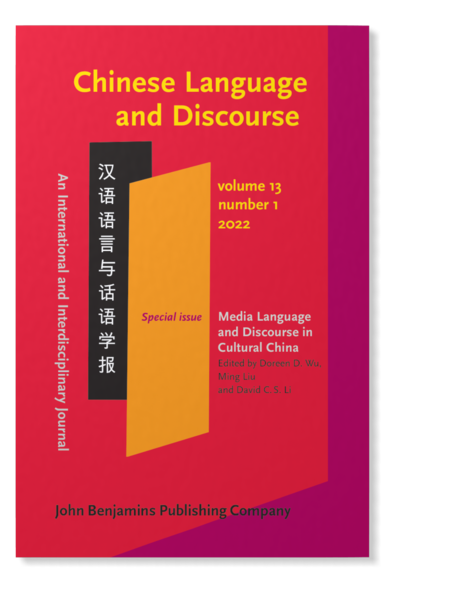
Article published In: Media Language and Discourse in Cultural China
Edited by Doreen D. Wu, Ming Liu and David C.S. Li
[Chinese Language and Discourse 13:1] 2022
► pp. 79–98
Stancetaking in Hong Kong political discourse
A corpus-assisted discourse study
Published online: 29 March 2022
https://doi.org/10.1075/cld.21001.liu
https://doi.org/10.1075/cld.21001.liu
Abstract
This study gives a corpus-assisted discourse study (CADS) of stancetaking in the public speeches of three former Chief Executives. Three large corpora have been built by collecting all the public speeches of the three former Chief Executives. It combines automatic semantic tagging with the tripartite analysis of stancetaking in terms of evaluation, positioning and (dis)alignment. The findings not only reveal their preferential ways of stancetaking but also the changing socio-political contexts behind their particular ways of stancetaking. It is argued that a combination of the methods and theories in critical discourse analysis, stancetaking, and corpus linguistics can generate more illuminating findings concerning stancetaking in political discourse.
Article outline
- 1.Introduction
- 2.Research background
- 3.Stance in political discourse analysis
- 4.Methodology
- 5.Findings
- 5.1Analysis of evaluation
- 5.2.2Analysis of (dis)alignment
- 5.2.3Analysis of positioning
- 6.Conclusion
References

References (53)
Baker, P., Gabrielatos, C., KhosraviNik, M., Krzyżanowski, M., McEnery, T., & Wodak, R. (2008). A useful methodological synergy? Combining critical discourse analysis and corpus linguistics to examine discourses of refugees and asylum seekers in the UK press. Discourse & Society, 19(3), 273–306.
Bednarek, M. (2006). Evaluation in Media Discourse: Analysis of a Newspaper Corpus. London and New York: Continuum.
Biber, D. (2006a). Stance in spoken and written university registers. Journal Of English for Academic Purposes, 5(2), 97–116.
(2006b). University Language: A Corpus-based Study of Spoken and Written Registers (Vol. 231). New York: John Benjamins.
Biber, D., & Finegan, E. (1989). Styles of stance in English: Lexical and grammatical marking of evidentiality and affect. Text, 9(1), 93–124.
Chafe, W. L., & Nichols, J. (Eds.). (1986). Evidentiality: The linguistic coding of epistemology (Vol. 201). Norwood: Ablex.
Cheng, W. (2013). Corpus-based linguistic approaches to critical discourse analysis. In C. Chapelle (Ed.), The encyclopedia of applied linguistics (pp. 1353–1360). West Sussex: Wiley-Blackwell.
Chilton, P. (1996). Security Metaphors: Cold War Discourse from Containment to Common House. Bern: Peter Lang.
Cienki, A., & Giansante, G. (2014). Conversational framing in televised political discourse: A comparison from the 2008 elections in the United States and Italy. Journal Of Language And Politics, 13(2), 255–288.
Connor-Linton, J. (2014). Author’s style and worldview: A comparison of texts about American nuclear arms policy. In S. Conrad & D. Biber (Eds.), Variation in English: Multi-Dimensional Studies (pp. 84–93). Harlow: Pearson Education.
Conrad, S., & Biber, D. (2000). Adverbial marking of stance in speech and writing. In S. Hunston & G. Thompson (Eds.), Evaluation in text: Authorial stance and the construction of discourse (Vol. 561, pp. 56–73). Oxford: Oxford University Press.
Du Bois, J. W. (2007). The stance triangle. In R. Eaglebreston (Ed.), Stancetaking in discourse: Subjectivity, evaluation, interaction (Vol. 1641, pp. 139–182). Amsterdam: John Benjamins.
Elder, C.-H. (2020). Trump vs. Clinton: Implicatures as public stance acts. In L. N. Berlin (Ed.), Positioning and stance in political discourse: The individual, the party, and the party line (pp. 71–91). Malaga: Vernon Press.
Englebretson, R. (2007). Stancetaking in discourse: Subjectivity, evaluation, interaction (Vol. 1641). Amsterdam: John Benjamins.
Fetzer, A. (2014). I think, I mean and I believe in political discourse: Collocates, functions and distribution. Functions Of Language, 21(1), 67–94.
Flowerdew, J. (2004). Identity politics and Hong Kong’s return to Chinese sovereignty: Analysing the discourse of Hong Kong’s first chief executive. Journal Of Pragmatics, 36(9), 1551–1578.
Furko, P. (2017). Manipulative uses of pragmatic markers in political discourse. Palgrave Communications, 3(1), 1–8.
Haselow, A. (2020). Expressing stance in spoken political discourse – The function of parenthetical inserts. Language Sciences, 101334.
Hidalgo-Downing, L. (2008). The expression of writer stance by modal adjectives and adverbs in comparable corpus of English and Spanish newspaper discourse. In A. M. Hornero, M. J. Luzón, S. M. Ornat, & S. Murillo (Eds.), Corpus Linguistics: Applications for the Study of English (pp. 125–140). Bern: Peter Lang.
Hidalgo-Downing, L., & Hanawi, Y. (2017). Bush and Obama’s addresses to the Arab world: Recontextualizing stance in political discourse. In K. Aijmer & D. Lewis (Eds.), Contrastive Analysis of Discourse-pragmatic Aspects of Linguistic Genres (pp. 187–209). New York: Springer.
Ho, S. Y. E., & Crosthwaite, P. (2018). Exploring stance in the manifestos of 3 candidates for the Hong Kong Chief Executive election 2017: Combining CDA and corpus-like insights. Discourse & Society, 29(6), 629–654.
Hunston, S. (2006). Truth and lies: The construction of factuality in a television documentary. In C. R. Caldas-Coulthard & M. T. Toolan (Eds.), The Writer’s Craft, the Culture’s Technology (pp. 181–194). Amsterdam: Rodopi.
Johnstone, B. (2009). Stance, style, and the linguistic individual. In A. Jaffe (Ed.), Stance: sociolinguistic perspectives (Vol. 291, pp. 52). Oxford: Oxford University Press.
Lempert, M. (2009). On ‘flip-flopping’: Branded stance-taking in US electoral politics. Journal Of Sociolinguistics, 13(2), 223–248.
Liu, M. (2017). “Contesting the cynicism of neoliberalism”: A corpus-assisted discourse study of press representations of the Sino-US currency dispute. Journal Of Language And Politics, 16(2).
Liu, M., & Zhong, J. (2020). Between national and local: Identity representations of post-colonial Hong Kong in a local English newspaper. Discourse, Context & Media, 361, 100401.
Marín-Arrese, J. I. (2013). Stancetaking and inter/subjectivity in the Iraq Inquiry: Blair vs. Brown. In J. I. Marín-Arrese, M. Carretero, J. Arús Hita, & J. van der Auwera (Eds.), English modality: core, periphery and evidentiality (pp. 411–445). Berlin: Mouton de Gruyter.
(2015). Epistemicity and stance: A cross-linguistic study of epistemic stance strategies in journalistic discourse in English and Spanish. Discourse Studies, 17(2), 210–225.
Martin, J. R., & White, P. R. (2005). The Language of Evaluation: Appraisal in English. New York: Palgrave Macmillan.
Morley, J., & Bayley, P. (Eds.). (2009). Corpus-Assisted Discourse Studies on the Iraq Conflict: Wording the War. New York and London: Routledge.
Partington, A. (2004). Corpora and discourse, a most congruous beast. In A. Partington, J. Morley, & L. Haarman (Eds.), Corpora and Discourse (pp. 11–20). Bern: Peter Lang.
Partington, A., Duguid, A., & Taylor, C. (2013). Patterns and Meaning in Discourse: Theory and Practice in Corpus-Assisted Discourse Studies (CADS). Amsterdam: John Benjamins.
Rayson, P. (2008). From key words to key semantic domains. International Journal Of Corpus Linguistics, 13(4), 519–549.
Thompson, G., & Hunston, S. (2000a). Evaluation in Text: Authorial Stance and the Construction of Discourse. New York: Oxford University Press.
(2000b). Evaluation: An introduction. In S. Hunston & G. Thompson (Eds.), Evaluation in text: Authorial stance and the construction of discourse (pp. 1–27). Oxford: Oxford University Press.
Tsui, E. (2012). Leung wins Hong Kong election. Financial Times. Retrieved from [URL]
Van Dijk, T. A. (2005). War rhetoric of a little ally: Political implicatures and Aznar’s legitimatization of the war in Iraq. Journal Of Language And Politics, 4(1), 65–91.
Veg, S. (2017). The rise of “localism” and civic identity in post-handover Hong Kong: Questioning the Chinese nation-state. The China Quarterly, 2301, 323–347.
Wang, B., & Feng, D. (2018). A corpus-based study of stance-taking as seen from critical points in interpreted political discourse. Perspectives, 26(2), 246–260.
Wodak, R. (1989). Language, Power and Ideology: Studies in Political Discourse (Vol. 71). Amsterdam: John Benjamins.
(2016). The discourse-historical approach. In R. Wodak & M. Meyer (Eds.), Methods of critical discourse analysis (3rd ed.). London: Sage.
Cited by (4)
Cited by four other publications
Liu, Ming
Wu, Chenghui, Yang Zhang & Yuhang Li
Bekmanova, Gulmira, Banu Yergesh, Aru Ukenova, Assel Omarbekova, Assel Mukanova & Yerkyn Ongarbayev
This list is based on CrossRef data as of 7 december 2025. Please note that it may not be complete. Sources presented here have been supplied by the respective publishers. Any errors therein should be reported to them.