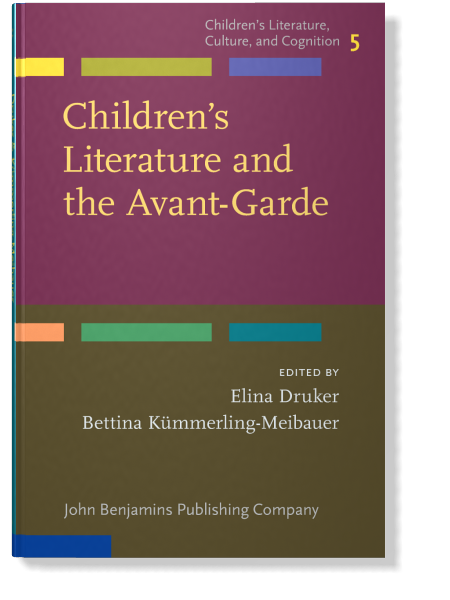
In:Children's Literature and the Avant-Garde
Edited by Elina Druker and Bettina Kümmerling-Meibauer
[Children’s Literature, Culture, and Cognition 5] 2015
► pp. v–vi
Get fulltext
This article is available free of charge.
Published online: 29 July 2015
https://doi.org/10.1075/clcc.5.toc
https://doi.org/10.1075/clcc.5.toc
Table of contents
Table of figures
Introduction: Children’s literature and the avant-garde
Vanguard tendencies since the beginning of the twentieth century
Chapter 1. John Ruskin and the mutual influences of children’s literature and the avant-garde
Chapter 2. Einar Nerman – From the picturebook page to the avant-garde stage
Chapter 3. Sándor Bortnyik and an interwar Hungarian children’s book
Chapter 4. The forgotten history of avant-garde publishing for children in early twentieth-century Britain
The Impact of the Russian avant-garde
Chapter 5. The square as regal infant: The avant-garde infantile in early Soviet picturebooks
Chapter 6. The 1929 Amsterdam exhibition of early Soviet children’s picturebooks: A reconstruction
Chapter 7. Rupture. Ideological, aesthetic, and educational transformations in Danish picturebooks around 1933
Chapter 8. Mirror images: On Soviet-Western reflections in children’s books of the 1920s and 1930s
Postbellum avant-garde children’s books
Chapter 9. Manifestations of the avant-garde and its legacy in French children’s literature
Chapter 10. Just what is it that makes Pop Art picturebooks so different, so appealing?
Chapter 11. Surrealism for children: Paradoxes and possibilities
About the editors and contributors
Subject Index
Name Index
