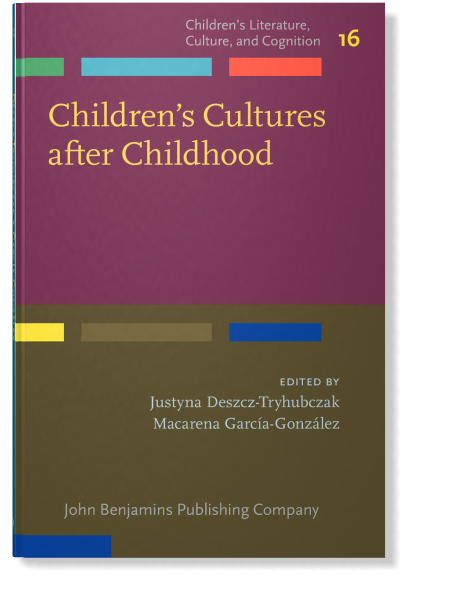
In:Children's Cultures after Childhood
Edited by Justyna Deszcz-Tryhubczak and Macarena García-González
[Children’s Literature, Culture, and Cognition 16] 2023
► pp. vii–viii
Get fulltext
Acknowledgements
Available under the Creative Commons Attribution-NonCommercial-NoDerivatives (CC BY-NC-ND) 4.0 license.
For any use beyond this license, please contact the publisher at rights@benjamins.nl.
Published online: 8 August 2023
https://doi.org/10.1075/clcc.16.ack
https://doi.org/10.1075/clcc.16.ack
Children’s Cultures after Childhood is a result of our shared following of posthumanist and new materialist orientations in children’s cultures scholarship, which with time turned into our com(mon)passions. As proposed by Olga Cielemęcka and Monika Rogowska-Stangret in their 2015 “Stigmergy as a Collective Research Practice”, published in Imagine There Were No Humanities: Transdisciplinary Perspectives, edited by K. C. Ackermann et al., “[c]om(mon)passions” are collective care-full research practices that draw on empathy, respect, openness, thoughtfulness, and constructiveness, thereby letting us render each other capable. We have relied on these connectivities in our attempts to do justice to the complexities of the multiple entanglements of childhoods, adulthoods, cultures, and natures. As our individual and joint research entanglements with posthumanism and new materialism are as vibrant as ever, we are now happy to invite other scholars to become open to them and possibly follow other related openings in their research.
We thank the contributors to this book for their willingness to reflect on the theoretical and practical aspects of after childhood with us and for their trust, patience, and timeliness while this volume was taking shape. We are also immensely grateful to the editors of John Benjamins Children’s Literature, Culture, and Cognition series for their advice and guidance. We would also like to thank the reviewers for their constructive suggestions and comments. Last but not least, we thank Valentina Rivera for her help in preparing this manuscript.
Finally, we wish to acknowledge that Macarena’s work on Children’s Cultures after Childhood has been facilitated by her grant CHILDCULTURES (MSC-UKRI, Grant Ref: EP/X033937/1). In addition, some of Justyna’s work on the volume was enabled by her grant from the Polish Agency for Academic Exchange (Mieczysław Bekker Programme, Agreement no. PPN/BEK/2019/1/00060/U/00001). They are both immensely grateful to these initiatives for providing the funding to support their research.
