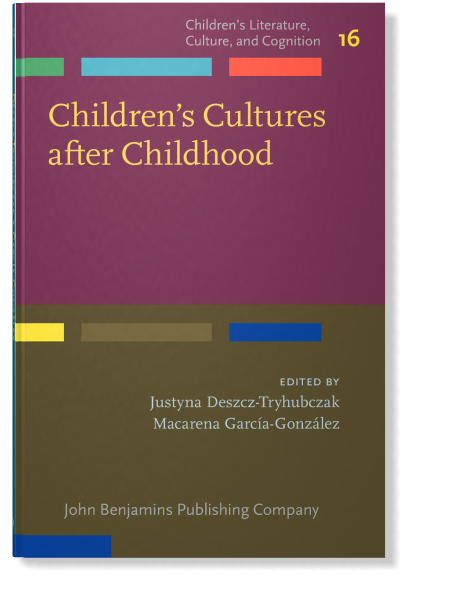
In:Children's Cultures after Childhood
Edited by Justyna Deszcz-Tryhubczak and Macarena García-González
[Children’s Literature, Culture, and Cognition 16] 2023
► pp. 152–170
Get fulltext
Chapter 10Down the back of a chair
What does a method of scrabbling with Le Guin’s “Carrier Bag Theory of Fiction” offer conceptualizations of “the child” in the Anthropocene?
Available under the Creative Commons Attribution-NonCommercial-NoDerivatives (CC BY-NC-ND) 4.0 license.
For any use beyond this license, please contact the publisher at rights@benjamins.nl.
Published online: 8 August 2023
https://doi.org/10.1075/clcc.16.10rij
https://doi.org/10.1075/clcc.16.10rij
Abstract
In this chapter, the authors work with Ursula Le Guin’s (1986) Carrier Bag Theory of Fiction to offer a reconfiguration of “the book” in childhood contexts. Attending to the relational agencies generated from messy entanglements of (hence hyphenated) reader-book-child-chair-cat-lice-mites, they feel their way around to arrive at other ideas about what books are, what books do, and what else they might potentiate in contemporary imaginations of “the child”. Le Guin retells the story of human origin by redefining technology as a cultural “carrier bag” rather than a weapon of domination. The authors offer a scrabbling methodology of “research-creation”: a method of scrabbling “down the back of the chair” (both literally and metaphorically). This feminist methodology attunes to assemblages of odds and ends, hair and dust mites, children’s literature and child readers and facilitates an exploration of the intersectional, relational meanings that might tell us something else about childhood in the Anthropocene.
Keywords: relational, posthuman, assemblage, material
Article outline
- From the margins
- Critique of “the child” and “childhood”: Towards a posthuman (re-)conceptualization of the child
- Limitations of contemporary conceptualizations for our doings on/for/with children
- Challenging contemporary approaches to childhood literacy: What (more) can a book do?
- Taking up the invitation for child agency
- Posthumanist approaches to researching with child, book, and more-than-human assemblages
- Scrabbling inside the book
- The mattering of books
- Researching-with nonhuman others; parasitic-others
- An un-ending-ness to our scrabbling methodology
References

References (36)
Primary sources
Secondary sources
Andersen, Marc M. & Roepstorff, Andreas. 2021. Play in Predictive Minds: A Cognitive Theory of Play. PsyArXiv.
Barad, Karen. 2003. Posthumanist Performativity: Towards and Understanding of How Matters Comes to Matter. Signs 28 (3): 801–831.
. 2007. Meeting the Universe Halfway: Quantum Physics and the Entanglement of Matter and Meaning. Durham, North Carolina: Duke University Press.
. 2017. What Flashes up: Theological-Political-Scientific Fragments. In Entangled Worlds: Religion, Science, and New Materialisms, Catherine Keller & Mary Jane Rubenstein (eds), 21–89. New York: Fordham University Press.
Cannella, Gaile S. 1997. Deconstructing Early Childhood Education: Social Justice and Revolution. Oxford: Peter Lang.
CLPE. 2021. Reading for Pleasure Research Report. CLPE. <[URL]> (July 1 2022).
Craft, Anna, Cremin, Teresa, Burnard, Pamela, Dragovic, Tatjana & Chappell, Kerry. 2012. Possibility Thinking: Culminative Studies of an Evidence-Based Concept Driving Creativity? Education 3–13 41 (5): 538–556.
Deleuze, Gilles & Guattari, Felix. 1980. A Thousand Plateaus: Capitalism and Schizophrenia. London: Continuum Books.
Hackett, Abigail & Somerville, Margare. 2017. Posthuman Literacies: Young Children Moving in Time, Place and More-Than-Human Worlds. Journal of Early Childhood Literacy 17 (3): 374–391.
Haraway, Donna J. 2003. The Companion Species Manifesto: Dogs, People and Significant Otherness. Chicago: University of Chicago Press.
2016. Staying with the Trouble: Making Kin in the Chthulucene. Durham, North Carolina: Duke University Press.
Haynes, Joanna & Murris, Karen. 2021. Right under Our Noses: The Postponement of Children’s Political Equality and the NOW. Childhood and Philosophy 17: 1–21.
Hohti, Riikka & Tammi, Tuure. 2019. The Greenhouse Effect: Multispecies Childhood and Non-Innocent Relations of Care. Childhood 26 (2): 169–185.
Hohti, Riikka. & Osgood, Jayne. 2020. Pets that Have “Something Inside”: The Material Politics of in/Animacy and Queer Kin within the Childhood Menagerie. Genealogy: Special Issue, Reimagining Childhood, Motherhood, Family & Community 4 (2): 38.
Hutt, John S, Tyler, Stephen, Hutt, Corinne, & Christopherson, Helen. 1989. Play, exploration, and learning: A natural history of the pre-school. London: Routledge.
Jacques, Zoe. 2015. Children’s Literature and the Posthuman: Animal, Environment, Cyborg. London: Routledge.
. 2018. Ursula le Guin Debate con Donna Haraway. Youtube. <[URL]> (1 July 2022).
Niccolini, Alyssa. 2021. Vulnerable Literacies. Welcoming Narratives in Education: A Tribute to the Life Work of Jonathan Silin. Occasional Paper Series 45 (1): 79-84.
Osgood, Jayne & Robinson, Kerry H. 2019. Feminists Researching Gendered Childhoods. London: Bloomsbury.
Pacini-Ketchabaw, Veronica & Nxumalo, Fikile. 2017. ‘Staying with the Trouble’ In Child-Insect-Educator Common Worlds. Environmental Education Research 23(10): 1414–1426.
Pellegrini, Anthony D. 1992. Kindergarten Children’s Social Cognitive Status as a Predictor of First-Grade Success. Early Childhood Research Quarterly 7 (4): 565–577.
Puig de la Bellacasa, María. 2015. Matters of Care: Speculative Ethics in More Than Human Worlds. Minneapolis: University of Minnesota Press.
Rollo, Toby. 2016. Separate but Equal: False Equality and the Political Exclusion of Children. Canadian Dimension 50 (2): 32–34.
Schroeder, Franziska & Óh Aodha, Mícheál. 2014. Soundweaving: Writings on Improvisation. Newcastle Upon Tyne: Cambridge Scholars Publishing.
Strom, Katie, Ringrose, Jessica, Jayne, Osgood & Renold, Emma. 2019. Editorial: PhEmaterialism: Response-able Research and Pedagogy. Reconceptualising Educational Research Methodology 10 (2).
Sylva, Kathy, Bruner, Jerome S. & Genova, Paul. 1976. The Role of Play in the Problem-Solving of Children 3–5 Years Old. In Play: Its Role in Development and Evolution, Kathy Sylva, Jerome S. Bruner & Paul Genova (eds), 55–67. Harmondsworth: Penguin.
Cited by (2)
Cited by two other publications
Aslanian, Teresa K., Anna R. Moxnes & Nina Odegard
This list is based on CrossRef data as of 7 december 2025. Please note that it may not be complete. Sources presented here have been supplied by the respective publishers. Any errors therein should be reported to them.