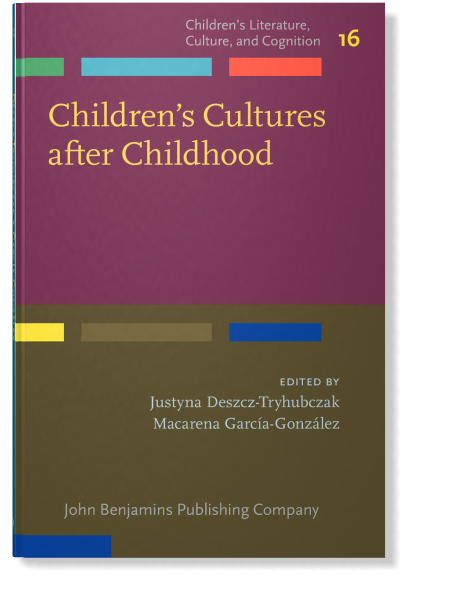
In:Children's Cultures after Childhood
Edited by Justyna Deszcz-Tryhubczak and Macarena García-González
[Children’s Literature, Culture, and Cognition 16] 2023
► pp. 137–150
Get fulltext
Chapter 9Fabric with feeling
Materiality, memory, and affect in Nina Sabnani’s Mukand and Riaz
Available under the Creative Commons Attribution-NonCommercial-NoDerivatives (CC BY-NC-ND) 4.0 license.
For any use beyond this license, please contact the publisher at rights@benjamins.nl.
Published online: 8 August 2023
https://doi.org/10.1075/clcc.16.09sub
https://doi.org/10.1075/clcc.16.09sub
Abstract
This chapter analyses the triadic relationship between materiality, memory, and affect in the Indian picturebook Mukand and Riaz (2007) by Nina Sabnani. Set against the backdrop of the Partition of India and Pakistan, the book is based on the “fragmented memories” of Sabnani’s father, a child refugee at the time (Sabnani 2007). This chapter examines how the book connects microhistory to macrohistory. Specifically, the chapter looks into the ability of artefacts to embody individual emotions and collective experiences and explores how this ability is translated through the material poetics of the picturebook. The chapter suggests that this work’s layered approach to materiality provokes a fine-grained understanding of human-object relations, contributing to new materialist children’s literature studies.
Article outline
- Touchstones for thought: Notes on an evolving research method
- Memory and narrativization: Thinking and becoming “with” material
- Transitive relations and criss-crossing modalities
- A return to touchstones: Implications for the study of children’s literature
Notes References

References (30)
Primary sources
Secondary sources
Alaimo, Stacy & Hekman, Susan. 2008. Material Feminisms. Bloomington and Indianapolis: University of Indiana Press.
Animators Guild. 2020. Tailoring Education: A Conversation with Nina Sabnani. [online] <[URL]> (5 December 2021).
Barad, Karen. 2003. Posthumanist Performativity: Toward an Understanding of How Matter Comes to Matter. Signs 28 (3): 801–831.
. 2007. Meeting the Universe Halfway: Quantum Physics and the Entanglement of Matter and Meaning. Durham and London: Duke University Press.
. 2015. Transmaterialities: Trans*/Matter/realities and Queer Political imaginings. GLQ 21(2–3): 387–422.
Basu, Paul & Coleman, Simon. 2008. Introduction: Migrant Worlds, Material Cultures. Mobilities 3 (3): 313–330.
Coole, Dianna & Frost, Samantha. 2010. New Materialisms: Ontology, Agency, and Politics. North Carolina: Duke University Press.
Diaz-Diaz, Claudia & Semenec, Paulina. 2020. Posthumanist and New Materialist Methodologies: Research after the Child. Springer Singapore Pte. Limited.
Dolphijn, Rick, & van der Tuin, Iris. 2012. New Materialism. Interviews and Cartographies. Ann Arbor: Open Humanities Press. <[URL]> (5 December 2021).
Haraway, Donna. 1988. Situated Knowledges: The Science Question in Feminism and the Privilege of Partial Perspective. Feminist Studies 14 (3): 575–599.
Hirsch, Marianne. 2012. An Interview with Marianne Hirsch. Columbia University Press. <[URL]> (20 May 2022).
. 2012. The Generation of Postmemory. Writing and Visual Culture after the Holocaust. New York: Columbia University Press.
Ingold, Tim. 2007. Materials against Materiality. Archaeological Dialogues 14 (1): 1–16. <[URL]> (5 December 2021).
McAdam, Julie. 2019. Narratives of change: the role of storytelling, artefacts and children’s literature in building communities of inquiry that care. Cambridge Journal of Education 49 (3): 293–30.
Menon, Radhika. E-mail Interview. Conducted by Niveditha Subramaniam. 9 November 2021
Ramanujan, Attipate K. 1989. Is there an Indian Way of Thinking? An Informal Essay. <[URL]> (5 December 2021).
1990. Who needs folklore? The Relevance of Oral Traditions to South Asian Studies. <[URL]> (5 December 2021).
Sabnani, Nina. 2020. About Nina Sabnani. [URL] (5 December 2021).
. E-mail Interview. Conducted by Niveditha Subramaniam. 16 October 2021
Saffrontree. 2013. Meet Nina Sabnani. [URL] (5 December 2021).
Sangat. 2020. ‘The Intersection of Spirituality and Social Justice: Amrita Nandy in conversation with feminist thinker, writer and filmmaker, Lata Mani’. <[URL]> (5 December 2021).
Smith, Laurajane, Wetherell, Margaret, Campbell, Gary. 2018. Emotions, Affective Practices, and the Past in the Present. London and New York: Routledge.
Cited by (2)
Cited by two other publications
Farrar, Jennifer, Evelyn Arizpe & Rachel Lees
This list is based on CrossRef data as of 7 december 2025. Please note that it may not be complete. Sources presented here have been supplied by the respective publishers. Any errors therein should be reported to them.