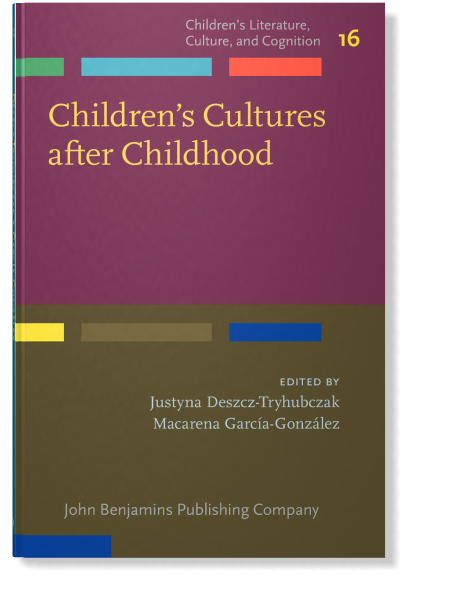
In:Children's Cultures after Childhood
Edited by Justyna Deszcz-Tryhubczak and Macarena García-González
[Children’s Literature, Culture, and Cognition 16] 2023
► pp. 102–121
Get fulltext
Chapter 7Dynamics of age and power in a children’s literature research assemblage
Available under the Creative Commons Attribution-NonCommercial-NoDerivatives (CC BY-NC-ND) 4.0 license.
For any use beyond this license, please contact the publisher at rights@benjamins.nl.
Published online: 8 August 2023
https://doi.org/10.1075/clcc.16.07dut
https://doi.org/10.1075/clcc.16.07dut
Abstract
The link between age and power in children’s literature has been explored through various lenses in recent years, with some scholars emphasizing the adult’s power and others focusing on the child’s power. To add to the current debate, this chapter analyses empirical qualitative data from readers’ reflections on their own age and the age of characters in the Dutch children’s book Iep!, written by Joke van Leeuwen. The chapter aims to adopt a “post-age” (Haynes & Murris 2017) perspective, with the participants’ individual experiences of Iep! becoming entwined and changed through encounters with human beings and matter.
Keywords: age, power, research assemblage, interviews
Article outline
- New materialism and power
- Age and power in children’s literature
- Shaping the interviews
- Negotiations of age and power in the research assemblage
- Age, characters, and power
- Closing thoughts and future potential
Acknowledgements Notes References

References (29)
Secondary sources
Alldred, Pam & Fox, Nick J. 2018. Teenagers, Sexualities-Education Assemblages and Sexual Citizenship: A New Materialist Analysis. In Re/Assembling the Pregnant and Parenting Teenager: Narratives from the Field, Annelies Kamp & Majella McSharry (eds), 219–42. Berna: Peter Lang AG.
Arnett, Jeffrey Jensen. 2000. Emerging Adulthood: A Theory of Development from the Late teens through the Twenties. American Psychologist 55 (5): 469–80.
Barad, Karen. 2007. Meeting the Universe Halfway: Quantum Physics and the Entanglement of Matter and Meaning. Durham & London: Duke University Press.
Beauvais, Clémentine. 2015. The Mighty Child: Time and Power in Children’s Literature [Children’s Literature, Culture, and Cognition (CLCC), Volume 4]. Amsterdam; Philadelphia: John Benjamins Publishing Company.
Berndtson, Arthur. 1970. The Meaning of Power. Philosophy and Phenomenological Research 31 (1): 73–84.
. 2020. “You Do It!”: Going-to-Bed Books and the Scripts of Children’s Literature. PMLA/Publications of the Modern Language Association of America 135 (5): 877–94.
Foucault, Michel. 1976. The History of Sexuality. Translated from French by Robert Hurley. 1st ed. Vol. 1: An Introduction. 4 vols. New York: Pantheon Books.
Fox, Nick J. & Alldred, Pam. 2015. New Materialist Social Inquiry: Designs, Methods and the Research-Assemblage. International Journal of Social Research Methodology 18 (4): 399–414.
García-González, Macarena & Deszcz-Tryhubczak, Justyna. 2020. New Materialist Openings to Children’s Literature Studies. International Research in Children’s Literature 13 (1): 45–60.
Green, Leslie. 1998. Power. Routledge Encyclopedia of Philosophy. Taylor and Francis. [online] <[URL]> (6 February 2023).
Green, Lorraine. 2010. Understanding the Life Course: Sociological and Psychological Perspectives. 1st ed. Cambridge: Polity.
Gubar, Marah. 2016. The Hermeneutics of Recuperation: What a Kinship-Model Approach to Children’s Agency Could Do for Children’s Literature and Childhood Studies. Jeunesse: Young People, Texts, Cultures 8 (1): 291–310.
Kraftl, Peter. 2020. After Childhood: Re-Thinking Environment, Materiality and Media in Children’s Lives. Oxon: Routledge.
Kraftl, Peter, Semenec, Paulina & Diaz-Diaz, Claudia. 2020. Interview with Peter Kraftl. In Posthumanist and New Materialist Methodologies: Research After the Child, 167–79. Springer Nature.
Law, John (ed). 1991. A Sociology of Monsters: Essays on Power, Technology, and Domination [Sociological Review Monograph 38]. London New York: Routledge.
Magnusson, Eva & Marecek, Jeanne. 2015. Doing Interview-Based Qualitative Research. Cambridge: Cambridge University Press.
Malone, Karen. 2016. Posthumanist Approaches to Theorizing Children’s Human-Nature Relations. In Space, Place, and Environment, Karen Nairn & Peter Kraftl (eds), 185–206. Singapore: Springer Singapore.
Nikolajeva, Maria. 2010. Power, Voice and Subjectivity in Literature for Young Readers. New York: Routledge.
Nilan, Pam. 2015. Youth Culture in/beyond Indonesia: Hybridity or Assemblage? In A Critical Youth Studies for the 21st Century [Youth in a Globalizing World, volume 2], Peter Kelly & Annelies Kamp (eds), 267–83. Leiden; Boston: Brill.
Nodelman, Perry. 2008. The Hidden Adult: Defining Children’s Literature. Baltimore: Johns Hopkins University Press.
Rampaul, Giselle. 2011. The West Indian Child as Subject/Object: Interrogating Notions of Power in “Annie John”. Journal of Caribbean Literatures 7 (1): 153–60.
Rudd, David. 2005. Theorising and Theories: How Does Children’s Literature Exist? In Understanding Children’s Literature. Peter Hunt (ed.), 15–29. Routledge.
Cited by (1)
Cited by one other publication
This list is based on CrossRef data as of 7 december 2025. Please note that it may not be complete. Sources presented here have been supplied by the respective publishers. Any errors therein should be reported to them.