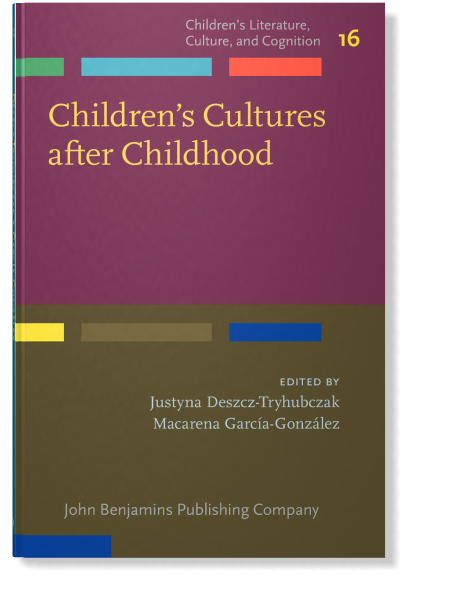
In:Children's Cultures after Childhood
Edited by Justyna Deszcz-Tryhubczak and Macarena García-González
[Children’s Literature, Culture, and Cognition 16] 2023
► pp. 71–86
Get fulltext
Chapter 5Childhood and its afterlives
Spectrality and haunting in children’s literature
Available under the Creative Commons Attribution-NonCommercial-NoDerivatives (CC BY-NC-ND) 4.0 license.
For any use beyond this license, please contact the publisher at rights@benjamins.nl.
Published online: 8 August 2023
https://doi.org/10.1075/clcc.16.05pry
https://doi.org/10.1075/clcc.16.05pry
Abstract
There is an opening in the study of children’s literature in the form of spectralities. By way of revealing this lacuna, this chapter diffractively reads J.M Barrie’s Peter Pan through Avery Gordon’s seminal spectral project Ghostly Matters. Reading these texts through one another shows that if we are to begin thinking after childhood, we must shift our conception of childhood away from a binary ontology governed by generational orderings. The argument presented herein is twofold: characters within children’s literature and the children’s book itself exist in dialogue with the past and the future, simultaneously before and after individual and subjective childhoods. Thus, a wider haunting occurs in children’s literature belonging to the so-called spectral turn that scholars have suggested exists across literature and culture.
Keywords: spectrality, hauntology, new materialism, childhood studies
Article outline
- The spectral turn: An opening to children’s literature studies
- Children’s literature without binaries?
- “Poor little half-and-half (…) You will be a Betwixt-and-Between” (Barrie: 121)
- He escaped, but his shadow hadn’t time to get out (Barrie: 214)
References

References (50)
Primary sources
Barrie, James Matthew. 2019. The Collected Peter Pan, ed. Fairhurst, Robert Douglas. Oxford: Oxford University Press.
Secondary sources
Baker, Jen. 2021. The Spectral Child. In Palgrave Gothic Handbook of Steam Age Gothic, Clive Bloom (ed). Cham: Palgrave Macmillan. 711–728.
Barad, Karen. 2007. Meeting the Universe Halfway: Quantum Physics and the Entanglement of Matter and Meaning. Durham and London: Duke University Press.
Beauvais, Clémentine. 2015. The Mighty Child. Amsterdam: John Benjamins Publishing Company.
Bernstein, Robin. 2011. Racial Innocence: Performing American Childhood and Race from Slavery to Civil Rights. New York & London: New York University Press.
Blanco Del Pilar, Maria & Peeren, Esther, eds. 2013. The Spectralities Reader: Ghosts and Haunting in Contemporary Cultural Theory. London: Bloomsbury.
Castle, Terry. 1993. The Apparitional Lesbian: Female Homosexuality and Modern Culture. New York: Columbia University Press.
Christensen, Nina. 2021. Agency. In Keywords for Children’s Literature, Second Edition. Philip Nel, Lissa Paul & Nina Christensen (eds). New York: New York University.
Coats, Karen. Jackson, Anna. 2008. Uncanny Hauntings, Canny Children. In The Gothic in Children’s Literature. London: Routledge.
Deszcz-Tryhubczak, Justyna & Jaques, Zoe, eds. 2021. Intergenerational Solidarity in Children’s Literature and Film. Jackson: University Press of Mississippi Press.
Ford Smith, Victoria. 2017. Between Generations: Collaborative Authorship in the Golden Age of Children’s Literature. Mississippi: University of Mississippi Press.
Freidman, Lester D. & Kavey, Allison B., eds. 2009. Second Star to the Right: Peter Pan in the Popular Imagination. London: Rutgers University Press.
García-González, Macarena. 2018. Post-representational Cultural Memory for Children in Chile: From La Composición to Bear Story. Children’s Literature in Education 51: 160–178.
García-González, Macarena & Deszcz-Tryhubczak, Justyna. 2020. New Materialist Openings to Children’s Literature Studies. International Research in Children’s Literature 13 (1): 45–60.
González-Rivas Fernández, Ana & Corcuera, Alfonso. 2012. Gothic Peter Pan. In Fearful symmetries Riley Olstead & Katherine Bischoping (eds). Inter-Disciplinary Press.
Gordon, Avery. 1997. Ghostly Matters: Haunting and the Sociological Imagination. Minneapolis: University of Minnesota Press.
Gubar, Marah. 2009. Artful Dodgers: Reconceiving the Golden Age of Children’s Literature. New York: Oxford University Press.
. 2016. The Hermeneutics of Recuperation: What a Kinship-Model Approach to Children’s Agency Could Do for Children’s Literature and Childhood Studies. Jeunesse, 8 (1): 291–310.
Haynes, Joanna & Karin Murris. 2017. Intra-Generational Education: Imagining a Post-Age Pedagogy. Educational Philosophy and Theory, 49(10): 971–83.
Holland, Sharon Patricia. 2013. Introduction: Raising the Dead. In The Spectralities Reader: Ghosts and Haunting in Contemporary Cultural Theory. Maria Blanco del Pilar & Esther Peeren (eds). London: Bloomsbury.
Jackson, Anna. 2019. Gothic Children’s Literature: Wolves in Walls and Clocks in Crocodiles. In The Edinburgh Companion to Gothic and the Arts. David Punter (ed). Edinburgh: Edinburgh University Press.
Jacques, Derrida. 1994. Specters of Marx: The State of the Debt, the Work of Mourning and the New International. (P. Kamuf, ed. and trans). New York & London: Routledge.
Jaques, Zoe. 2015. Children’s Literature and the Posthuman: Animal, Environment, Cyborg. New York & London: Routledge.
Kavey, Allison B. 2009. Introduction: From Peanut Butter Jars to the Silver Screen. In In Second Star to the Right: Peter Pan in the Popular Imagination. Kavey (eds). Lester D. Friedman Allison Kavey (ed). London: Rutgers University Press.
Kraftl, Peter. 2020. After Childhood: Re-thinking Environment, Materiality and Media in Children’s Lives. Abingdon: Routledge.
Lesnik-Oberstein, Karen. 2004. Children’s Literature: New Approaches. Basingstoke: Palgrave Macmillan.
. 2019. The Case of The Case of Peter Pan or the Impossibility of Children’s Fiction: Deconstruction, Psychoanalysis, Childhood, Animality. Oxford Literary Review. 41 (2): 238–257.
Nikolajeva, Maria. 2009. Power, Voice and Subjectivity in Literature for Young Readers. London: Routledge.
. 2021. Afterword: The Case of the Evil (Step)mother, or the Impossibility of Intergenerational Solidarity. In Intergenerational Solidarity in Children’s Literature and Film. Justyna Deszcz-Tryhubczak & Zoe Jaques (eds). Jackson: University Press of Mississippi Press.
Nodelman, Perry. 1992. The Other: Orientalism, and Children’s Literature. Children’s Literature Association Quarterly, 17 (1): 29–35.
. Specters. In Symptoms of the Planetary Condition: A Critical Vocabulary, Mercedes Bunz, Birgit Mara Kai & Kathrin Thiele (eds), 167–171. Lüneeburg: Meson Press.
Rose, Jacqueline. 1984. The Case of Peter Pan, Or, The Impossibility of Children’s Fiction. London: Macmillan.
Rudd, David. 2020. The Theory Wars Revisited: Rose and the Reading Critics vs. the Liberal Humanists. The Lion and the Unicorn, 44 (1): 89–109.
Sánchez-Eppler, Karen. 2005. Dependent States: The Child’s Part in Nineteenth-Century American Culture. Chicago: University of Chicago Press.
Spivak, Gayatri Chakravorty. 2013. Ghostwriting. In The Spectralities Reader: Ghosts and Haunting in Contemporary Cultural Theory. Maria Blanco del Pilar & Esther Peeren (eds). London: Bloomsbury.
Stockton, Kathryn Bond. 2009. The Queer Child, Or Growing Sideways in the Twentieth Century. Durham: Duke University Press.
Stoddard Holmes, Martha. 2009. Peter Pan and the Possibilities of Children’s Literature. Freidman. In Second Star to the Right: Peter Pan in the Popular Imagination. Lester D. Friedman & Allison Kavey (eds). London: Rutgers University Press.
Thurschwell, Pamela. 2010. The Ghost Worlds of Modern Adolescence. In Popular Ghosts: The Haunted Spaces of Everyday Culture. Maria Pilar del Blanco & Esther Pereen (eds). London: Continuum.
Ulanowicz, Anastasia. 2013. Second-Generation Memory and Contemporary Children’s Literature: Ghost Images. Oxford: Routledge.
Cited by (1)
Cited by one other publication
This list is based on CrossRef data as of 7 december 2025. Please note that it may not be complete. Sources presented here have been supplied by the respective publishers. Any errors therein should be reported to them.