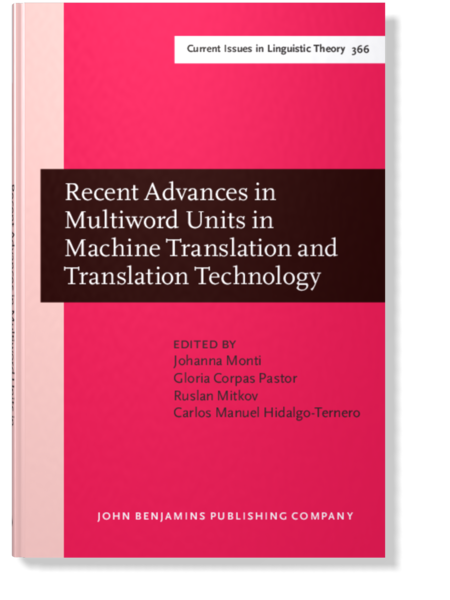
In:Recent Advances in Multiword Units in Machine Translation and Translation Technology
Edited by Johanna Monti, Gloria Corpas Pastor, Ruslan Mitkov and Carlos Manuel Hidalgo-Ternero
[Current Issues in Linguistic Theory 366] 2024
► pp. 124–140
Chapter 7Verb collocations and their semantics in the specialized language of science
Published online: 7 November 2024
https://doi.org/10.1075/cilt.366.07jim
https://doi.org/10.1075/cilt.366.07jim
Abstract
This chapter is concerned with verb collocations in the specialized language of science. I pay
attention to their semanticity, since my main objective is to discover the topics evoked in terms of their integrating
elements. The methodology applied is as follows: first, I compile a specialized corpus of research articles; second, I
automatically extract a list of collocation candidates, which is manually revised; third, the selected collocations
are semantically classified. As this work is motivated by a previous study on noun collocations, I perform a
comparative analysis. The findings are that noun and verb collocations share similar semantic frames, although the
method employed in each study yields different, but complementary, results.
Article outline
- 1.Introduction
- 2.Previous research: Noun collocations in scientific English
- 3.Methodology
- 4.Data analysis
- 4.1EXPERIMENTATION
- 4.2RESEARCH
- 4.3SUBJECTS
- 4.4CHANGE
- 4.5Comparative analysis: Noun collocations vs. verb collocations
- 5.Conclusions
Notes References

References (22)
Biber, D., & Barbieri, F. (2007). Lexical
bundles in university spoken and written registers. English for Specific
Purposes, 26(3), 263–286.
British National
Corpus, version 3 (BNC XML
Edition). Distributed by Bodleian
Libraries, University of Oxford, on behalf of the BNC Consortium. [URL]
Collins English
Dictionary. HarperCollins Publishers.
Evert, S. (2009). Corpora
and collocations. In A. Lüdeling & M. Kytö (Eds.), Corpus
linguistics: An international handbook, volume
2 (pp. 1212–1248). Walter de Gruyter.
Fillmore, C. J. (1982). Frame
semantics. In Linguistic Society of
Korea (Ed.), Linguistics in the morning
calm (pp. 111–137). Hanshin Publishing Company.
(2006). Frame
semantics. In D. Geeraerts, R. Dirven, & J. R. Taylor (Eds.), Cognitive
linguistics: Basic
readings (pp. 373–400). Mouton de Gruyter.
FrameNet. International Computer
Science Institute.
Gledhill, C. (2009). Colligation
and the cohesive function of present and past tense in the scientific research
article. In D. Banks (Ed.), Les Temps et les textes de
spécialité (pp. 65–84). L’Harmattan.
Halliday, M. A. K. (1993). On
the language of physical science. In M. A. K. Halliday & J. R. Martin (Eds.), Writing
science: Literacy and discursive
power (pp. 54–68). The Falmer Press.
Jiménez-Navarro, E. L. (2019). Nominal
collocations in scientific English: A frame-semantic
approach. In G. Corpas Pastor & R. Mitkov (Eds.), Computational
and corpus-based
phraseology (pp. 187–199). Springer.
Luzón Marco, M. J. (2000). Collocational
frameworks in medical research papers: A genre-based study. English for
Specific
Purposes, 19(1), 63–86.
Newton, I. (1704). Opticks
or a treatise of the reflections, refractions, inflections and colours of
light. Dover Publications 1952.
Pérez-Llantada, C. (2014). Formulaic
language in L1 and L2 expert academic writing: Convergent and divergent
usage. Journal of English for Academic
Purposes, 14, 84–94.
Pęzik, P. (2018). Facets
of prefabrication. Perspectives on modelling and detecting phraseological
units. Wydawnictwo Uniwersytetu Łódzkiego.
Sketch
Engine [Computer software]. Lexical Computing
Limited.