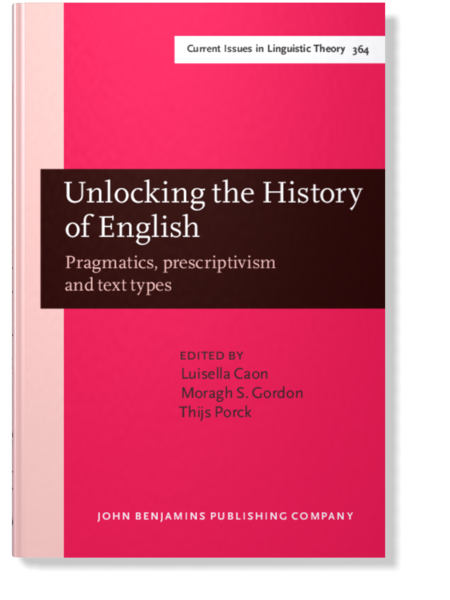
In:Unlocking the History of English: Pragmatics, prescriptivism and text types
Edited by Luisella Caon, Moragh S. Gordon and Thijs Porck
[Current Issues in Linguistic Theory 364] 2024
► pp. v–vi
Published online: 4 April 2024
https://doi.org/10.1075/cilt.364.toc
https://doi.org/10.1075/cilt.364.toc
Table of contents
ForewordVII
Ingrid Tieken-Boon van Ostade
Introduction: Unlocking the history of English1
Luisella Caon
Moragh Gordon
Thijs Porck
Part I.Pragmatics and prescriptivism
Researching understatement in the history of English10
Claudia Claridge
The rise and fall of sentence-internal capitalization in English: A corpus-based approach33
Jessica Nowak
Stefan Hartmann
Gender, genre, and prescriptivism: Eighteenth-century female playwrights’ use of you was and you were60
James Hyett
Carol Percy
Part II.Political, legal and medical text types
A manipulative technique in a congressional debate: A case study from 178986
Juhani Rudanko
Paul Rickman
Is legal discourse really “outside the ravages of time”? A diachronic analysis of nominalizations in British judicial decisions101
Paula Rodríguez-Puente
Duties, offices, and conduct: The lexis of moral sense and practical ethics in late eighteenth-century medical
writing129
Elisabetta Lonati
Part III.The language of late modern letters
Changing styles of letter-writing? Evidence from 400 years of early English letters in a POS-tagged corpus154
Tanja Säily
Turo Vartiainen
Harri Siirtola
Terttu Nevalainen
“No criticism or remarks & pray burn it as fast as you read it”: Exploring copying practices in Mary Hamilton’s private correspondence180
Tino Oudesluijs
Filled-in petition forms and hand-drafted petitions to the Foundling
Hospital: A comparison and the influence of letter-writing manuals198
Hospital: A comparison and the influence of letter-writing manuals198
Nuria Calvo Cortés
“Quhen I am begun to write I really knou not what to say”: Inter- and intra-writer variation in the use of <quh‑> in Early Modern Scots225
Sarah van Eyndhoven
Index
