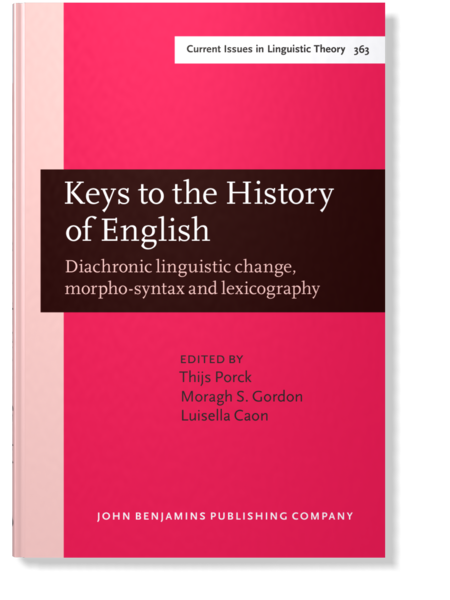
In:Keys to the History of English: Diachronic linguistic change, morpho-syntax and lexicography
Edited by Thijs Porck, Moragh S. Gordon and Luisella Caon
[Current Issues in Linguistic Theory 363] 2024
► pp. 212–232
Investigating the dynamics of the lexicon
A socio-historical perspective of the borrowing of Yiddish words into English
Published online: 4 April 2024
https://doi.org/10.1075/cilt.363.10lan
https://doi.org/10.1075/cilt.363.10lan
Abstract
This chapter focuses on the lexical influence of Yiddish on English throughout its history. The findings
rely on an analysis of the linguistic evidence in electronic dictionaries and corpora. Specific value will be accorded
to the use of Yiddish borrowings in informal language. Yiddish has provided English with a number of terms relating to
various semantic domains, ranging from gastronomy, faith and religion, to people and everyday life. An important
objective is to provide an overview of the domains influenced by Yiddish over time. Particular attention will be given
to socio-cultural and historical reasons that might explain the introduction and spread of Yiddish borrowings into
different domains over the centuries, contributing to variation in the English lexicon.
Article outline
- 1.Introduction
- 2.Previous studies on the impact of Yiddish on English
- 3.Methodology
- 4.Types of loan influences
- 5.Subject areas influenced by Yiddish over the centuries
- 5.1Discussion of the results
- 6.Conclusion
Notes References

References (34)
Benor, S. B. 2000. Loan
words in the English of modern Orthodox Jews: Yiddish or
Hebrew? In S. Chang (Ed.), Proceedings
of the Berkeley Linguistic Society’s 25th annual meeting,
1999, 287–298. Berkeley Linguistics Society.
2010. Ethnolinguistic
repertoire: Shifting the analytic focus in language and
ethnicity. Journal of
Sociolinguistics 14(2). 159–183.
2011. Mensch,
bentsh, and balagan: Variation in the American Jewish linguistic
repertoire. Language &
Communication 31. 141–154.
Bernstein, C. G. 2006. Representing
Jewish identity through
English. In J. Brutt-Griffler & C. Evans Davies (Eds.), English
and
ethnicity, 107–129. Palgrave Macmillan.
BNC = British National
Corpus. Originally compiled by Oxford University Press. [URL]
Carstensen, B. 1968. Zur
Systematik und Terminologie deutsch-englischer
Lehnbeziehungen. In H. Brekle & L. Lipka. (Eds.), Wortbildung,
Syntax und Morphologie. Festschrift zum 60. Geburtstag von Hans Marchand am 1.
Oktober 1967, 32–45. Mouton.
COCA = Corpus of Contemporary American
English. Compiled by M. Davies. [URL]
Feinsilver, L. M. 1958. Like
influences from Yiddish and Pennsylvanian German. American
Speech 33(3). 231–233.
Fishman, J. A. 1965. Yiddish
in America. Socio-linguistic description and
analysis. Bloomington: Indiana University.
Haspelmath, M. 2008. Loanword
typology: Steps toward a systematic cross-linguistic study of lexical
borrowability. In T. Stolz, D. Bakker & R. Salas Palomo (Eds.), Aspects
of language contact: New theoretical, methodological and empirical findings with special focus on
Romancisation
processes, 43–62. Mouton de Gruyter.
2009. Lexical
borrowing: Concepts and
issues. In M. Haspelmath & U. Tadmor (Eds.), Loanwords
in the World’s languages: A comparative
handbook, 35–54. Mouton de Gruyter.
Hellerstein, K. 1980. Yiddish
voices in American
English. In L. Michaels & C. Ricks (Eds.), The
state of the
language, 182–201. University of California Press.
Horn, D. 2006. The
future of Yiddish – in English: Field notes from the New
Ashkenaz. The Jewish Quarterly
Review 96(4). 471–480.
Landmann, J. 2023. The
dynamic lexicon of English: A socio-cognitive approach towards loan processes and their linguistic
effects. Brill.
Movie Corpus. Compiled by M.
Davies. [URL]
Myers-Scotton, C. 2002. Contact
linguistics: Bilingual encounters and grammatical
outcomes. Oxford University Press.
OED = Oxford English
Dictionary. Oxford University Press. [URL]
Ornstein-Galicia, J. L. 1988. The
bottom line: Affective borrowing from Yiddish in colloquial American
English. Orbis: International Journal of General
Linguistics and Linguistic
Documentation 35. 171–190.
Schmid, H. 2018. Ein
integratives soziokognitives Modell des dynamischen
Lexikons. In S. Engelberg, H. Lobin, K. Steyer & S. Wolfer (Eds.), Wortschätze:
Dynamik, Muster, Komplexität (Institut für Deutsche Sprache
Jahrbuch
2017), 215–231. De Gruyter.
Schultz, J. 2019. The
impact of Yiddish on the English language: An overview of lexical borrowing in the variety of subject areas
and spheres of life influenced by Yiddish over
time. English
Today 35(3). 2–7.
Soap Corpus = Corpus of American Soap
Operas. Compiled by M. Davies. [URL]
Steinmetz, S. 2001. Yiddish
and English: The story of Yiddish in America, 2nd
edn. The University of Alabama Press.
Thomason, S. 2003. Contact
as a source of language
change. In R. D. Janda & B. D. Joseph (eds.), A
handbook of historical
linguistics, 687–712. Blackwell.
TV Corpus. Compiled by Mark
Davies. [URL]
Cited by (1)
Cited by one other publication
This list is based on CrossRef data as of 6 december 2025. Please note that it may not be complete. Sources presented here have been supplied by the respective publishers. Any errors therein should be reported to them.