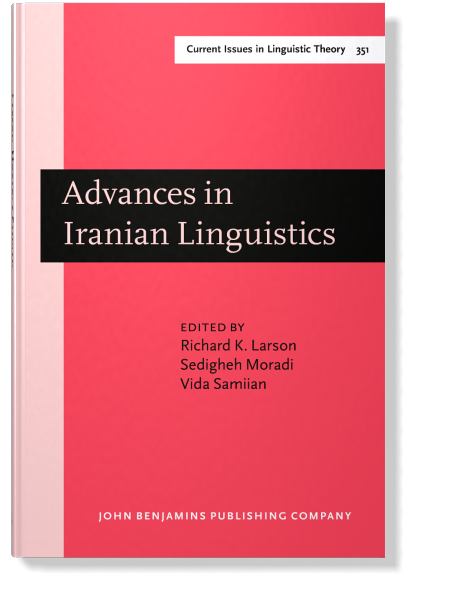
In:Advances in Iranian Linguistics
Edited by Richard K. Larson, Sedigheh Moradi and Vida Samiian
[Current Issues in Linguistic Theory 351] 2020
► pp. 1–14
Chapter 1Advances in Iranian linguistics
An introduction
Published online: 22 July 2020
https://doi.org/10.1075/cilt.351.01mor
https://doi.org/10.1075/cilt.351.01mor
Abstract
The diffusion of Iranian languages throughout a large part of the world, their deep recorded history, the remarkably intricate typological variation they show, and their extensive contact with languages belonging to different linguistic families make Iranian linguistics a fascinating and highly promising area for research in linguistic theory. Despite this remarkable scientific potential, however, and unlike the situation with nearly every other major language family, there are few collections of works focusing exclusively on languages of the Iranian family. The present volume is part of a current ongoing effort to address this gap, providing a theoretically informative and constructive venue for scholars working in Iranian linguistics. The twelve chapters of the current volume are selected from over 40 papers presented at the first North American Conference in Iranian Linguistics (NACIL1) held at Stony Brook University, April 28–30, 2017.
Article outline
- 1.Iranian languages as a stable diversity hub
- 2.Classification of Iranian languages
- 3.Iranian linguistics
- 3.1Diachronic and typological studies
- 3.2Modern studies
Notes References

References (37)
Corbett, Greville. 2003. Agreement: Canonical instances and the extent of the phenomenon. In Booij, Geert E., Janet DeCesaris, Angela Ralli, and Sergio Scalise (eds.), Topics in morphology: Selected papers from the Third Mediterranean Morphology Meeting, 109–128. Barcelona: Universitat Pompeu Fabra.
. 2006. Internal and external forces in typology: Evidence from Iranian languages. Journal of Universal Language 7(1). 29–47.
. 2001. Word order typology of Iranian languages. The Journal of Humanities of the Islamic Republic of Iran 8(2). 17–23.
Eberhard, David M., Gary F. Simons, and Charles D. Fennig (eds.). 2019. Ethnologue: Languages of the world. 22nd edition. Dallas, Texas: SIL International. Online version: [URL]
Ghomeshi, Jila. 1997. Non-projecting nouns and the ezafe: Construction in Persian. Natural Language and Linguistic Theory 15(4). 729–788.
Haig, Geoffrey. 2008. Alignment change in Iranian languages: A construction grammar approach. Berlin: Walter de Gruyter.
Iranskie Iazyki. (3 vols): Yugo-Zapadnye Iranskie Iazyki. 1997; Severo-Zapadnye Iranskie Iazyki. 1999; Vostochnye Iranskie Iazyki. 2000.
Johnson, Edwin Lee. 1917. Historical grammar of the ancient Persian language (Vol. 8). New York: American Book Company.
Kolokonte, Marina. 2008. Bare argument ellipsis and information structure. Newcastle: Newcastle University dissertation.
Lazard, Gilbert. 1992. A Grammar of Contemporary Persian. Vol. 106. Costa Mesa, CA: Mazda Publishers.
Moyne, John Abel. 1970. The Structure of Verbal Construction in Persian. Cambridge: Harvard University dissertation.
Narasimhan, Vagheesh M., Nick Patterson, Priya Moorjani, Nadin Rohland, Rebecca Bernardos, Swapan Mallick, et al. 2019. The formation of human populations in South and Central Asia. Science 365, eaat7487.
Nichols, Johanna. 1992. Linguistic diversity in space and time. Chicago: University of Chicago Press.
Nyberg, Henrik Samuel. 1923. The Pahlavi documents from Avromân. In Le Monde Oriental 17(2/3). 182–230.
Paul, Ludwig. 2003. The position of Balochi among Western Iranian languages: The verbal system. In Carina Jahani and Agnes Korn (eds.), The Baloch and their neighbors: Ethnic and linguistic contact in Balochistan in historical and modern times, 61–71. Wiesbaden: Reichert Verlag.
. 1998. The position of Zazaki among West Iranian languages. In Nicholas Sims-Williams (ed.), Proceedings of the Third European Conference of Iranian Studies held in Cambridge. Part I: Old and Middle Iranian studies, 163–177. Wiesbaden: Dr. Ludwig Reichert.
Payne, John R., and Behrooz Mahmoodi-Bakhtiari. 2009. Iranian languages. In Bernard Comrie (ed.). The world’s major languages, 453–460. London: Routledge.
Samiian, Vida. 1983. Structure of phrasal categories in Persian: An X-bar analysis. Los Angeles, CA: UCLA dissertation.
Sedighi, Anousha, and Pouneh Shabani-Jadidi (eds.). 2018. The Oxford handbook of Persian linguistics. Oxford: Oxford University Press.
Skjærvø, Prods Oktor. 2006. Iran vi. Iranian languages and scripts. Encyclopædia Iranica, XIII/4. 344–377, available online at [URL] (accessed on 30 December 2012).
Stilo, Donald. 2009. An introduction to the Araxes-Iran linguistic area. Manuscript. Leipzig: Max Planck Institute for Evolutionary Anthropology.
. 2006. Circumpositions as an areal response: The case study of the Iranian zone. In Lars Johanson and Christiane Bulut (eds.). Turkic-Iranian contact areas: Historical and linguistic aspects, 310–333. Wiesbaden: Harrassowitz Verlag.
. 2005. Iranian as buffer zone between the universal typologies of Turkic and Semitic. In Éva Ágnes Csató, Bo Isaksson and Carina Jahani (eds.). Linguistic convergence and areal diffusion: Case studies from Iranian, Semitic and Turkic, 35–63. London; New York: Routledge.
Cited by (1)
Cited by one other publication
This list is based on CrossRef data as of 6 december 2025. Please note that it may not be complete. Sources presented here have been supplied by the respective publishers. Any errors therein should be reported to them.