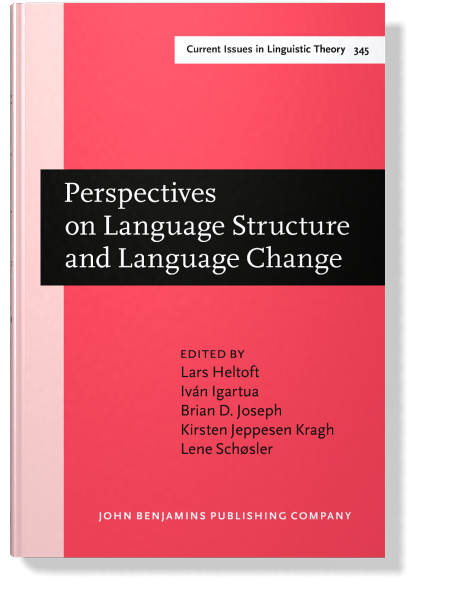
In:Perspectives on Language Structure and Language Change: Studies in honor of Henning Andersen
Edited by Lars Heltoft, Iván Igartua, Brian D. Joseph, Kirsten Jeppesen Kragh and Lene Schøsler
[Current Issues in Linguistic Theory 345] 2019
► pp. 205–231
Aspects of grammaticalization and reanalysis in the voice domain in the transition from Latin to early Italo-Romance
Published online: 18 June 2019
https://doi.org/10.1075/cilt.345.09cen
https://doi.org/10.1075/cilt.345.09cen
Abstract
This article discusses some aspects of the grammaticalization and reanalysis of lexical verbs as passive auxiliaries and light verbs in the passage from Latin to (Italo-)Romance, focussing on (i) the diachronic relationship between auxiliarization and light verbs, (ii) the direction of the changes and (iii) the pertinacity to change of light verbs. The light verb uses of the verbs under investigation (COME, BECOME), both in Late Latin and in some early Italo-Romance vernaculars, exhibit a different type of decategorialization and desemanticization compared with auxiliaries, attested later than their auxiliary function.
Keywords: grammaticalization, reanalysis, voice, light verbs, auxiliaries
Article outline
- 1.Introduction
- 2.Auxiliarization, light verb constructions and voice
- 2.1Auxiliaries vs light verbs
- 2.1.1Auxiliarization and changes in the argument structure of predicates
- 2.1.2Light/vector/serial verbs and argument structure
- 2.1Auxiliaries vs light verbs
- 3.Light verbs and (passive) auxiliaries in Late Latin and early (Italo-)Romance
- 3.1Fieri and its early Italo-Romance continuants
- 3.2Venire in Late Latin and early Italo-Romance
- 4.Origin of BECOME and COME as voice markers and light verbs
- 4.1Light verb behaviour of the passive auxiliary essere ‘be’
- 5.Auxiliaries, light verbs and change in the passage to Italo-Romance
- 6.Conclusions
Acknowledgements Abbreviations Notes Old Italian sources

References (73)
Ascanio De’ Mori, Novelle = Parabosco, Girolamo. 1832. Raccolta di novellieri italiani, vol. 3. 1: 945. Florence: Tipografia Borghi & Compagni.
Bonvesin = Contini, Gianfranco. 1937 (ed.). Cinque Volgari di Bonvesin de la Riva. Modena: Società Tipografica Modenese (Second half of the 13th century, Lombard: Milanese).
Caternu = Rinaldi, Gaetana M. 1989. Il <<Caternu>> dell'Abate Angelo Senisio. L'Amministrazione del Monastero di San Martino delle Scale dal 1371 al 1381. Palermo: Centro di Studi Filologici e Linguistici Siciliani.
Cronica degli imperadori = Ceruti, Antonio. 1878 (ed.). Cronica degli imperadori. Archivio Glottologico Italiano Vol. 3: 177–243 1301,Venetian
Decameron = Branca, Vittore. 1976 (ed.).
Giovanni Boccaccio, Decameron
. Florence: Accademia della Crusca (1370, Florentine).
Leggenda di messer Gianni di = Cappelli, Andrea. 1861. Leggenda di messer Gianni di Procida (Giovanni di Procida e il Vespro siciliano). In Miscellanea di opuscoli inediti e rari dei secoli XIV e XV, vol. I, 43–68. Turin: Unione Tipografico-Editrice
Metamorfosi d'Ovidio = Basi, Casimiro & Guasti, Cesare. 1848 (eds.). Cinque altri libri delle Metamorfosi d'Ovidio volgarizzate da ser Arrigo Simintendi da Prato (libri VI-XV), vol. II. Prato, per Ranieri Guasti (Tuscan, 1333).
Il Novellino = Conte, Alberto. 2001 (ed.). Il Novellino. Roma: Salerno (End of the 13th century, 1281–1300).
Passione = Salvioni, Carlo. 1886 (ed.). La Passione e altre antiche scritture lombarde. Archivio Glottologico Italiano Vol. 9: 1–22. (15th century, Lombard (Comasco).
Pistole di Seneca = Bottari, Giovanni. 1717 (ed.).
Volgarizzamento delle Pistole di Seneca e del Trattato della Provvidenza di Dio
. Florence: Tartini & Franchi (1325?, Florentine).
Straparola = Pastore Stocchi, Manlio. 1979 (ed.). Giovan Francesco Straparola, Le piacevoli notti, vol. 1, Bari: Laterza.
Tavola Ritonda = Polidori, Filippo L.1864 (ed.).La Tavola Ritonda o l'Istoria di Tristano. Bologna: Romagnoli (1350, Florentine).
Trecentonovelle=Pernicone, Vincenzo.1946. Sacchetti, Il Trecentonovelle. Firenze: Sansoni (1400, Florentine) Sposizione del Vangelo Secondo Matteo = Palumbo, Pietro. 1954 (ed.). Sposizione del Vangelo della Passione secondo Matteo, vols. I–II. Palermo: Centro di studi filologici e linguistici siciliani.
Villani, Cronica = Porta, Giovanni. 1990/91. Giovanni Villani, Nuova Cronaca. Parma: Fondazione Pietro Bembo/Ugo Guanda Editore (1348, Florentine).
References
Acedo-Matellán, Víctor. 2015. The morphosyntax of transitions. A case study in Latin and other languages. Oxford: Oxford University Press.
Adams, James N. 2013. Social variation and the Latin language. Cambridge: Cambridge University Press.
Aikhenvald Alexandra, Y. 2006. Serial verb constructions in typological perspective. In Alexandra Y. Aikhenvald, & Robert M. W. Dixon (eds.), Serial verb constructions: A cross-linguistic typology, 1–68. Oxford: Oxford University Press.
Ambrosini, Riccardo. 2000. Sulla sintassi del verbo nella prosa toscana del Dugento ovvero tempo e aspetto nell'italiano antico. Lingua e Stile 35.4: 121–146.
Andersen, Henning. 2001. Actualization and the (uni)directionality of change. In Henning Andersen (ed.), Actualization: Linguistic change in progress, 226–248. Amsterdam: John Benjamins.
. 2006. Grammation, regrammation, and degrammation: Tense loss in Russian. Diachronica 23. 231–258.
. 2008. Grammaticalization in a speaker-oriented theory of change. In Thórhallur Eythórsson (ed.), Grammatical change and linguistic theory: The Rosendal papers. 11–44. Amsterdam: John Benjamins.
Bertuccelli Papi, Marcella. 1980. Studi sulla diatesi passiva in testi italiani antichi. Pisa: Pacini.
Bisang, Walter. 2008. Grammaticalization and the areal factor – the perspective of East and mainland Southeast Asian languages. In María J. López & Elena Seoane (eds.), Rethinking grammaticalization, 55–88. Amsterdam: John Benjamins.
. 2011. Grammaticalization and linguistic typology. In Heiko Narrog & Bernd Heine (eds.), 105–117.
Butt, Miriam. 1997. Complex predicates in Urdu. In Alex Alsina, Joan Bresnan & Peter Sells (eds.), 107–149.
. 2010. The light verb jungle: Still hacking away. In Mengistu Amberber, Brett Baker, & Mark Harvey (eds.), Complex predicates: Cross-linguistic perspectives on event structure, 48–78. Cambridge: Cambridge University Press.
Butt, Miriam & Aditi Lahiri. 2003. Historical stability vs. historical change. MS: University of Konstanz.
Cennamo, Michela. 2003. Perifrasi passive in testi non toscani delle origini. In Nicoletta Maraschio & Teresa Poggi Salani (eds.), Italia linguistica anno Mille, Italia linguistica anno Duemila, Atti del XXXIV Congresso della Società di Linguistica Italiana (Florence, 18–20 October 2000), 105–127. Rome: Bulzoni.
. 2005. Passive auxiliaries in Late Latin. In Sándor Kiss & Giampaolo Salvi (eds.), Festschrift Herman, 179–196. Tübingen: Niemeyer.
. 2006. The rise and grammaticalization paths of Latin fieri and facere as passive auxiliaries. In Werner Abraham & Larisa Leisiö (eds.), Passivization and typology, 311–336. Amsterdam: John Benjamins.
. 2007. Auxiliaries and serials between Late Latin and early Romance. In Delia Bentley & Adam Ledgeway (eds.), Sui dialetti italoromanzi. Saggi in onore di Nigel B. Vincent, The Italianist, Special supplement 1. 63–87.
. 2016. Voice. In Martin Maiden & Adam Ledgeway (eds.), The Oxford guide to the Romance languages, 967–980. Oxford: Oxford University Press.
Dik, Simon. 1987. Copula auxiliarization: how and why? In Martin Harris & Palo Ramat (eds.), Historical development of auxiliaries, 54–84. Berlin: Mouton De Gruyter.
Giacalone Ramat, Anna. 2000. Some grammaticalization patterns for auxiliaries. In John C. Smith & Delia Bentley (eds.), Historical Linguistics 1995, vol. 1, 125–154. Amsterdam: John Benjamins.
Giacalone Ramat, Anna & Andrea Sansò. 2014.
Venire (‘come’) as a passive auxiliary in Italian. In Maud Devos & Jenneke van der Wal (eds.), Come and go off the beaten grammaticalization path, 21–44. Berlin: Mouton de Gruyter.
Harris, Alice C. & Lyle Campbell. 1995. Historical syntax in cross-linguistic perspective. Cambridge: Cambridge University Press.
Haspelmath, Martin. 1987. Transitivity alternations of the anticausative type, Köln: Institut für Sprachwissenschaft. Universität zu Köln. (Arbeitspapiere N.F. 5).
. 1990. The grammaticization of passive morphology. Studies in Language 14: 25–70.
. 2011. On S, A, P, T and R as comparative concepts for alignment typology. Linguistic Typology 15. 535–567.
. 2016. The Social verb construction: comparative concept and cross-linguistic generalizations. Language and Linguistics 17.291–319.
Heine, Bernd. 1993. Auxiliaries. Cognitive forces and grammaticalization. Oxford: Oxford University Press.
. 2003. Grammaticalization. In Brian Joseph & Robert D. Janda (eds.), The Handbook of Historical Linguistics, 576–601. Oxford: Blackwell.
Heine, Bernd & Tania Kuteva. 2011. The areal dimension of grammaticalization. In Heiko Narrog & Bernd Heine (eds.), 291–301.
Heltoft, Lars. 2017. The regrammation of paradigms: The development of auxiliaries in Danish. Acta Linguistica Hafniensia 49. 255–285.
Hook, Peter E. 1974. The Compound Verb in Hindi. Ann Arbor: Centre for South and Southeast Asian Studies: The University of Michigan.
Hook, Peter E. 1991. The emergence of perfective aspect in Indo-Aryan languages. In Elisabeth C. Traugott & Bernd Heine (eds.), Approaches to Grammaticalization, vol. Vol. II, 59–89. Amsterdam: John Benjamins.
Hopper, Paul J. & Elisabeth Closs Traugott. 1993. Grammaticalization. Cambridge: Cambridge University Press.
Kragh, Kirsten Jeppesen & Lene Schøsler. 2015. Regrammation and paradigmatization: Diachronic analysis of a number of progressive periphrases in French. Journal of French Language Studies 25. 265–293.
La Fauci, Nunzio. 2000. Modularità della diatesi: convergenze e divergenze grammaticali nel passivo. In Fabiana Fusco, Vincenzo Orioles & Alice Parmeggiani (eds.), Processi di convergenza e differenziazione nelle lingue dell'Europa medievale e moderna, 73–97. Udine: Forum.
Ledgeway, Adam. 2009. Grammatica diacronica del napoletano, Tübingen: Niemayer. Beihefte zur Zeitschrift für romanische Philologie 350.
Lehmann, Christian. 2002. Thoughts on grammaticalization, 2nd revis. edn. Erfurt: Arbeitspapiere des Seminars für Sprachwissenschaft der Universität Erfurt.
Löfstedt, Einar. 1938/39. Lateinisch-Griechisches und Lateinisch-Romanisches. Studia Neophilologica 11. 173–185.
Michaelis, Susanne. 1998. Antikausativ als Brücke zum Passiv: fieri, venire und se im Vulgärlateinische und Altitalienischen. In Wolfgang Dahmen, Günter Holtus, Johannes Kramer, Michael Metzeltin & Otto Winkelmann (eds.), Neuere Beschreibungsmethoden der Syntax romanischen Sprachen, Tübingen: Narr, 69–98.
Narrog, Heiko & Bernd Heine. 2011 (eds.),
The Oxford Handbook of Grammaticalization
. Oxford: Oxford University Press.
Osam, E. Keku. 2004. An introduction to the structure of Akan: its verbal and multiverbal systems. Legon: (Ghana) Department of Linguistics.
Pinkster, Harm. 2015. The Oxford Latin syntax. Vol. I: The simple clause. Oxford: Oxford University Press.
Rohlfs, Gerhard. 1969. Grammatica storica della lingua italiana e dei suoi dialetti. Morfologia. Torino: Einaudi.
Rosen, Carol. 1997. Auxiliation and serialization: on discerning the difference. In Alex Alsina, Joan Bresnan & Peter Sells (eds.), 175–202.
Salvi, Giampaolo. 2010. La realizzazione della struttura argomentale. In Giampaolo Salvi & Lorenzo Renzi (eds.), Grammatica dell'italiano antico, 122–189. Bologna: Il Mulino.
Seiss, Melanie. 2009. On the difference between auxiliaries, serial verbs and light verbs. In Miriam Butt & Tracy Holloway King (eds.), Proceedings of the LFG09 conference. Stanford: CSLI, 501–519.
Squartini, Mario. 2003. La grammaticalizzazione di <venire + participio> in italiano: anticausativo o Risultativo?. In Claus D. Pusch & Andreas Wesch (eds.), Verbalperiphrasen in den (ibero-)romanischen Sprachen. Hamburg: Buske, 23–34.
Svennung, Josef. 1935.
Untersuchungen zu Palladius und zur Lateinischen Fach- und Volkssprache
. Uppsala: Almqvist & Wiksell.
Cited by (2)
Cited by two other publications
Luraghi, Silvia, Guglielmo Inglese & Daniel Kölligan
Cennamo, Michela
2020. The actualization of new voice patterns in Romance. In Historical Linguistics 2017 [Current Issues in Linguistic Theory, 350], ► pp. 109 ff.
This list is based on CrossRef data as of 6 december 2025. Please note that it may not be complete. Sources presented here have been supplied by the respective publishers. Any errors therein should be reported to them.