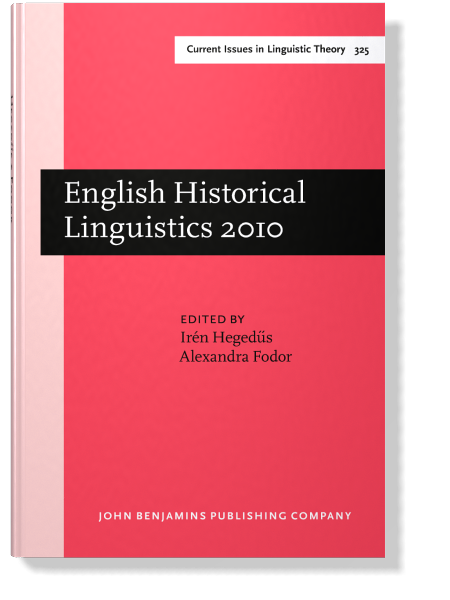
In:English Historical Linguistics 2010: Selected Papers from the Sixteenth International Conference on English Historical Linguistics (ICEHL 16), Pécs, 23-27 August 2010
Edited by Irén Hegedűs and Alexandra Fodor
[Current Issues in Linguistic Theory 325] 2012
► pp. v–vi
Get fulltext
This article is available free of charge.
Published online: 13 November 2012
https://doi.org/10.1075/cilt.325.toc
https://doi.org/10.1075/cilt.325.toc
Table of contents
Foreword & Acknowledgements
Introduction: Coins, clothes and corpora: Ways and means to refine investigations into the history of English
Norse influence on English in the light of general contact linguistics
The Germanic roots of the Old English sound system
Monetary policy and Old English dialects
The order and schedule of nominal plural formation transfer in three Southern dialects of Early Middle English
The temporal and regional contexts of the numeral ‘two’ in Middle English
Grammaticalisation, contact and corpora: On the development of adverbial connectives in English
Discourse organization and the rise of final then in the history of English
The origins of how come and what…for
“Providing/provided that”: Grammaticalization or loan translation?
Prefer: The odd verb out
The 400 million word Corpus of Historical American English (1810–2009)
Gender change from Old to Middle English
“Please tilt me-ward by return of post”: On the vicissitude of a marginal pronominal construction in the history of English
Multilingualism in the vocabulary of dress and textiles in late medieval Britain: Some issues for historical lexicology
“No man entreth in or out”: How are typologically unsuitable loanverbs integrated into English?
Beyond questions and answers: Strategic use of multiple identities in the historical courtroom
The demise of gog and cock and their phraseologies in dramatic discourse: A study into historical pragmatics of tabooistic distortions
Index
