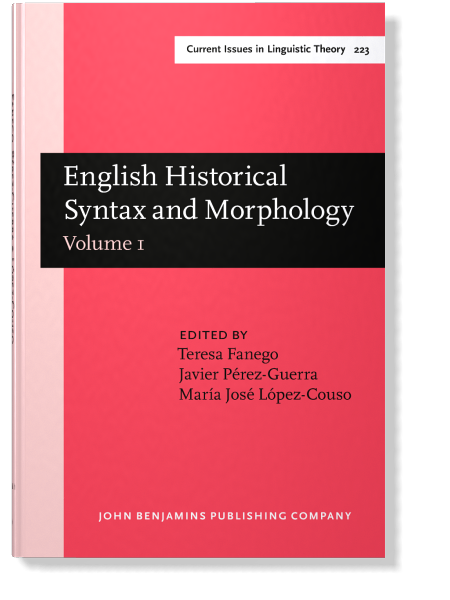
In:English Historical Syntax and Morphology: Selected papers from 11 ICEHL, Santiago de Compostela, 7–11 September 2000
Edited by Teresa Fanego, Javier Pérez-Guerra and María José López-Couso
[Current Issues in Linguistic Theory 223] 2002
► pp. v–vi
Get fulltext
This article is available free of charge.
Published online: 18 July 2002
https://doi.org/10.1075/cilt.223.toc
https://doi.org/10.1075/cilt.223.toc
Table of contents
Addressesvii
Acknowledgementsix
Introduction
Two types of passivization of ‘V+NP+P’ constructions in relation to idiomatization
On the development of a friend of mine
Historical shifts in modification patterns with complex noun phrase structures: How long can you go without a verb?
Grammaticalization versus lexicalization reconsidered: On the late use of temporal adverbs
The derivation of ornative, locative, ablative, privative and reversative verbs in English: A historical sketch
From gold-gifa to chimney sweep? Morphological (un)markedness of Modern English agent nouns in a diachronic perspective
A path to volitional modality
Is it, stylewise or otherwise, wise to use -wise? Domain adverbials and the history of English -wise
The loss of the indefinite pronoun man: Syntactic change and information structure
The progressive in Older Scots
Detransitivization in the history of English from a semantic perspective
Morphology recycled: The Principle of Rhythmic Alternation at work in Early and Late Modern English grammatical variation
Name index
Subject index
