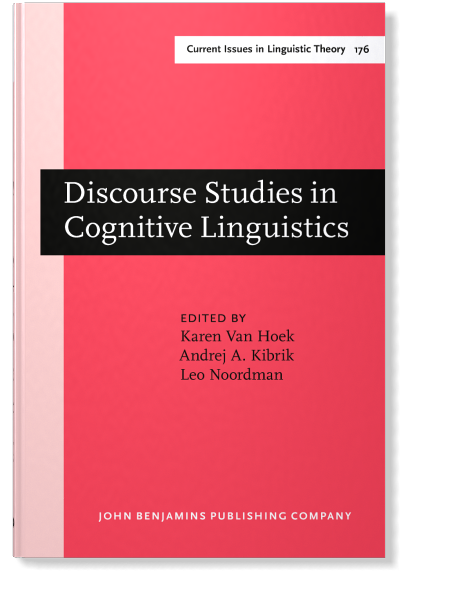
In:Discourse Studies in Cognitive Linguistics: Selected papers from the 5th International Cognitive Linguistics Conference, Amsterdam, July 1997
Edited by Karen Van Hoek, Andrej A. Kibrik and Leo Noordman
[Current Issues in Linguistic Theory 176] 1999
► pp. 133–148
Prosodic Markers of Text Structure
Published online: 15 June 1999
https://doi.org/10.1075/cilt.176.11noo
https://doi.org/10.1075/cilt.176.11noo

Cited by (8)
Cited by eight other publications
Abdalla, Mohamed, Frank Rudzicz & Graeme Hirst
Schwanenflugel, Paula J., Matthew R. Westmoreland & Rebekah George Benjamin
YANG, Xiaohong, Mingxing XU & Yufang YANG
Zhang, Liang, Yuan Jia & Aijun Li
Benjamin, Rebekah George, Paula J. Schwanenflugel, Elizabeth B. Meisinger, Carolyn Groff, Melanie R. Kuhn & Lilly Steiner
Yang, Xiaohong & Yufang Yang
Kuhn, Melanie R., Paula J. Schwanenflugel & Elizabeth B. Meisinger
This list is based on CrossRef data as of 5 december 2025. Please note that it may not be complete. Sources presented here have been supplied by the respective publishers. Any errors therein should be reported to them.