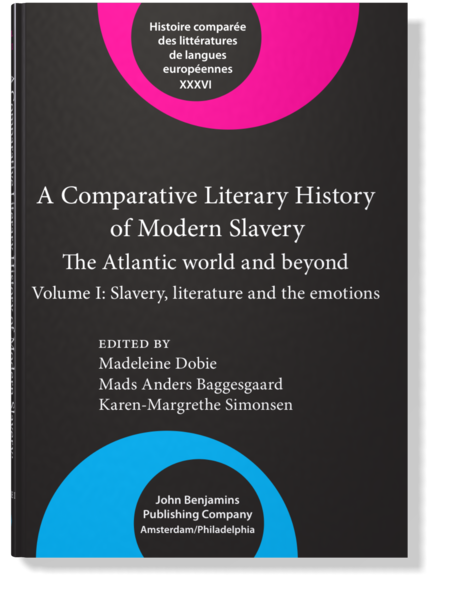
In:A Comparative Literary History of Modern Slavery: The Atlantic world and beyond
Edited by Madeleine Dobie, Mads Anders Baggesgaard and Karen-Margrethe Simonsen
[Comparative History of Literatures in European Languages XXXVI] 2024
► pp. 173–190
Chapter 9“No one can imagine my feelings”
The rhetoric of race, slavery, and emotional difference in the antebellum South
Published online: 12 December 2024
https://doi.org/10.1075/chlel.xxxvi.09dwy
https://doi.org/10.1075/chlel.xxxvi.09dwy
Abstract
This chapter details the ideological foundations of the emotional norms of slavery and debates over whether those
practices and feelings were tied to race or to slave status. It examines how theories of racialized emotional difference circulated,
and the proslavery ramifications of those ideas, as well as how formerly enslaved people used the medium of slave narratives to refute
white supremacist ideas about their affective inferiority and subvert the expectations of sentimental audiences. Abolitionists’
argument that emotional differences were rooted in slave status, not race, jeopardized proslavery ideology and individual
slaveholders, as it meant that after Emancipation, black people would expect the same emotional liberty as free people.
Keywords: United States, antebellum period, abolitionism, sentimentalism, slave narratives
Article outline
- Transient griefs and beastly cruelty
- Social constructs and biological imperatives
- The feelings of a freeman
- Feelings only a slave can imagine
- Feelings no words can express
- A stranger to sensibility
- Conclusion
Notes References

References (35)
Ball, Charles. 1859. Fifty
years in chains; or, the Life of an American slave. New York: H. Dayton Publishers.
Bibb, Henry. (1849)
1969. “Narrative of the life and adventures of Henry Bibb, an American slave, written by
himself.” In Puttin’ on ole massa: The slave narratives of Henry Bibb,
William Wells Brown, and Solomon Northup, edited by Gilbert Osofsky, 51–171. New York: Harper & Row.
Blassingame, John, ed. 1998. Slave
testimony: Two centuries of letters, speeches, interviews, and autobiographies. Baton Rouge: Louisiana State University Press.
Brown, Henry. (1849)
2002. Narrative of the life of Henry ‘Box’ Brown, written by himself, edited
by Richard Newman and Henry Gates, Jr. New York: Oxford University Press.
Brown, William. (1847)
1969. “Narrative of William W. Brown, a fugitive slave, written by
himself.” In Puttin’ on ole massa: The slave narratives of Henry Bibb,
William Wells Brown, and Solomon Northup, edited by Gilbert Osofsky, 173–223. New York: Harper & Row.
Cassity, Michael. 1985. Legacy
of fear: American race relations to 1900. Westport, Connecticut: Greenwood Press.
Clark, Elizabeth. 1995. ‘The
sacred rights of the weak’: Pain, sympathy, and the culture of individual rights in antebellum
America.” The Journal of American
History
82
: 463–493.
Craft, William. 1991. Running
a Thousand Miles for Freedom; Or, the Escape of William and Ellen Craft from Slavery. Salem, NH: Ayer Company Publishers, Inc.
Dew, Thomas R. 1852. “Professor Dew on
slavery.” In The pro-slavery argument: As maintained by the most
distinguished writers of the southern states, containing the several essays, on the subject, of Chancellor Harper, Governor
Hammond, Dr. Simms, and Professor
Dew, 287–490. Charleston: Walker, Richards and Co.
. (1845)
2003. Narrative of the life of Frederick Douglass, an American slave. New York: Barnes and Noble Classics.
Faust, Drew Gilpin. 1981. The Ideology of Slavery: Proslavery
Thought in the Antebellum South, 1830–1860. Baton Rouge: Louisiana State University Press.
Flint, Timothy. 1826. Recollections
of the last ten years, passed in occasional residences and journeyings in the valley of the Mississippi, from Pittsburg and the
Missouri to the Gulf of Mexico, and from Florida to the Spanish frontier; in a series of letters to the Rev. James Flint of Salem,
Massachusetts. Boston: Cummings, Hilliard, & Company.
Fredrickson, George. 1971. The
Black Image in the White Mind: The Debate on Afro-American Character and Destiny,
1817–1914. Hanover, NH: Wesleyan University Press.
Hammond, James H. 1852. “Hammond’s Letters on
Slavery.” In The pro-slavery argument: As maintained by the most
distinguished writers of the southern states, containing the several essays, on the subject, of Chancellor Harper, Governor
Hammond, Dr. Simms, and Professor
Dew, 98–174. Charleston: Walker, Richards and Co.
Harper, William. 1852. “Harper’s
memoir on slavery.” In The pro-slavery argument: As maintained by the
most distinguished writers of the southern states, containing the several essays, on the subject, of Chancellor Harper, Governor
Hammond, Dr. Simms, and Professor
Dew, 1–98. Charleston: Walker, Richards and Co.
Heglar, Charles. 2001. Rethinking
the Slave Narrative: Slave Marriage and the Narratives of Henry Bibb and William and Ellen
Craft. Westport, CT: Greenwood Press.
Henson, Josiah. 1849. The
Life of Josiah Henson: Formerly a Slave, Now an Inhabitant of
Canada. Boston: Arthur D. Phelps.
Hunter, Tera. 2017. Bound
in Wedlock: Slave and Free Black Marriage in the Nineteenth Century. Cambridge, MA: Belknap Press.
Jacobs, Harriet. (1861)
2001. Incidents in the Life of a Slave Girl. Mineola, NY: Dover Publications, Inc.
Jefferson, Thomas. 1802. Notes
on The State of Virginia, With an Appendix. Boston: Printed by H. Sprague.
Johnson, Walter. 1999. Soul
by Soul: Life Inside the Antebellum Slave Market. Cambridge, MA: Harvard University Press.
Kemble, Frances A. 1992. Journal of a residence on a Georgian
plantation in 1838–1839. Savannah: GA, Beehive Foundation.
Lane, Lunsford. (1842)
1968. “The Narrative of Lunsford Lane, formerly of Raleigh,
N.C.” In Five slave narratives: A
compendium, edited by William Katz, 1–54. New York: Arno Press.
Northup, Solomon. (1853)
1969. “Twelve Years A Slave.” In Puttin’ on
ole massa: The slave narratives of Henry Bibb, William Wells Brown, and Solomon Northup, edited
by Gilbert Osofsky, 225–406. New York: Harper & Row.
Pollard, Edward. (1859)
1968. Black diamonds gathered in the darkey homes of the south. New York: Negro Universities Press.
Rogers, Molly. 2010. Delia’s
Tears: Race, Science, and Photography in Nineteenth-Century America. New Haven: Yale University Press.
Sanchez-Eppler, Karen. 1990. Touching
Liberty: Abolition, Feminism and the Politics of the
Body. Berkeley: University of California Press.
Sawyer, George. 1858. Southern
institutes: An inquiry into the origin and early prevalence of slavery and the
slave-trade. Philadelphia: J.B. Lippincott & Co.
Stroyer, Jacob. (1898)
1968. “My Life in the South.” In Five slave
narratives: A compendium, edited by William Katz, 3–100. New York: Arno Press.
Tadman, Michael. 1989. Speculators
and Slaves: Masters, Traders and Slaves in the Old South. Madison, WI: University of Wisconsin Press.
Tawil, Ezra. 2006. The
Making of Racial Sentiment: Slavery and the Birth of the Frontier Romance. New York: Cambridge University Press.