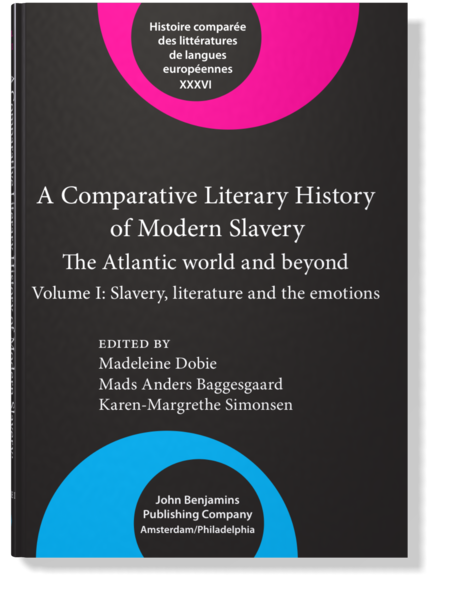
In:A Comparative Literary History of Modern Slavery: The Atlantic world and beyond
Edited by Madeleine Dobie, Mads Anders Baggesgaard and Karen-Margrethe Simonsen
[Comparative History of Literatures in European Languages XXXVI] 2024
► pp. 18–33
Chapter 1Slavery, sentimentality and the abolition of affect
Published online: 12 December 2024
https://doi.org/10.1075/chlel.xxxvi.01fes
https://doi.org/10.1075/chlel.xxxvi.01fes
Abstract
This essay addresses the way details about the unspeakable conditions on the slave ships interrupt the
sentimentalization of the plight of the enslaved in order to examine the political volatility of affect — in particular, disgust — in
the late eighteenth-century metropolitan debates over the abolition of the slave trade. While disgust, with its capacity to assign
abject qualities to objects, would seem to be the province of the proslavery advocates seeking to strip the enslaved of their claim to
humanity, this volatile affect also plays a role in abolitionist efforts to convert visceral responses to descriptions of the Middle
Passage into an impetus for action, making dehumanizing revulsion into moral outrage.
Keywords: abolition, Great Britain Parliament, sentimentality, affect, slave trade, disgust

References (41)
Ahern, Stephen, ed. 2013. Affect
and Abolition in the Anglo-Atlantic, 1770–1830. Farnham, UK: Ashgate.
, ed. 2017. “Nothing
More than Feelings?: Affect Theory Reads the Age of Sensibility.” The Eighteenth Century: Theory
and
Interpretation 58 (3): 281–295.
Baucom, Ian. 2005. Specters
of the Atlantic: Finance Capital, Slavery, and the Philosophy of History. Durham, NC: Duke UP.
Berlant, Lauren. 2008. “Intuitionists,
History and the Affective Event.” American Literary
History 20: 845–60.
Boulukos, George. 2008. The
Grateful Slave: The Emergence of Race in Eighteenth-Century British and American
Culture. Cambridge: Cambridge University Press.
Burn, Andrew. 1792. A
Second Address to the People of Great Britain Containing a New, and Most Powerful Argument to Abstain from the Use of West India
Sugar, 2nd ed. London: M. Gurney.
Byrd, Alexander. 2008. Captives
and Voyagers: Black Migrants across the Eighteenth-Century British Atlantic World. Baton Rouge: Louisiana State University Press.
Clarkson, Thomas. 1788. An
essay on the slavery and commerce of the human species: particularly the African, translated from a Latin dissertation, which was
honored with the first prize in the University of Cambridge, for the year 1785. 2nd edition, rev. and
considerably enlarged. London: Printed and sold by J. Phillips.
. 1789. The
Substance of the Evidence of Sundry Persons on the Slave Trade Collected in the Course of a Tour Made in the Autumn of the Year
1788. London: James Phillips.
. 1808. History
of the Rise, Progress, and Accomplishment of the Abolition of the Slave
Trade, 3 vols. London: Longman, Hurst, Rees, and Orme.
Cobbett, William. 1817. The
Parliamentary History of England from the Earliest Period to the Year
1803, 36 vols. London: T. C. Hansard.
Dobie, Madeleine. 2008. “Translation
in the Contact Zone: Antoine Galland’s Mille et une nuits: contes
arabes
.” In The Arabian Nights in Historical Context: Between
East and West, edited by Saree Makdisi and Felicity Nussbaum. Oxford: Oxford University Press, 25–49.
Ellis, Julie. 1999. Cato’s
Tears and the Making of Anglo-American
Emotion. Chicago: University of Chicago Press.
Falconbridge, Alexander. 1788. An
Account of the Slave Trade on the Coast of
Africa. London: James Phillips.
Favret, Mary. 1998. “Flogging:
The Anti-Slavery Movement Writes Pornography.” In Romanticism and
Gender, edited by Anne Janowitz. Cambridge: D.S. Brewer.
Festa, Lynn. 2006. Sentimental
Figures of Empire in Eighteenth-Century Britain and
France. Baltimore: Johns Hopkins University Press.
Fox, Charles James. 1853. The Speeches of the Right Honourable
Charles James Fox in the House of Commons, 3rd
ed. London: Aylott and Co.
Great Britain. Parliament. House of
Commons. 1791. Abridgment of the Evidence, taken before a select committee of the
whole house, to whom it was referred to consider of the
Slave-trade. London: n.p.
Gregg, Melissa and Gregory Seigworth. 2010. “Introduction.” In The
Affect Theory Reader. Durham: Duke UP.
Halttunen, Karen. 1995. “Humanitarianism
and the Pornography of Pain in Anglo-American Culture.” American Historical
Review 100 (2): 303–334.
Johnson, Claudia. 1995. Equivocal
Beings: Politics, Gender, and Sentimentality in the
1790s. Chicago: University of Chicago Press.
Lambert, Sheila. 1975. House
of Commons Sessional Papers of the Eighteenth
Century. Wilmington: Scholarly Resources, Inc.
Massumi, Brian. 2002. Parables
for the Virtual: Movement, Affect, Sensation. Durham: Duke University Press.
Pinch, Adela. 1996. Strange
Fits of Passion: Epistemologies of Emotion, Hume to
Austen. Stanford: Stanford University Press.
Rancière, Jacques. 2010. “Ten
Theses on Politics.” In Dissensus: On Politics and
Aesthetics, translated by Steven Corcoran. London: Bloomsbury Academic, 35–52, 44.
Samuels, Shirley, ed. 1992. The
Culture of Sentiment: Race, Gender, and Sentimentality in Nineteenth-Century America. New York: Oxford University Press.
Smallwood, Stephanie. 2008. Saltwater
Slavery: A Middle Passage from Africa to American
Diaspora. Cambridge: Harvard University Press.
Spinks, Lee. 2001. “Thinking
the Post-Human: Literature, Affect, and the Politics of Style.” Textual
Practice 15.1: 23–46.
Sussman, Charlotte. 2000. Consuming
Anxieties: Consumer Protest, Gender, and British Slavery,
1713–1833. Stanford: Stanford University Press.