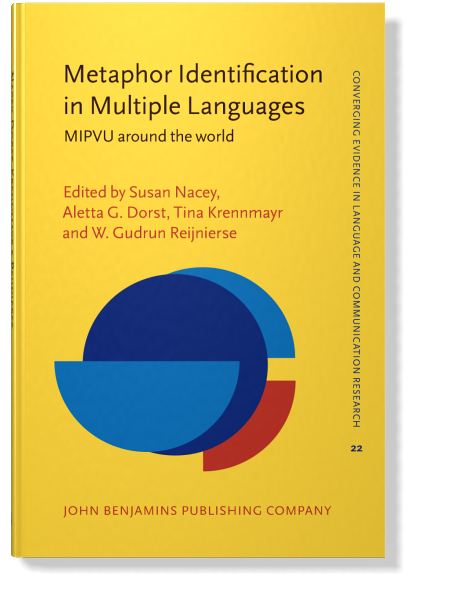
In:Metaphor Identification in Multiple Languages: MIPVU around the world
Edited by Susan Nacey, Aletta G. Dorst, Tina Krennmayr and W. Gudrun Reijnierse
[Converging Evidence in Language and Communication Research 22] 2019
► pp. 247–265
Chapter 12Linguistic metaphor identification in Chinese
Published online: 28 November 2019
https://doi.org/10.1075/celcr.22.12wan
https://doi.org/10.1075/celcr.22.12wan
Article outline
- 12.1Introduction
- 12.2Operationalisation issues
- 12.2.1Data of this study
- 12.2.2Choice of lexical tools
- 12.2.3Use of lexical tools
- 12.2.3.1Sense descriptions
- 12.2.3.2Part-of-speech information
- 12.3Linguistic issues
- 12.3.1Demarcation of lexical units in Chinese texts
- 12.3.2Chinese-specific types of lexical units
- 12.3.2.1Verb-object compounds
- 12.3.2.2Resultative verb compounds
- 12.3.2.3Reduplications
- 12.3.2.4Proper names, idioms and fixed expressions
- 12.4Annotation categories
- 12.4.1Indirect metaphor
- 12.4.2Direct metaphor
- 12.4.3Implicit metaphor
- 12.4.4Borderline cases
- 12.5Conclusions
Notes References

References (32)
Cheung, C. C.-H. (2016). Chinese: Parts of speech. In S.-W. Chan (Ed.), The Routledge encyclopedia of the Chinese language (pp. 242–294). London: Routledge.
Chien, L., & Harris, R. A. (2010). Scheme trope chroma chengyu: Figuration in Chinese
four-character idioms. Cognitive Semiotics,
6
, 155–178.
Commercial Press Dictionary Research Centre. (2010). hanyu xuexi cidian [A learner’s dictionary of Modern Chinese]. Beijing: Commercial Press.
Chuang, Y. -C. (2012). Gestures, language, and what they reveal about
thought. In F. MacArthur, J. L. Oncins-Martínez, M. Sánchez-García, & A. M. Piquer-Píriz (Eds.), Metaphor in use: Context, culture, and communication (pp. 261–281). Amsterdam: John Benjamins.
DeFrancis, J. (1989). Visible speech: The diverse oneness of writing systems. Honolulu, HI: University of Hawaii Press.
Deignan, A. (2015). MIP, the corpus, and dictionaries: What makes the best
for metaphor analysis? Metaphor and the Social World 5(1), 145–154.
Dorst, A. G. (2011). Personification in discourse: Linguistic forms,
conceptual structures and communicative functions. Language and Literature 20(2), 113–135.
Dorst, A. G., & Kaal, A. A. (2012). Metaphor in discourse: Beyond the boundaries of
MIP. In F. MacArthur, J. L. Oncins-Martínez, M. Sánchez-García, & A. M. Piquer-Píriz (Eds.), Metaphor in use: Context, culture, and communication (pp. 51–68). Amsterdam: John Benjamins.
Han, C. (2014). Metaphor and entertainment: A corpus-based approach to language
in Chinese online news. New York, NY: Palgrave Macmillan.
Huang, C.-R., Hsieh, S.-K., Hong, J.-F., Chen, Y.-Z., Su, I.-L., Chen, Y.-X., & Huang, S.-W. (2010). Chinese WordNet: Design, implementation, and application
of an infrastructure for cross-lingual knowledge
processing. Journal of Chinese Information Processing 24(3), 14–23.
Huang, C.-R., & Xue, N. (2015). Modelling word concepts without convention: Linguistic
and computational issues in Chinese word
identification. In W. S.-Y. Wang, & C.-F. Sun (Eds.), The Oxford handbook of Chinese linguistics (pp. 348–361). New York, NY: Oxford University Press.
Jing-Schmidt, Z. (2008). Much mouth much tongue: Chinese metonymies and metaphors
of verbal behaviour. Cognitive Linguistics 19(2), 241–282.
Lee, L.-H., Hsieh, S.-K., & Huang, C.-R. (2009). CWN-LMF: Chinese WordNet in the lexical markup
framework. Proceedings of the 7th Workshop on Asian Language Resources (pp.123–130). Stroudsburg, PA: Association for Computational Linguistics.
Li, X. (Ed.) (2014). Xiandai hanyu guifan cidian (3rd Ed.) [A standard dictionary of Modern Chinese]. Beijing: Foreign Language Teaching and Research Press.
Li, C. N., & Thompson, S. A. (1981). Mandarin Chinese: A functional reference grammar. Berkeley: University of California Press.
Lu, X., & Wang, B. P.-Y. (2017). Towards a metaphor-annotated corpus of Mandarin
Chinese. Language Resources & Evaluation 51(3), 663–694.
McEnery, T., & Xiao, R. (2004). The Lancaster corpus of Mandarin Chinese: A corpus for
monolingual and contrastive language study. In M. Lino, M. Xavier, F. Ferreira, R. Costa & R. Silva (Eds.), Proceedings of the Fourth International Conference on Language Resources and
Evaluation (pp.1175–1178). Paris: European Language Resources Association.
Packard, J. L. (2000). The morphology of Chinese: A linguistic and cognitive
approach. Cambridge: Cambridge University Press.
Pasma, T. (2012). Metaphor identification in Dutch
discourse. In F. MacArthur, J. L. Oncins-Martínez, M. Sánchez-García, & A. M. Piquer-Píriz (Eds.), Metaphor in use: Context, culture, and communication (pp. 69–83). Amsterdam: John Benjamins.
Pragglejaz Group (2007). MIP: A method for identifying metaphorically used words
in discourse. Metaphor and Symbol 22(1), 1–39.
Steen, G. J., Dorst, A. G., Herrmann, J. B., Kaal, A. A., Krennmayr, T., & Pasma, T. (2010). A method for linguistic metaphor identification: From MIP to
MIPVU. Amsterdam: John Benjamins.
Tay, D. (2015). Metaphor in case study articles on Chinese university
counselling service websites. Chinese Language and Discourse 6(1), 28–56.
Thompson, S. A. (1973). Resultative verb compounds in Mandarin Chinese: A case
for lexical rules. Language 49(2), 361–379.
Tsou, B. K., & Kwong, O. Y. (2015). Some basic and salient linguistic features across Chinese
speech communities from a corpus linguistics
perspective. In W. S.-Y. Wang, & C.-F. Sun (Eds.), The Oxford handbook of Chinese linguistics (pp. 601–614). New York; NY: Oxford University Press.
Veale, T., Shutova, E., & Beigman Klebanov, B. (2016). Metaphor: A computational perspective. San Rafael, CA: Morgan & Claypool Publishers.
Wiedenhof, J. (2015). A grammar of Mandarin. Amsterdam: John Benjamins.
Cited by (8)
Cited by eight other publications
Shao, Lu, Binghan Zheng & Haiyan Wan
Yang, Kaiwen & Ya Sun
Li, Tianhao & Sirong He
Liu, Yufeng & Dechao Li
Mannoni, Michele & Silvia Cavalieri
2024. Metaphors for legal terms concerning vulnerable people. Terminology. International Journal of Theoretical and Applied Issues in Specialized Communication 30:1 ► pp. 134 ff.
Chow, Mei-Yung Vanliza & Jeannette Littlemore
2022. Metaphorical conceptualizations of cancer treatment in English and Chinese languages. International Journal of Language and Culture 9:2 ► pp. 194 ff.
Mannoni, Michele
This list is based on CrossRef data as of 5 december 2025. Please note that it may not be complete. Sources presented here have been supplied by the respective publishers. Any errors therein should be reported to them.