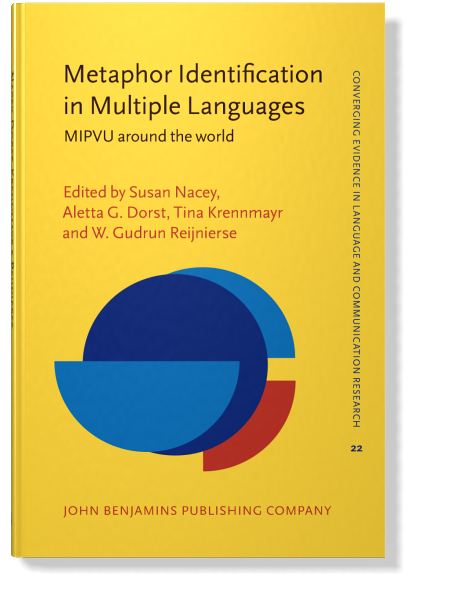
In:Metaphor Identification in Multiple Languages: MIPVU around the world
Edited by Susan Nacey, Aletta G. Dorst, Tina Krennmayr and W. Gudrun Reijnierse
[Converging Evidence in Language and Communication Research 22] 2019
► pp. 183–202
Chapter 9Linguistic metaphor identification in Polish
Published online: 28 November 2019
https://doi.org/10.1075/celcr.22.09mar
https://doi.org/10.1075/celcr.22.09mar
Article outline
- 9.1Introduction
- 9.2Data collection and coding
- 9.3Linguistic issues
- 9.3.1Demarcation of lexical units: Unitisation
- 9.3.2Establishing the basic and contextual sense: Itemisation
- 9.3.2.1Dictionary issues
- 9.3.2.2Grammatical category
- 9.3.2.3Prepositions
- 9.3.2.4Borrowings
- 9.3.2.5Novel metaphors at the level of morphology
- 9.3.3Metaphor and declination
- 9.3.4Metaphor categorisation: Direct, indirect and implicit metaphors
- 9.4Sample analysis
- 9.5Applying MIPVU to Polish: Reliability measures
- 9.6MIPVU for Polish: Final guidelines and conclusions
Acknowledgements Notes References

References (21)
Badryzlova, Y., Isaeva, Y., Shekhtman, N., & Kerimov, R. (2013). Annotating a Russian corpus of conceptual metaphor: A
bottom-up approach. In Proceedings of the Workshop on Metaphor in NLP. Atlanta, GA, 13 June 2013, 77–86. [URL]
Bralczyk, J., Sobol, E., Drabik, L., Kłosińska, A., Kubiak-Sokół, A., Stankiewicz, A. Szewczyk, M., & Wiśniakowska, L. (2005). Słownik języka polskiego. Warszawa: Wydawnictwo Naukowe PWN. [URL]
Dobrzyńska, T. (1994). Mówiąc przenośnie …: studia o metaforze. Warszawa: Instytut Badań Literackich PAN.
Juszczyk, K., & Kamasa, V. (2016). Ku metodzie identyfikacji wyrażeń
metaforycznych dla polszczyzny na przykładzie rozmów o karierze
zawodowej. Język a Komunikacja 37, 177–186.
Landis, J. R., & Koch, G. G. (1977). The measurement of observer agreement for categorical
data. Biometrics 33(1), 159–174.
Marhula, J., & Rosiński, M. (2014). Identifying metaphor in spoken discourse: Insights from
applying MIPVU to radio talk data. Studia Anglica Rasoviensia 11, 32–43.
Pragglejaz Group (2007). MIP: A method for identifying metaphorically used words
in discourse. Metaphor & Symbol 22(1), 1–39.
Przybylska, R. (2002). Polisemia przyimków polskich w świetle semantyki
kognitywnej. Kraków: Universitas.
Radden, G., & Matthis, E. (2002). Why ‘similar to’, but ‘different from.’ In H. Cuyckens & G. Radden (Eds.), Perspectives on prepositions (pp.231–255). Berlin: Max Niemeyer Verlag.
Steen, G. J. (2007). Finding metaphor in grammar and usage. Amsterdam: John Benjamins.
Steen, G. J., Dorst, A. G., Herrmann, J. B., Kaal, A. A., Krennmayr, T., & Pasma, T. (2010). A method for linguistic metaphor identification: From MIP to
MIPVU. Amsterdam: John Benjamins.
Urbonaitė, J. (2015). Metaphor identification procedure MIPVU: An attempt to
apply it to Lithuanian. Taikomoji kalbotyra 7, 1–25. [URL]
Cited by (8)
Cited by eight other publications
Gaskins, Dorota Katarzyna, Gabriella Rundblad & Michael Flor
Rosiński, Maciej
Bachryj, Maciej
Bajzát, Tímea Borbála & Simon Gábor
2024. A case study of comparative metaphor analysis in Finnish and Hungarian news texts. Journal of Uralic Linguistics 3:1 ► pp. 55 ff.
Zoltán Kövecses, Réka Benczes, Anna Rommel & Veronika Szelid
Johansson Falck, Marlene & Lacey Okonski
KALIN SALI, Mesout
This list is based on CrossRef data as of 5 december 2025. Please note that it may not be complete. Sources presented here have been supplied by the respective publishers. Any errors therein should be reported to them.