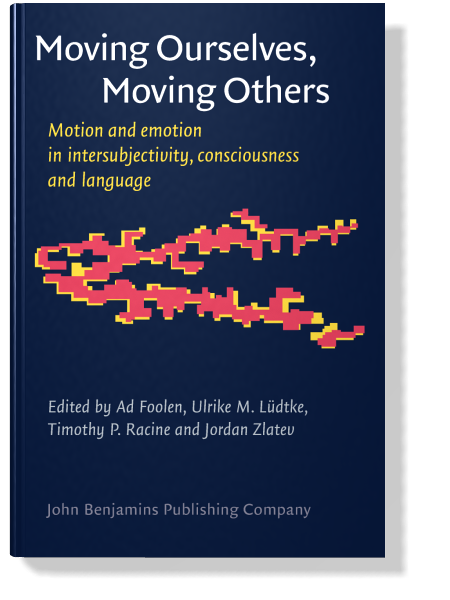
In:Moving Ourselves, Moving Others: Motion and emotion in intersubjectivity, consciousness and language
Edited by Ad Foolen, Ulrike M. Lüdtke, Timothy P. Racine and Jordan Zlatev
[Consciousness & Emotion Book Series 6] 2012
► pp. 451–484
Get fulltext
Epilogue
Natural sources of meaning in human sympathetic vitality
Available under the Creative Commons Attribution-NonCommercial-NoDerivatives (CC BY-NC-ND) 4.0 license.
For any use beyond this license, please contact the publisher at rights@benjamins.nl.
Published online: 12 April 2012
https://doi.org/10.1075/ceb.6.18tre
https://doi.org/10.1075/ceb.6.18tre
“It is by natural signs chiefly that we give force and energy to language; and the less language has of them, it is the less expressive and persuasive. […] Artificial signs signify, but they do not express; they speak to the understanding, as algebraical characters may do, but the passions, the affections, and the will, hear them not: these continue dormant and inactive, till we speak to them in the language of nature, to which they are all attention and obedience.”
Thomas Reid (1764). An Inquiry into the Human Mind on the Principles of Common Sense.

Cited by (9)
Cited by nine other publications
Kokkinaki, Theano
Marx, Viola & Emese Nagy
Trevarthen, Colwyn
2015. The developmental psychology and neuropsychology of emotion in language. In Emotion in Language [Consciousness & Emotion Book Series, 10], ► pp. 3 ff.
Trevarthen, Colwyn
Daly, Anya
Daly, Anya
Daly, Anya
Daly, Anya
This list is based on CrossRef data as of 15 november 2025. Please note that it may not be complete. Sources presented here have been supplied by the respective publishers. Any errors therein should be reported to them.