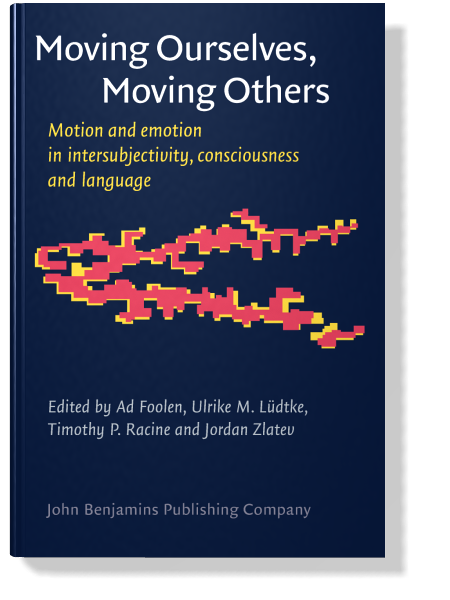
In:Moving Ourselves, Moving Others: Motion and emotion in intersubjectivity, consciousness and language
Edited by Ad Foolen, Ulrike M. Lüdtke, Timothy P. Racine and Jordan Zlatev
[Consciousness & Emotion Book Series 6] 2012
► pp. 243–260
Get fulltext
Reaching, requesting and reflecting
From interpersonal engagement to thinking
Available under the Creative Commons Attribution-NonCommercial-NoDerivatives (CC BY-NC-ND) 4.0 license.
For any use beyond this license, please contact the publisher at rights@benjamins.nl.
Published online: 12 April 2012
https://doi.org/10.1075/ceb.6.10car
https://doi.org/10.1075/ceb.6.10car
From many contemporary theoretical perspectives, the body and emotions play little role in the development of thinking and consciousness. If emotions are given any part it is in biasing thinking, rather then contributing to cognitive development. This volume, in contrast, presents alternatives to that position. From our perspective, embodied engagement with others – necessarily involving emotions – has a role in structuring the interactional conditions in which the development of thinking occurs. Just the body and emotions, however, are insufficient; the mythical baby isolated on a desert island would have a body and emotions (or at least the potential for their further development), but would not go on to develop human forms of thinking. What is needed is a shared history of routine patterns of interpersonal engagement. The body and emotions are necessary for setting up these forms of interaction and routines in which communication can emerge and then thinking and consciousness. In this sense, the development of human forms of thinking requires a social environment. We draw from Mead the point that self-awareness arises from interacting with others, and thus, self-consciousness is inherently social (Farr 1980; Mead 1909, 1910a, 1910b, 1922, 1934; Morss 1985). Keywords: Infant communication; gestures; social cognition; meaning; G.H. Mead

Cited by (2)
Cited by two other publications
Carpendale, Jeremy I. M. & Charlie Lewis
This list is based on CrossRef data as of 15 november 2025. Please note that it may not be complete. Sources presented here have been supplied by the respective publishers. Any errors therein should be reported to them.