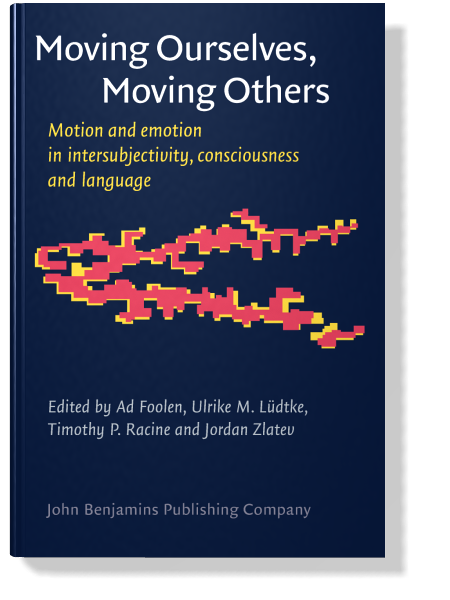
In:Moving Ourselves, Moving Others: Motion and emotion in intersubjectivity, consciousness and language
Edited by Ad Foolen, Ulrike M. Lüdtke, Timothy P. Racine and Jordan Zlatev
[Consciousness & Emotion Book Series 6] 2012
► pp. 197–220
Get fulltext
Intersubjectivity in the lifeworld
Meaning, cognition, and affect
Available under the Creative Commons Attribution-NonCommercial-NoDerivatives (CC BY-NC-ND) 4.0 license.
For any use beyond this license, please contact the publisher at rights@benjamins.nl.
Published online: 12 April 2012
https://doi.org/10.1075/ceb.6.08ful
https://doi.org/10.1075/ceb.6.08ful
Adequate accounts of intersubjectivity must recognise that it is a social, cognitive, and affective phenomenon. I draw on Jürgen Habermas’ formal-pragmatic theory of meaning and of the lifeworld as an alternative to phenomenological approaches. However, his conception of the lifeworld reflects a cognitivist bias. Intersubjectivity cannot be adequately conceptualised merely in terms of our mutual accountability and exchange or reasons; the affective dimension of our social interactions must also be recognised. I propose to redress this shortcoming by taking account of empirical research on intersubjectivity, joint attention, and attachment. This leads me to suggest supplementing the three Habermasian validity claims to truth, normative rightness, and sincerity with a fourth, a claim to attachment, which fits with understanding the earliest infant interactions in terms of altercentric participation. Since an adequate account of the social nature of linguistic communication must do justice not only to the lifeworld as a shared background of intelligibility, but also as a background against which differences in point of view are articulated, I conclude with a brief look at the ontogeny of perspective. Keywords: lifeworld; intersubjectivity; validity claims; attachment; cognition; affect; perspective; J. Habermas; M. Merleau-Ponty

Cited by (1)
Cited by one other publication
This list is based on CrossRef data as of 15 november 2025. Please note that it may not be complete. Sources presented here have been supplied by the respective publishers. Any errors therein should be reported to them.