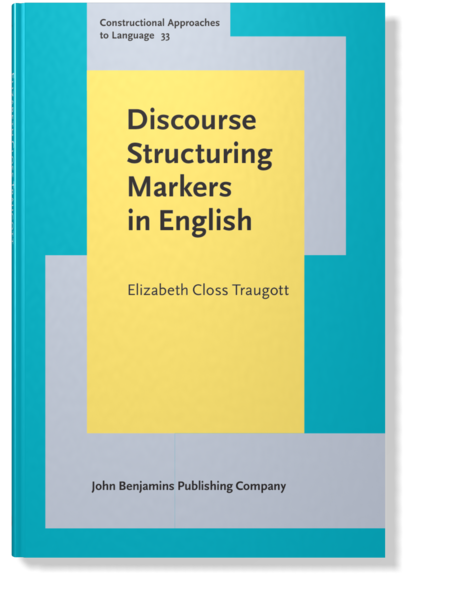
In:Discourse Structuring Markers in English: A historical constructionalist perspective on pragmatics
Elizabeth Closs Traugott
[Constructional Approaches to Language 33] 2022
► pp. v–x
Get fulltext
This article is available free of charge.
Published online: 4 March 2022
https://doi.org/10.1075/cal.33.toc
https://doi.org/10.1075/cal.33.toc
Table of contents
List of figures
xi
List of tables
xiii
List of abbreviations
xv
Preface and acknowledgments
xvii
Chapter 1.Introduction and overview
1
1.1Introduction
1
1.2Goals
3
1.3The empirical domain: Discourse Structuring Markers
3
1.4Overview of the book
6
1.5Data and methodology
12
1.6Summary
17
Part I.Foundations
19
Chapter 2.Cognitive linguistics and construction grammar
21
2.1Introduction
21
2.2Cognitive linguistics
21
2.3Goldberg’s model of construction grammar
23
2.4Croft’s (2001) model of a construction
26
2.5The semantics-pragmatics continuum
27
2.6Summary of key points
30
Chapter 3.A Diachronic Construction Grammar view of language change
33
3.1Introduction
33
3.2What changes and how?
34
3.2.1“Usage changes” vs. “grammar changes”
34
3.2.2Innovation vs. change
36
3.2.3Gradualness vs. abruptness
36
3.3Mechanisms for change
37
3.3.1Neoanalysis, analogy, borrowing and frequency
38
3.3.2Pragmatic inferencing
41
3.4Subjectification and intersubjectification
44
3.5Constructionalization and constructional changes
45
3.6A brief comparison of work on constructionalization and on grammaticalization
52
3.7Contexts for change
55
3.8Summary of key points
58
Chapter 4.Discourse Structuring Markers and some generalizations about how they arise
59
4.1Introduction
59
4.2Pragmatic markers
59
4.2.1Characteristics of Pragmatic Markers
60
4.2.2Characteristics of Discourse Markers
61
4.3Discourse Structuring Markers
63
4.3.1Constructional properties of Discourse Structuring Markers
64
4.3.2Types of Discourse Structuring Markers
67
4.3.3Interim summary
68
4.4Generalizations about the rise of Discourse Structuring Markers
69
4.4.1From Circumstance adverbial to [[Conjunct adverbial] ↔ [Discourse Structuring Marker]]
69
4.4.2From monofunctional to multifunctional Discourse Structuring Marker function
72
4.4.3Contexts for the rise of Discourse Structuring Markers
73
4.5A preliminary case study: The development of after all
74
4.5.1
After all in contemporary American English
75
4.5.2A sketch of the history of after all
76
4.6Summary
83
Chapter 5.Alternative hypotheses about the rise of Discourse Markers
85
5.1Introduction
85
5.2The grammaticalization hypothesis
86
5.3The pragmaticalization hypothesis
90
5.4The hypothesis of cooptation to thetical grammar
92
5.5The Diachronic Construction Grammar Hypothesis
97
5.6Summary comparison of the four approaches
99
Part II.Case studies
101
Chapter 6.The development of elaborative markers
103
6.1Introduction
103
6.2
Also
105
6.3
Further and furthermore
110
6.3.1
Further
110
6.3.2
Furthermore
112
6.4
Moreover
114
6.5Other elaborators
116
6.6Conclusion
118
Chapter 7.The development of contrastive markers
121
7.1Introduction
121
7.2
But
121
7.2.1Background
121
7.2.2The history of but
123
7.3
All the same
127
7.4
Instead
135
7.5Conclusion
137
Chapter 8.The development of markers of “digressive” topic shift
139
8.1Introduction
139
8.2
By the way
140
8.3Three relatively unproductive markers of digression
147
8.3.1
By the by
147
8.3.2
Incidentally and parenthetically
149
8.4Some other alleged digressives
151
8.5Summary
153
Chapter 9.The development of markers of return to a prior topic
155
9.1Introduction
155
9.2
To return to X point
157
9.3
Back to X point
159
9.4
Back to X topic
161
9.5Discussion
162
9.6Summary
164
Chapter 10.The development of combinations of DMs
165
10.1Introduction
165
10.2DM combinations with also
169
10.2.1
And + also
169
10.2.2
So + also
171
10.2.3Combinations of two DMs with also
172
10.3The combination now then
174
10.4The rise of the combination Oh, by the way
179
10.4.1OBTW1
180
10.4.2OBTW2
181
10.5
Oh combined with other DMs
184
10.6Discussion
184
10.7Conclusion
186
Part III.Three open issues for a historical constructionalist perspective on pragmatics
189
Chapter 11.Subjectification, intersubjectification and the rise of DSMs
191
11.1Introduction
191
11.2Characterizing subjectivity and intersubjectivity
192
11.3Characterizing subjectification and intersubjectification
193
11.4The relationship of textualization and (inter)subjectification in the development of DSMs
193
11.4.1Some generalizations
198
11.4.2Digressive markers, textualization, subjectification and intersubjectification
198
11.5Summary
201
Chapter 12.Clausal positions of DMs
203
12.1Introduction
203
12.2The main positions with respect to the clausal host
207
12.2.1Pre-clausal position
207
12.2.2Post-clausal position
209
12.2.3Clause-medial position
212
12.3A hypothesis about the relationship between subjectivity, intersubjectivity and position
213
12.4Two case studies revisited with position in focus
214
12.4.1Positions in which elaborative and contrastive after all is used
215
12.4.2Positions in which digressive by the way is used
219
12.5Conclusion
223
Chapter 13.Changes in networks and nodes
225
13.1Introduction
225
13.2The network metaphor
226
13.2.1“Vertical” inheritance networks
227
13.2.2“Horizontal” networks
229
13.3Networks and change
230
13.3.1Vertical inheritance networks and change
230
13.3.2Horizontal networks and change
231
13.4Representing changing networks
232
13.5Incorporating context into network models
235
13.6Conclusion
237
Chapter 14.Conclusion and prospects
239
14.1Introduction
239
14.2Summary of main points
239
14.3Some suggestions for further work
243
References
245
Index
267
