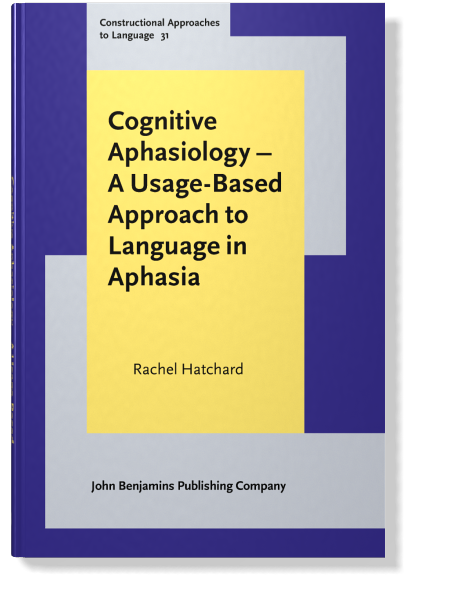
In:Cognitive Aphasiology – A Usage-Based Approach to Language in Aphasia
Rachel Hatchard
[Constructional Approaches to Language 31] 2021
► pp. vii–xii
Get fulltext
This article is available free of charge.
Published online: 11 October 2021
https://doi.org/10.1075/cal.31.toc
https://doi.org/10.1075/cal.31.toc
Table of contents
List of tables
List of figures
List of common abbreviations
Acknowledgements
Chapter 1.Introduction
Part I.Aphasia and linguistic theory
Chapter 2.Aphasia and the rule-based approach
Chapter 3.The constructivist, usage-based approach and its potential in aphasiology
Part II.Methods for research in Cognitive Aphasiology
Chapter 4.Method of data collection
Chapter 5.Developing a reliable transcription method
Chapter 6.Speech segmentation (extraction of strings for analysis)
Part III.Case study analyses of six speakers with aphasia
Chapter 7.Quantitative and qualitative analyses of verbs
Chapter 8.Quantitative analyses of strings
Chapter 9.Qualitative analyses of strings
Chapter 10.Overall discussion of findings, implications and limitations
Part IV.Looking forward
Chapter 11.What next for Cognitive Aphasiology?
References
Appendices
I.Language profiles of case study participants
II.Protocol for counting words in a speech sample
III.Transcription protocol
IV.First segmentation protocol
V.Second segmentation protocol (string extraction)
VI.Protocol for extraction and classification of verbs
VII.All verb tokens produced
by HB
VIII.All verb tokens produced by MH
IX.All strings and subordinate clauses produced by HB
X.All strings and subordinate clauses produced by MH
Index
