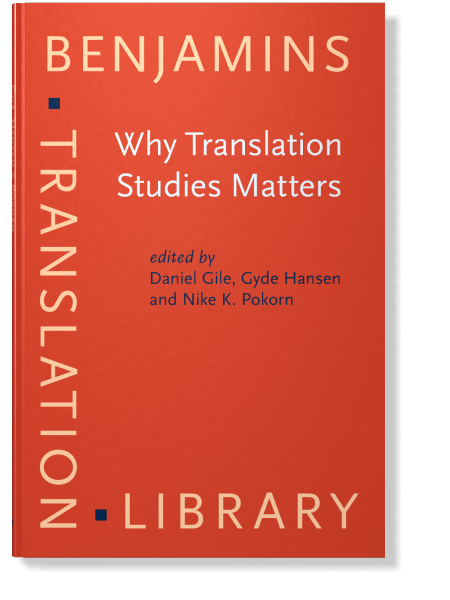
In:Why Translation Studies Matters
Edited by Daniel Gile, Gyde Hansen and Nike K. Pokorn
[Benjamins Translation Library 88] 2010
► pp. 97–104
Is Translation Studies going Anglo-Saxon?
Critical comments on the globalization of a discipline
Published online: 25 February 2010
https://doi.org/10.1075/btl.88.09sne
https://doi.org/10.1075/btl.88.09sne
The paper focusses on the dominant role of English in the academic discourse of Translation Studies and the effects this has on communication within the scientific community: the danger is increasing that the language English is not only used as a means of communication (e.g. with publications and conferences exclusively in English), but actually forms part of the object of discussion, dealing with facets of languages contrasted to English, and using English examples, whereby non-native speakers are disadvantaged, other approaches are ignored, and “pseudo-English” discourse is increasingly tolerated. The paper discusses the subtle difficulties involved in English academic discourse and presents a number of possible solutions, concentrating on the concept of passive multilingualism and the introduction of “bridge languages” as a means of gaining access to languages other than English or the active working language of the individual scholar.

Cited by (14)
Cited by 14 other publications
Skibińska, Elżbieta
Kaźmierczak, Marta
Kaźmierczak, Marta
Lee, Hyang & Won Jun Nam
Echeverri, Álvaro
Schedlitzki, Doris, Pasi Ahonen, Paresh Wankhade, Gareth Edwards & Hugo Gaggiotti
Megale, Fabrizio
Zhang, Junfeng & Yingping Pang
Steyaert, Chris & Maddy Janssens
Snell-Hornby, Mary
Snell-Hornby, Mary
2014. EST 2012—A vision fulfilled?. Target. International Journal of Translation Studies 26:2 ► pp. 239 ff.
Valdeón, Roberto A.
2013. Gambier, Yves & Luc van Doorslaer, eds. 2009. The metalanguage of translation. Target. International Journal of Translation Studies 25:3 ► pp. 439 ff.
This list is based on CrossRef data as of 4 december 2025. Please note that it may not be complete. Sources presented here have been supplied by the respective publishers. Any errors therein should be reported to them.