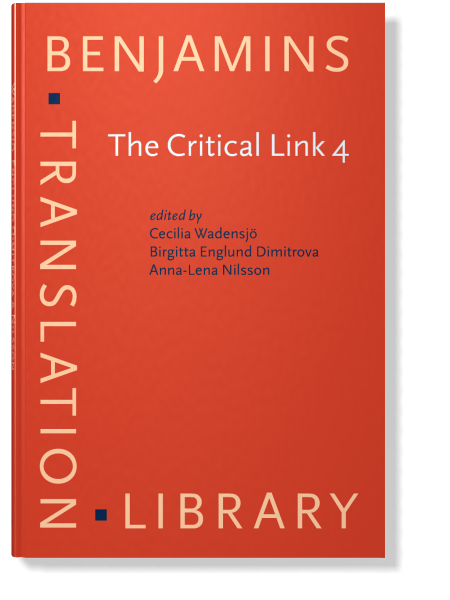
In:The Critical Link 4: Professionalisation of interpreting in the community
Edited by Cecilia Wadensjö, Birgitta Englund Dimitrova and Anna-Lena Nilsson
[Benjamins Translation Library 70] 2007
► pp. v–viii
Get fulltext
This article is available free of charge.
Published online: 16 May 2007
https://doi.org/10.1075/btl.70.toc
https://doi.org/10.1075/btl.70.toc
Table of contents
Acknowledgements
Foreword: Interpreting professions, professionalisation and professionalism
Critical linking up9
Critical linking up: Kinship and convergence in interpreting studies
Interpreters on duty in Interaction: Studies of micro dynamics25
The interpreter in multi-party medical encounters
Interpreting in asylum hearings: Issues of saving face
Conversational dynamics as an instructional resource in interpreter-mediated technical settings
A data driven analysis of telephone interpreting
Interpreters in the community: Studies of macro dynamics77
Interpreter-mediated police interviews: Working as a professional team
Community interpreting in Poland
Alternative futures for a National Institute of Translation: A case study from Malaysia
The interpreter’s ‘third client’: Interpreters, professionalism and interpreting agencies
Developing local standards133
The Swedish system of authorizing interpreters
Establishment, maintenance and development of a national register
From Aequitas to Aequalitas: Establishing standards in legal interpreting and translation in the European Union
The California standards for healthcare interpreters: Ethical principles, protocols and guidance on role and intervention
Professional ideology: Food for thought179
Professionalisation of interpreting with the community: Refining the model
Why bother? Institutionalisation, interpreter decisions and power relations
The interpreter as advocate: Malaysian court interpreting as a case in point
Professionalisation on interpreters: The case of mental health care
Professional stocks of interactional knowledge in the interpreter’s profession
Aristotelian ethics and modern professional interpreting
Improving and assessing professional skills: Training initiatives and programmes251
Formative assessment: Using peer and self-assessment in interpreter training
Interpreter internship program: Forging employer and community partnerships
On-line and between the lines: The internet and glossary production for public service interpreters
A bachelor programme in interpreting: An example from the Netherlands
From helpers to professionals: Training of community interpreters in Sweden
Index
