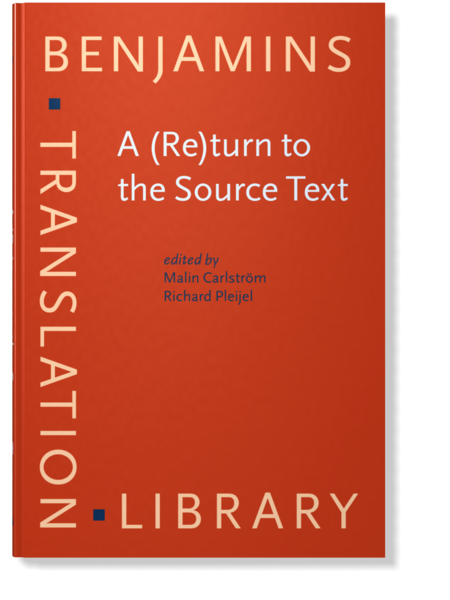
In:A (Re)turn to the Source Text
Edited by Malin Carlström and Richard Pleijel
[Benjamins Translation Library 169] 2026
► pp. 35–64
Get fulltext
Translation as fraud
Tracing the imagined original of a Russian pseudotranslation book series
Available under the Creative Commons Attribution-NonCommercial-NoDerivatives (CC BY-NC-ND) 4.0 license.
For any use beyond this license, please contact the publisher at rights@benjamins.nl.
Published online: 20 February 2026
https://doi.org/10.1075/btl.169.01car
https://doi.org/10.1075/btl.169.01car
Abstract
In this chapter, I analyze a Russian pseudotranslation book series as translations from imagined originals.
Drawing on Toury’s notion of assumed translation (2012) and Liu’s (2019) focus on the metatextual characteristics of pseudotranslation, I aim to: (1) classify
the book series, (2) establish how this type of pseudotranslation differs from translations with regular source and target
texts, and (3) discuss the benefits and consequences of perceiving pseudotranslations as translations from imagined originals.
Firstly, based on an analysis of paratexts, I classify the book series as a hoax or a marketing strategy. Secondly, I argue
that the notion of “imagined original” forces the reader to pay attention to the pitfalls and inherent ambiguity of
pseudotranslation, while also drawing attention to issues related to imagology and ethics.
Keywords: pseudotranslation, imagined original, source text, translation studies, imagology, ethics
Article outline
- 1.Introduction
- 2.Pseudotranslations as translations of imagined originals
- 2.1Background and theoretical framework
- 2.2Reasons for pseudotranslation
- 2.3Pseudotranslation, manipulation, imagology
- 3.The Tsvet boli series: Plot and publication history
- 3.1The plot of the book series
- 3.2Publication history
- 4.Results: The generic and discursive levels
- 4.1The generic level
- 4.1.1Peritexts
- 4.1.2Epitexts
- 4.1.3Generic connections to translations in the main text
- 4.2The discursive level
- 4.1The generic level
- 5.Textual level: Interferences and distortions
- 5.1Interferences
- 5.2Distortions on textual level
- 5.2.1Outside perspective and stereotypical representations of Swedes
- 5.2.2Outside perspective and stereotypical representations of Sweden
- 6.Discussion and conclusions
Notes Primary sources References Appendix

References (48)
Baer, Brian J. 2017. “De-Sacralizing the
Origin(al) and the Transnational Future of Translation
Studies.” Perspectives 25 (2): 227–244.
2019. “Teaching Literature in
Translation.” In The Routledge Handbook of Literary
Translation, ed. by Kelly Washbourne and Ben Van Wyke, 58–71. Routledge.
Beller, Manfred. 2007. “Perception,
Image, Imagology.” In Imagology: The Cultural Construction
and Literary Representation of National Characters. A Critical Survey, ed.
by Manfred Beller and Joep Leerssen, 3–16. Brill.
Berglund, Karl. 2017. Mordens marknad: Litteratursociologiska studier i det tidiga 2000-talets svenska
kriminallitteratur [A market of murders: Sociological literary
studies in Swedish crime fiction in the early 21st century]. PhD
diss., Uppsala University.
Eksmo. 2013а. “Eva Khansen ‘Tsvet boli — krasnyi’ [Eva Khansen ‘The color of pain
— red’].” Last modified April 17, 2013. Accessed April 18, 2025. [URL]
. 2013b. “Eva Khansen ‘Tsvet boli — chernyi [Eva Khansen ‘The color of pain —
black].” Last modified August 1, 2013. Accessed April 18, 2025. [URL]
. n.d.-a. “Eva Khansen. Biografiia [Eva Khansen.
Biography].” Accessed April 15, 2025. [URL]
. n.d.-b. “Knigi avtora Eva Khansen [Books by the author Eva
Khansen].” Accessed April
15, 2025. [URL]
Federalʹnoe agentstvo po tehnicheskomu regulirovaniiu i
metrologii. 2006. GOST Р 7.0.4–2006 Izdaniia, vykhodnye
svedeniia — obshchie trebovaniia i pravila oformleniia [Editions.
Publication data. General requirements and rules of
design]. Standartinform.
Flynn, Peter, Joep Leerssen, and Luc van Doorslaer. 2016. Interconnecting
Translation Studies and Imagology. John Benjamins.
Genette, Gérard. 1997. Paratexts:
Thresholds of Interpretation. Translated by J. E. Lewin. Cambridge University Press.
Hatim, Basil. 1997. “Intertextual
Intrusion: Towards a Framework for Harnessing the Power of the Absent Text in
Translation.” In Translating Sensitive Texts: Linguistic
Aspects, ed. by Karl Simms, 29–46. Rodopi B. V.
Hermans, Theo. 1999. Translation
in Systems: Descriptive and Systemic Approaches Explained. St. Jerome.
Hübenette Högberg, Frida. 2009. “Millennium-turister invaderar Stockholm. [Millennium
tourists invade Stockholm].” Aftonbladet. May 17. [URL]
Kellman, Stephen G. 2010. “Alien Autographs: How
Translators Make Their
Marks.” Neohelicon 37: 7–19.
Leerssen, Joep. 2007. “Imagology:
History and Method.” In Imagology: The Cultural Construction
and Literary Representation of National Characters. A Critical Survey, ed.
by Manfred Beller and Joep Leerssen, 17–32. Brill.
Lefevere, André. 2000. “Pseudotranslations.” In Encyclopedia
of Literary Translation into
English, vol. 2, ed.
by Olive Classe, 1122–1123. Fitzroy Dearborn.
Liu, Jane Qian. 2019. “Pseudotranslation,
Intertextuality and Metafictionality: Three Case Studies of Pseudotranslation from Early Twentieth-Century
China.” Perspectives, Studies in Translatology 27 (3): 389–403.
Naudé, Jacobus A. 2008. “The Role of
Pseudo-Translations in Early Afrikaans Travel Writing.” Southern African Linguistics
and Applied Language
Studies 26 (1): 97–106.
NE. n.d. “Shvedskaia
semʹia.” In NEs ryska
ordbok. Nationalencyclopedin. [URL] (accessed September 19, 2024)
Nationalencyklopedin. n.d. “Ni-tilltal [formal
address]”. Accessed April
18, 2025. [URL]
Neumeyer, Joy. 2013. “Fake
Reviews in Fake Newspapers Hype up New “Swedish” Crime Novel.” The Internet Archive,
Wayback machine. Accessed March
1, 2021. [URL]
Podlevskikh Carlström, Malin. 2022. “Swedish
Crime Fiction in the Soviet Union: Publication and Paratextual
Framing.” Samlaren 143: 141–177. [URL]
. 2023. “Swedish
Crime Fiction in Russia: Publication, Marketing and Paratextual
Framing.” Samlaren 144: 320–360. [URL]
. 2024. “In
Prosperous Sweden… Representations of Sweden in Russian Reviews of Swedish Crime Fiction
2000–2021.” Mikael: Finnish Journal of Translation and Interpreting
Studies 17 (1): 105–121.
Rodríguez Pérez, Yolanda. 2016. “The
Adventures of an Amsterdam Spaniard: Nation-Building in a 17th-Century Dutch
Pseudo-Translation.” In Interconnecting Translation Studies
and Imagology, ed. by Peter Flynn, Joep Leerssen and Luc van Doorslaer, 37–52. John Benjamins.
Rühling, Lutz. 2007. “Swedes.” In Imagology:
The Cultural Construction and Literary Representation of National Characters. A Critical
Survey, ed. by Manfred Beller and Joep Leerssen, 248–250. Brill.
Santoyo, Julio César. 1984. “La traducción como
técnica narrativa.” Actas del IV Congreso de la Asociación Española de Estudios Anglo-Norteamericanos), 37–53. Quoted
in Şehnaz Tahir Gürçağlar. “Pseudotranslation on the Margin of Fact and
Fiction.” In A Companion to Translation
Studies, ed. by Sandra Bermann and Catherine Porter, 516–527. John Wiley and Sons, 2014.
Savchyn, Valentyna. 2021. “Literary
Translation behind Bars in the Late Soviet Union: Contextual Voices of Vasylʹ Stus and Ivan
Svitlychnyi.” East, West: Journal of Ukrainian
Studies 8 (2): 235–273.
Sohár, Anikó. 1998. “‘Genuine’
and ‘Fictitious’ Translations of Science Fiction and Fantasy in
Hungary.” In Unity in Diversity? Current trends in
Translation Studies, ed. by Lynne Bowker, Michael Cronin, Dorothy Kenny and Jennifer Pearson, 39–46. St. Jerome.
Strümper-Krobb, Sabine. 2018. “Pretending
Not to be Original: Pseudotranslations and their
Functions.” In The Fictions of
Translation, ed. by Judith Woodsworth, 199–213. John Benjamins.
Tahir Gürçağlar, Şehnaz. 2014. “Pseudotranslation
on the Margin of Fact and Fiction.” In A Companion to
Translation Studies, ed, by Sandra Bermann and Catherine
Porter, 516–527. John Wiley and Sons.
Toury, Gideon. 1981. “Translated
Literature: System, Norm, Performance: Toward a TT-Oriented Approach to Literary
Translation.” Poetics
Today 2 (4): 9–27.
. 1995. Descriptive
Translation Studies — and Beyond. John Benjamins.
. 2012. Descriptive
Translation Studies — and Beyond. Revised ed. John Benjamins.
Venuti, Lawrence. 2009. “Translation,
Intertextuality, Interpretation.” Romance
Studies 27 (3): 157–173.
Verbeke, Demmy. 2010. “Swag-Bellied
Hollanders and Dead-Drunk Almaines: Reputation and Pseudo-Translation in Early Modern
England.” Dutch
Crossing 34 (2): 182–191.
Witt, Susanna. 2011. “Between
the Lines: Totalitarianism and Translation in the
USSR.” In Contexts, Subtexts and Pretexts Literary
Translation in Eastern Europe and Russia, ed. by Brian James Baer, 149–170. John Benjamins.