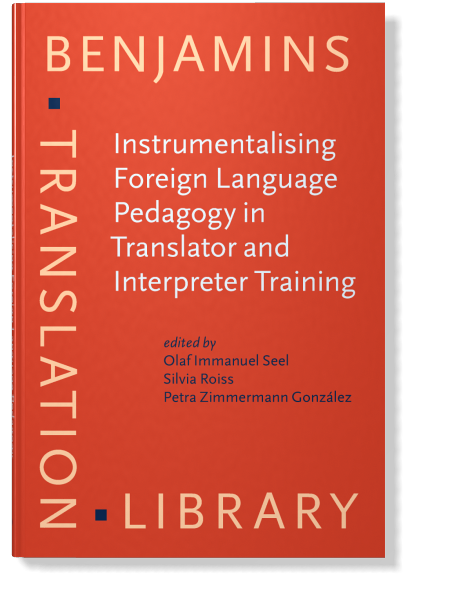
In:Instrumentalising Foreign Language Pedagogy in Translator and Interpreter Training: Methods, goals and perspectives
Edited by Olaf Immanuel Seel, Silvia Roiss and Petra Zimmermann-González
[Benjamins Translation Library 161] 2023
► pp. 138–155
Chapter 8The scaffolded language emergence approach in translation programs
A monolingual, nonlinear path towards additional language emergence
Published online: 1 June 2023
https://doi.org/10.1075/btl.161.08kir
https://doi.org/10.1075/btl.161.08kir
This chapter introduces the epistemological foundations of the Scaffolded Language Emergence (SLE) approach to promoting the emergence of additional languages in adults and suggests some ideas and techniques for its implementation in the classroom at university level. Developed over a period of some 20 years by Don Kiraly at the School of Translation, Linguistics and Cultural Studies (FTSK) of the University of Mainz, Germany, the SLE approach has been used successfully to introduce hundreds of translation students at that institution to one or more of 15 additional languages.
The authors have found this approach to be an innovative way to foster additional language acquisition in the context of translator training. They believe that adopting such an approach at an early stage of one’s translation study program can provide a fertile environment for adults to establish a basis in a foreign language. Its early adoption can also help adult language learners develop and rediscover their natural skills for learning a language by means of personalized, embodied and authentic learning activities.
Article outline
- 1.Introduction
- 2.The essence of the approach
- 3.The monolingual initial language experience
- 4.What actually goes on in an SLE class
- 5.Rationale for the use of SLE in translation and interpreting degree programs
- 6.Some core ideas for implementing a language course based on SLE
- 6.1The facilitators’ roles
- 6.2Setting the stage for an SLE course
- 6.3Authenticity and complexity
- 6.4Drawing on affordances
- 6.5Collaboration, autonomy, and affect in the classroom
- 6.6Embodiment and grammaticalization
- 7.Conclusion
Notes References

References (18)
Bleyhl, Werner. 2005. “Die Defizite des traditionellen Fremdsprachenunterrichts oder: Weshalb ein Paradigmenwechsel, eine Umkehr, im Fremdsprachenunterricht erfolgen muss.” Fremdsprachen lehren und lernen 34: 45–64.
Cerezo Herrero, Enrique. 2021. “La didáctica de lenguas extranjeras en los estudios de traducción e interpretación: ¿Qué nos dice la investigación?” Hermēneus, Revista de Traducción e Interpretación 22: 41–73. .
García, Ofelia, and Li Wei. 2014. Translanguaging: Language, Bilingualism and Education. Basingstoke: Palgrave Macmillan.
Gómez, Norman. 2021. “La enseñanza de la traducción en pregrado universitario en Hispanoamérica: estudio de casos múltiple de seis instituciones con programas de traducción (Argentina/Colombia/Venezuela).” PhD diss. Johannes Gutenberg Universität Mainz.
Gregorio Cano, Ana. 2014. “Estudio empírico-descriptivo del desarrollo de la competencia estratégica en la formación de traductores.” PhD diss. Universidad de Granada. [URL]
Kiraly, Don, and Brenda Finocchiaro. 2020. SLE: Un approccio didattico per facilitare l’emergenza delle lingue straniere: dalla teoria alla pratica. Munich: Akademische Verlagsgemeinschaft München.
Kiraly, Don, and Norman Gómez. 2019. SLE: Un enfoque didáctico para fomentar la emergencia de lenguas adicionales. Munich: Akademische Verlagsgemeinschaft München.
Kiraly, Don, and Sarah Signer. 2017. Scaffolded Language Emergence in the Classroom: From Theory to Practice. Berlin: Frank & Timme.
Lakoff, George, and Mark Johnson. 1999. Philosophy in the Flesh: The Embodied Mind and Its Challenge to Western Thought. New York: Basic Books.
Larsen-Freeman, Diane. 2011. “A Complexity-Theory Approach to Second Language Development/acquisition.” In Alternative Approaches to Second Language Acquisition, ed. by Dwight Atkinson, 47–78. Abingdon. New York: Purdue University Press.
Nord, Christiane. 2005. “Training Functional Translators.” In Training for the New Millennium: Pedagogies for Translation and Interpreting, ed. by Martha Tennent, 209–24. Amsterdam: John Benjamins.
Saldanha, Gabriela, and Sharon O’Brien. 2013. Research Methodologies in Translation Studies. Manchester UK: St. Jerome Publishing.
Torres-Simón, Ester, and Anthony Pym. 2019. “European Masters in Translation: A Comparative Study.” In The Evolving Curriculum in Interpreter and Translator Education: Stakeholder perspectives and voices, ed. by David B. Sawyer, Frank Austermühl and Vanessa Enríquez Raído, 75–98. Amsterdam: John Benjamins.
Ulrych, Margherita. 2005. “Training Translators: Programmes, Curricula, Practices.” In Training for the New Millennium: Pedagogies for Translation and Interpreting, ed. by Martha Tennent, 3–33. Amsterdam: John Benjamins.
van Lier, Leo. 1996. Interaction in the Language Curriculum: Awareness, Autonomy and Authenticity. New York: Longman.
Cited by (1)
Cited by one other publication
This list is based on CrossRef data as of 4 december 2025. Please note that it may not be complete. Sources presented here have been supplied by the respective publishers. Any errors therein should be reported to them.