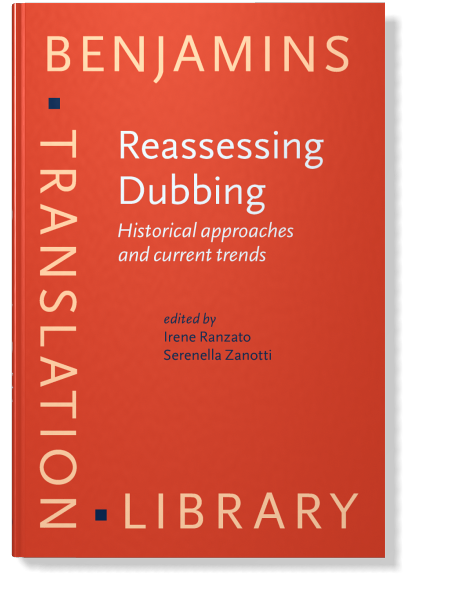
In:Reassessing Dubbing: Historical approaches and current trends
Edited by Irene Ranzato and Serenella Zanotti
[Benjamins Translation Library 148] 2019
► pp. 211–227
Chapter 10Representing orality through questions in original and translated film dialogue
Published online: 6 August 2019
https://doi.org/10.1075/btl.148.10ghi
https://doi.org/10.1075/btl.148.10ghi
Abstract
Due to their preeminently spoken nature, direct questions are favourite loci to represent orality in telecinematic talk, where they are overrepresented and fulfill both mimetic and diegetic functions (Ghia 2014). However, no systematic comparisons have been drawn between translated and non-translated film dialogue in the same target language to identify potential register-specificities in question representation. Based on the analysis of the Pavia Corpus of Film Dialogue (Pavesi 2014), this chapter investigates question usage across dubbed and original Italian film dialogue, on both a formal and a functional level. Findings show common traits between the two registers, but document differences in pattern distribution, which typify dubbed discourse and may result from both source text interference and T-universals (Chesterman 2004).
Keywords: film dialogue, dubbing, direct questions, orality markers, T-universals
Article outline
- 1.Introduction
- 2.Direct questions from conversation to fictive orality
- 3.Translation universals
- 4.The study
- 4.1Aim and research questions
- 4.2Methodology and material
- 4.3Results
- 4.3.1A case in point: Weak connectors
- 5.Discussion
- 6.Conclusion
Notes References Appendix

References (53)
Baños, Rocío. 2013. “‘That is So Cool’: Investigating the Translation of Adverbial Intensifiers in English-Spanish Dubbing through a Parallel Corpus of Sitcoms.” Perspectives: Studies in Translatology 21(4): 526–542.
. 2014. “Orality Markers in Spanish Native and Dubbed Sitcoms: Pretended Spontaneity and Prefabricated Orality.” Meta: journal des traducteurs / Meta: Translators’ Journal 59(2): 406–435.
Bazzanella, Carla. 1994. Le facce del parlare. Un approccio pragmatico all’italiano parlato. Firenze: La Nuova Italia.
Bednarek, Monika. 2012. “‘Get Us the Hell Out of Here’. Key Words and Trigrams in Fictional Television Series.” International Journal of Corpus Linguistics 17(1): 35–63.
Berretta, Monica. 1996. “Come inseriamo elementi nuovi nel discorso / 3: ‘Che mi fa paura è la nebbia’.” Italiano e Oltre 2: 116–122.
Biber, Douglas, Stig Johansson, Geoffrey Leech, Susan Conrad, and Edward Finegan. 1999. Longman Grammar of Spoken and Written English. London: Longman.
Bonsignori, Veronica, Silvia Bruti, and Silvia Masi. 2011. “Formulae across Languages: English Greetings, Leave-Takings and Good Wishes in Italian Dubbing.” In Audiovisual Translation in Closeup: Practical and Theoretical Approaches, ed. by Adriana Şerban, Anna Matamala, and Jean-Marc Lavaur, 23–44. Bern: Peter Lang.
Bonsignori, Veronica, and Silvia Bruti. 2014. “How People Greet Each Other in TV Series and Dubbing.” In The Languages of Dubbing: Mainstream Audiovisual Translation in Italy, ed. by Maria Pavesi, Maicol Formentelli, and Elisa Ghia, 89–111. Bern: Peter Lang.
Birner, Betty J., and Gregory Ward. 1998. Information Status and Noncanonical Word Order in English. Amsterdam: John Benjamins.
Brincat, Joseph M. 2000. “Il doppiaggio di telefilm americani: una varietà tradotta dell’italiano parlato-recitato?” In L’Italiano oltre frontiera. V Convegno internazionale, Leuven, 22–25 April 1998, ed. by Serge Vanvolsem, Dieter Vermandere, Yves D’Hulst, and Franco Musarra, 245–258. Firenze: Franco Cesati Editore.
2014. “Morphological and Semantic Simplification in Dubbing Techniques. Translating the Dialogue of the British Films Ae Fond Kiss… and The Queen.” In The Languages of Dubbing: Mainstream Audiovisual Translation in Italy, ed. by Maria Pavesi, Maicol Formentelli, and Elisa Ghia, 197–216. Bern: Peter Lang.
Bubel, Claudia. 2011. “Relationship Impression Formation.” In Telecinematic Discourse: Approaches to the Language of Films and Television Series, ed. by Roberta Piazza, Monika Bednarek, and Fabio Rossi, 225–247. Amsterdam: John Benjamins.
. 2016. “Dubbing a TV Drama Series: The Case of The West Wing.” In inTRAlinea, Special Issue: A Text of Many Colours – translating The West Wing, ed. by Christopher Taylor. Accessed October 29, 2016. [URL].
Chesterman, Andrew. 2004. “Beyond the Particular.” In Translation Universals. Do they Exist?, ed. by Anna Mauranen and Pekka Kujamäki, 33–49. Amsterdam: John Benjamins.
Clayman, Steven E., Marc N. Elliott, John Heritage, and Laurie L. McDonald. 2006. “Historical Trends in Questioning Presidents, 1953–2000.” Presidential Studies Quarterly 36(4): 561–583.
D’Achille, Paolo. 2011. “Roma, italiano di.” In Enciclopedia dell’italiano, ed. by Raffaele Simone, 1262–1265. Roma: Istituto della Enciclopedia Italiana.
Fava, Elisabetta. 1995. “Il tipo interrogativo.” In Grande grammatica italiana di consultazione. III. Tipi di frasi, deissi, formazione delle parole, ed. by Lorenzo Renzi, Giampaolo Salvi, and Anna Cardinaletti, 70–127. Bologna: Il Mulino.
Forchini, Pierfranca. 2010. ““I mean, what was that about?” Spontaneous and Movie Conversation Compared.” L’analisi linguistica e letteraria 18(2): 323–334.
. 2012. Movie Language Revisited. Evidence from Multi-Dimensional Analysis and Corpora. Bern: Peter Lang.
Formentelli, Maicol. 2014. “Vocatives Galore in Audiovisual Dialogue: Evidence from a Corpus of American and British Films.” English Text Construction 7(1): 53–83.
Freddi, Maria. 2009. “The Phraseology of Contemporary Filmic Speech: Formulaic Language and Translation.” In Analysing Audiovisual Dialogue. Linguistic and translational insights, ed. by Maria Freddi, and Maria Pavesi, 101–123. Bologna: CLUEB.
Ghia, Elisa. 2012. Subtitling Matters. New Perspectives on Subtitling and Foreign Language Learning. Oxford: Peter Lang.
. 2014. ““That is the question”. Direct interrogatives in English Film Dialogue and Dubbed Italian.” In The Languages of Dubbing: Mainstream Audiovisual Translation in Italy, ed. by Maria Pavesi, Maicol Formentelli, and Elisa Ghia, 57–88. Bern: Peter Lang.
Ghia, Elisa, and Maria Pavesi. 2016. “The Language of Dubbing and its Comprehension by Learner-Viewers. A Resource for Second Language Acquisition?” Across Languages and Cultures 17(2): 233–252.
. 2005. Beyond Rhetorical Questions. Assertive Questions in Everyday Interaction. Amsterdam: John Benjamins.
Marzá, Anna I., and Frederic Chaume. 2009. “The Language of Dubbing: Present Facts and Future Perspectives.” In Analysing Audiovisual Dialogue. Linguistic and Translational Insights, ed. by Maria Freddi, and Maria Pavesi, 31–39. Bologna: CLUEB.
Mauranen, Anna, and Pekka Kujamäki (eds). 2004. Translation Universals. Do they Exist?. Amsterdam: John Benjamins.
Pavesi, Maria. 2005. La traduzione filmica. Aspetti del parlato doppiato dall’inglese all’italiano. Roma: Carocci.
. 2008. “Spoken Language in Film Dubbing: Target Language Norms, Interference and Translational Routines.” In Between Text and Image. Updating Research in Screen Translation, ed. by Delia Chiaro, Christine Heiss, and Chiara Bucaria, 79–99. Amsterdam: John Benjamins.
. 2009. “Pronouns in Film Dubbing and the Dynamics of Audiovisual Communication.” VIAL (Vigo International Journal of Applied Linguistics) 6: 89–107.
. 2011. “Exploring the Role of Address Shifts in Film Translation: An Extended Illustration from Crash.” In Minding the Gap: Studies in Linguistic and Cultural Exchange for Rosa Maria Bollettieri Bosinelli, ed. by Raffaella Baccolini, Delia Chiaro, Chris Rundle, and Sam Whitsitt, 111–132. Bologna: Bononia University Press.
. 2013. “This and That in the Language of Film Dubbing: A Corpus-based Analysis.” Meta 58(1): 107–137.
. 2014. “The Pavia Corpus of Film Dialogue: A Means to Several Ends.” In The Languages of Dubbing: Mainstream Audiovisual Translation in Italy, edited by Maria Pavesi, Maicol Formentelli, and Elisa Ghia, 29–54. Bern: Peter Lang.
. 2016. “The Space of Italian Dubbing: From Naturalness to Creativity in Fictive Orality.” In Remediating, Rescripting, Remaking: Language and Translation in the New Media, ed. by Michela Canepari, Gillian Mansfield, and Franca Poppi, 13–30. Carocci: Roma.
Quaglio, Paulo. 2009. Television Dialogue. The Sitcom Friends vs. Natural Conversation. Amsterdam: John Benjamins.
Rodríguez Martín, María Elena, and María Moreno Jaén. 2009. “Teaching Conversation through Films: A Comparison of Conversational Features and Collocations in the BNC and a Micro-Corpus of Movies.” The International Journal of Learning 16(7): 445–458.
Romero-Fresco, Pablo. 2009. “Naturalness in the Spanish Dubbing Language: A Case of Not-so-close Friends.” Meta 54(1): 49–72.
. 2012. “Dubbing Dialogues…Naturally: A Pragmatic Approach to the Translation of Transition Markers in Dubbing.” In Multidisciplinarity in Audiovisual Translation, special issue of MonTI. 4, ed. by Rosa Agost, Pilar Orero, and Elena Di Giovanni, 181–205. San Vicente del Raspeig: Publicaciones de la Universidad de Alicante.
Sobrero, Alberto A., and Annarita Miglietta. 2011. “Per un approccio varietistico all’insegnamento dell’italiano a stranieri.” Italiano LinguaDue 1: 233–260.
Steensig, Jakob, and Paul Drew. 2008. “Introduction: Questioning and Affiliation/Disaffiliation in Interaction.” Discourse Studies 10(1): 5–15.
Taylor, Christopher. 2006. “I Knew He’d Say That! A Consideration of the Predictability of Language Use in Film.” In MuTra 2006 – Audiovisual Translation Scenarios: Conference Proceedings, ed. by Mary Carroll, Heidrun Gerzymisch-Arbogast, and Sandra Nauert, 1–11. Saarbrücken: MuTra. Accessed October 29, 2016. [URL].
Telmon, Tullio. 1993. “Varietà regionali.” In Introduzione all’italiano contemporaneo. Vol. 2, ed. by Alberto A. Sobrero, 93–149. Bari: Laterza.
Toury, Gidéon. 1995. Descriptive Translation Studies and Beyond. Amsterdam: John Benjamins.
Wang, Xin. 2014. “A Cognitive Pragmatic Study of Rhetorical Questions.” English Language and Literature Studies 4(1): 42–47.
Zago, Raffaele. 2015. ““That’s none of your Business, Sy”. The Pragmatics of Vocatives in Film Dialogue.” In Participation in Public and Social Media Interactions, ed. by Marta Dynel, and Jan Chovanec, 183–207. Amsterdam: John Benjamins.
. 2016. “Original Italian Films vs. Original English Films: A Quantitative Analysis via the Pavia Corpus of Film Dialogue and the WordSmith Tools.” Paper presented at the international conference Linguistic and Cultural Representation, Sapienza Università di Roma & Università degli Studi di Roma Tre, Rome, Italy, February 11–13.
Zanotti, Serenella. 2014. ““It Feels like Bits of me are Crumbling or Something”: General Extenders in Original and Dubbed Television Dialogue.”. In The Languages of Dubbing: Mainstream Audiovisual Translation in Italy, ed. by Maria Pavesi, Maicol Formentelli, and Elisa Ghia, 113–140. Bern: Peter Lang.
Cited by (2)
Cited by two other publications
Formentelli, Maicol, Liviana Galiano & Maria Pavesi
2025. Grammatical complexity in film dialogue. International Journal of Corpus Linguistics 30:1 ► pp. 51 ff.
This list is based on CrossRef data as of 3 december 2025. Please note that it may not be complete. Sources presented here have been supplied by the respective publishers. Any errors therein should be reported to them.