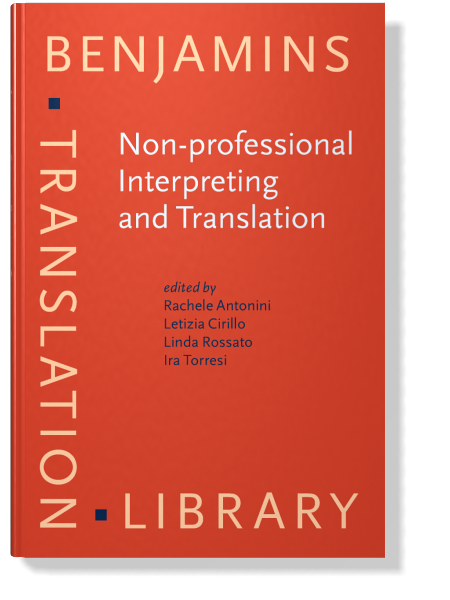
In:Non-professional Interpreting and Translation: State of the art and future of an emerging field of research
Edited by Rachele Antonini, Letizia Cirillo, Linda Rossato and Ira Torresi
[Benjamins Translation Library 129] 2017
► pp. 337–357
Chapter 17Seeing brokering in bright colours
Participatory artwork elicitation in CLB research
Published online: 19 June 2017
https://doi.org/10.1075/btl.129.17tor
https://doi.org/10.1075/btl.129.17tor
Abstract
A recurrent issue in child language brokering (CLB) research is how to best adjust ethnographic methodologies in order to collect data from young children. There are a number of practical considerations in addition to the necessary ethical aspects. Questionnaires and other methods relying on the written word may prove inadequate for first- and second-graders, and even for older bilingual or multilingual children who may not have the same level of literacy in all their languages. Methods relying on the spoken word, such as interviews, focus groups or participant observation, may prove similarly problematic when groups of respondents have mixed language proficiency levels. Artwork elicitation, on the contrary, can be an effective and inclusive way to collect qualitative data about young children’s feelings and perceptions about CLB. It has the potential to elicit visual narratives from large groups of children (e.g. entire classes or schools), while leaving them free to include aspects of the phenomenon being investigated that would otherwise be difficult for them to describe in words. This chapter explores primary school children’s experience of CLB as it emerges from artwork submitted for the “Budding translators” competition described by Antonini (this volume), and proposes an analysis that draws mainly on visual and social semiotics.
Article outline
- 1.Why artwork elicitation
- 2.The study: Data collection and method of analysis
- 3.The child in the middle: Where does the broker stand?
- 4.The colours of brokering
- 5.Conclusions
Notes References

References (39)
Angelelli, Claudia. 2004. Revisiting the Interpreter's Role. A Study of Conference, Court and Medical Interpreters in Canada, Mexico and the United States. Amsterdam & Philadelphia: John Benjamins.
Baker, Jillian, Jason Loxton & Kate Sherren. 2013. "Using Art Elicitation to Deliver and Evaluate a Grade 4 Climate Change Instructional Module". Applied Environmental Education and Communication 12:2. 130–142.
Blommaert, Ian. 2001. “Investigating Narrative Inequality: African Asylum Seekers' Stories in Belgium”. Discourse & Society 12. 413–449.
. 2004. “Grassroots Historiography and the Problem of Voice: Tshibumba’s Histoire du Zaïre”. Journal of Linguistic Anthropology 14:1. 6–23.
. 2008. Grassroots Literacy: Writing, Identity and Voice in Central Africa. London: Taylor & Francis.
Bot, Hanneke. 2003. “The Myth of the Uninvolved Interpreter Interpreting in Mental Health and the Development of a Three-Person Psychology”. The Critical Link 3 ed. by Luise Brunette, Georges Bastin, Isabelle Hemlin & Heather Clarke, 27–35. Amsterdam & Philadelphia: John Benjamins.
Cirillo, Letizia, Ira Torresi & Cristina Valentini. 2010. “Institutional perceptions of Child Language Brokering in Emilia Romagna”. mediAzioni 10. 269–296.
Collier, John & Malcolm Collier. 1986. Visual Anthropology: Photography as a Research Method. Albuquerque: University of New Mexico Press.
Di Rubbo, Claudia. 2014. “La scuola di oggi: accoglienza e integrazione degli alunni stranieri presso la scuola primaria Diego Fabbri, il child language brokering come pratica interculturale”. MA dissertation, University of Bologna.
Dryden, Caroline, Alan Metcalfe, Jenny Owen & Geraldine Shipton. 2009. “Picturing the Lunchbox: Children Drawing and Talking about ‘Dream’ and ‘Nightmare’ Lunchboxes in the Primary School Setting”. Children, Food and Identity in Everyday Life ed. by Allison James, Anne Trine Jørholt & Vebjørg Tingstad, 69–93. London & New York: Palgrave.
Goffman, Erving. 1981. “Footing”. Forms of Talk, 124–159. Philadelphia: University of Pennsylvania Press.
Hale, Sandra. 2008. “Controversies over the Role of the Court Interpreter”. Crossing Borders in Community Interpreting ed. by Carmen Valero-Garcés & Anne Martin, 99–121. Amsterdam & Philadelphia: John Benjamins.
. 2011. “The Need to Raise the Bar: Court Interpreters as Specialised Experts”. The Judicial Review 10. 237–258.
Haraway, Donna. 1988. “Situated Knowledges: The Science Question in Feminism and the Privilege of Partial Perspective”. Feminist Studies 14. 575–599.
Harper, Douglas. 2002. “Talking about Pictures: A Case for Photo-elicitation”. Visual Studies 17:1. 13–26.
Inghilleri, Moira. 2011. Interpreting Justice: Ethics, Politics and Language. London & New York: Routledge.
Kolb, Bettina. 2008. “Involving, Sharing, Analysing: Potential of the Participatory Photo Interview”. Forum: Qualitative Social Research 9:3. n.p. (art. 12).
Kress, Gunther. 1997. Before Writing: Rethinking the Paths to Literacy. London & New York: Routledge.
Kress, Gunther & Theo Van Leeuwen. 1996/2006. Reading Images: The Grammar of Visual Design. London & New York: Routledge.
Mason, Ian. 2012. “Gaze, Positioning and Identity in Interpreter-Mediated Discourse”. Coordinating Participation in Dialogue Interpreting ed. by Claudio Baraldi & Laura Gavioli, 177–199. Amsterdam & Philadelphia: John Benjamins.
Orellana, Marjorie F. 1999. “Space and Place in an Urban Landscape: Learning from Children’s Views of Their Social Worlds”. Visual Sociology 14:1/2. 73–89.
2003. “Responsibilities of Children in Latino Immigrant Homes”. New Directions for Youth Development 100. 25–39.
2009. Translating Childhoods: Immigrant Youth, Language, and Culture. New Brunswick, NJ & London: Rutgers University Press.
Orellana, Marjorie F. & Arcelia Hernández. 1998. “Talking the Walk: Children Reading Urban Environmental Print”. The Reading Teacher 52:6. 612–619.
Penn, Claire & Jennifer Watermeyer. 2012. “Cultural Brokerage and Overcoming Communication Barriers: A Case Study from Aphasia”. Coordinating Participation in Dialogue Interpreting ed. by Claudio Baraldi & Laura Gavioli, 269–295. Amsterdam & Philadelphia: John Benjamins.
Pöchhacker, Franz. 2012. “Interpreting Participation: Conceptual Analysis and Illustration of the Interpreter's Role in Interaction”. Coordinating Participation in Dialogue Interpreting ed. by Claudio Baraldi & Laura Gavioli, 45–69. Amsterdam & Philadelphia: John Benjamins.
Rossato, Linda. 2014. “Gli insegnanti e la mediazione linguistica nelle scuole italiane: tra interazione ed integrazione”. La mediazione linguistica e culturale non professionale in Italia ed. by Rachele Antonini, 33–54. Bologna: BUP.
Roy, Cynthia B. 1993. “The Problem with Definitions, Descriptions and the Role Metaphors of Interpreters”. Journal of Interpretation 6:1. 127–154.
Rudvin, Mette. 2002. “How Neutral is ‘Neutral'? Issues in Interaction and Participation in Community Interpreting”. Perspectives on Interpreting ed. by Giuliana Garzone, Peter Mead & Maurizio Viezzi, 217–233. Bologna: CLUEB.
Rydzik, Agnieska, Annette Pritchard, Nigel Morgan & Diane Sedgley. 2013. “The Potential of Arts-based Transformative Research”. Annals of Tourism Research 40. 283–305.
Scollon, Ron & Suzie Wong Scollon. 2003. Discourses in Place: Language in the Material World. London & New York: Routledge.
Tate, Granville & Graham H. Turner. 1997. “The Code and the Culture: Sign Language Interpreting – In Search of the New Breed's Ethics”. Deaf Worlds 13:3. 27–34.
Valero-Garcés, Carmen. 2005. “Emotional and Psychological Effects on Interpreters in Public Services: A Critical Factor to Bear in Mind”. Translation Journal 3:9. n.p.
Cited by (5)
Cited by five other publications
Albuquerque, Diego Luiz
Bayraktar-Özer, Özge
Jutorán, Mariana Orozco & Mireia Vargas-Urpí
Ceccoli, Federica
This list is based on CrossRef data as of 15 november 2025. Please note that it may not be complete. Sources presented here have been supplied by the respective publishers. Any errors therein should be reported to them.