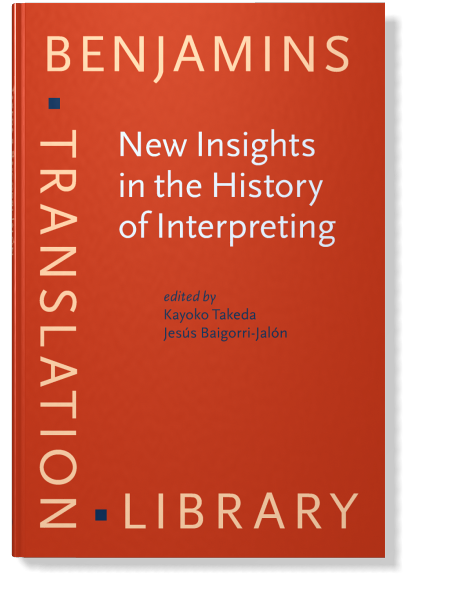
In:New Insights in the History of Interpreting
Edited by Kayoko Takeda and Jesús Baigorri-Jalón
[Benjamins Translation Library 122] 2016
► pp. 225–246
Get fulltext
Guilt, survival, opportunities, and stigma
Japanese interpreters in the postwar occupation period (1945-1952)
Available under the Creative Commons Attribution-NonCommercial-NoDerivatives (CC BY-NC-ND) 4.0 license.
For any use beyond this license, please contact the publisher at rights@benjamins.nl.
Published online: 10 March 2016
https://doi.org/10.1075/btl.122.09tak
https://doi.org/10.1075/btl.122.09tak
Following the end of World War II, Japanese interpreters faced unique and
complex opportunities and hardships. In occupied Japan, thousands of local
interpreters (and translators) were recruited to assist in a variety of occupation operations led by
the US forces. In war crimes trials, Japanese linguists played an important role
as interpreters in court proceedings against their former superiors and compatriots.
At the same time, some interpreters who had served in the Japanese
Army were prosecuted as war criminals. Wartime interpreters were also tapped
as witnesses to testify for the prosecution during trials. These
diverse experiences of Japanese interpreters during the occupation period shine
light on some issues and risks faced by wartime interpreters and local interpreters
serving foreign military occupiers.

Cited by (3)
Cited by three other publications
Martin, Anne & María Gómez-Amich
2021. Ideology, positionality and war. Interpreting. International Journal of Research and Practice in Interpreting 23:2 ► pp. 269 ff.
Takeda, Kayoko
This list is based on CrossRef data as of 15 november 2025. Please note that it may not be complete. Sources presented here have been supplied by the respective publishers. Any errors therein should be reported to them.